
Imatinib-Verunreinigungen
Angebot für ein Set anfordern
- Angebot für dieses Set anfragen
Alle EP-Verunreinigungen von Imatinib
12 ProdukteDie 12 Produkte ansehen
- Imatinib EP Impurity A VL272007
CAS 55314-16-4 - Imatinib EP Impurity B VL272003
CAS 581076-65-5 - Imatinib EP Impurity B(HCl Salt) VE008330
CAS 581076-67-7 - Imatinib EP impurity C VL272004
CAS 404844-02-6 - Imatinib EP Impurity C (HCl Salt) VE008632
CAS 1820893-54-6 - Imatinib EP Impurity C (Mesylate Salt) VE0021203
CAS 404844-03-7 - Imatinib EP Impurity D VL272002
CAS 1821122-73-9 - Imatinib EP Impurity D (Free Base) VE0023463
- Imatinib EP Impurity F VL272008
CAS 152460-10-1 - Imatinib EP Impurity G (Diydrochloride Salt) VE0021202
CAS 34352-59-5 - Imatinib EP Impurity H VL272005
CAS 350-03-8 - Imatinib Impurity J VL272009
CAS 571186-91-9
- Imatinib EP Impurity A VL272007
- Angebot für dieses Set anfragen
Alle Nitrosamin-Verunreinigungen von Imatinib
3 ProdukteDie 3 Produkte ansehen
- N-Nitroso Benzamide VE0024093
- N-Nitroso Imatinib VE0013972
- N-Nitroso Imatinib EP Impurity C VE0015092
CAS 2816369-80-7


1–37 von 37 Ergebnissen36 auf Lager
| Struktur | Produktname |
|---|---|
| Des(methylpiperazinyl-N-methyl) Imatinib Dimer ImpurityCAS-Nr. 1365802-18-1 · VE0015073 · Auf Lager | |
| Imatinib (Piperidine)-N4-OxideCAS-Nr. 938082-57-6 · VE0015093 · Auf Lager | |
| Imatinib Carboxylic ImpurityCAS-Nr. 106261-49-8 · VE009042 · Auf Lager | |
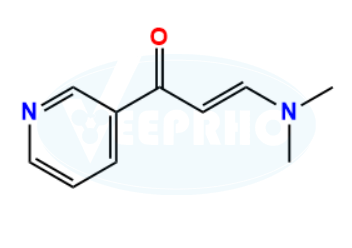
| Imatinib EP Impurity ACAS-Nr. 55314-16-4 · VL272007 · Auf Lager | |
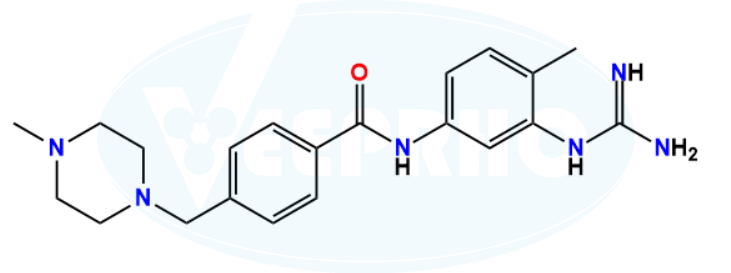
| Imatinib EP Impurity BCAS-Nr. 581076-65-5 · VL272003 · Auf Lager | |
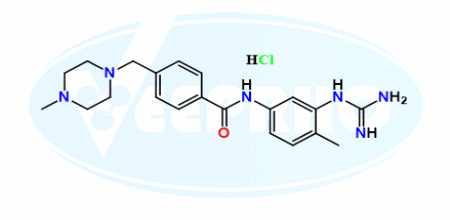
| Imatinib EP Impurity B(HCl Salt)CAS-Nr. 581076-67-7 · VE008330 · Auf Lager | |
| Imatinib EP impurity CCAS-Nr. 404844-02-6 · VL272004 · Auf Lager | |
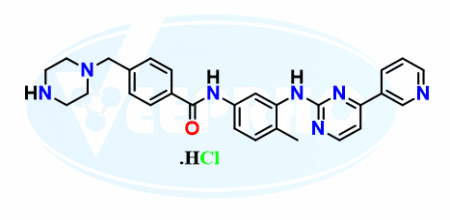 | Imatinib EP Impurity C (HCl Salt)CAS-Nr. 1820893-54-6 · VE008632 · Auf Lager |
| Imatinib EP Impurity C (Mesylate Salt)CAS-Nr. 404844-03-7 · VE0021203 · Auf Lager | |
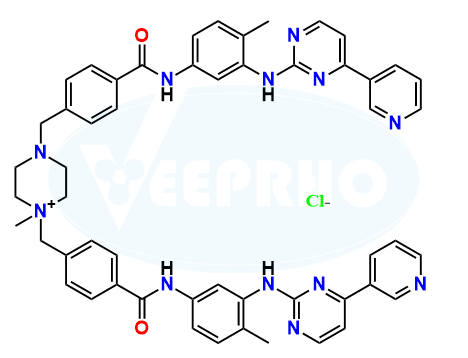 | Imatinib EP Impurity DCAS-Nr. 1821122-73-9 · VL272002 · Auf Lager |
| Imatinib EP Impurity D (Free Base)VE0023463 · Auf Lager | |
| Imatinib EP Impurity FCAS-Nr. 152460-10-1 · VL272008 · Auf Lager | |
| Imatinib EP Impurity G (Diydrochloride Salt)CAS-Nr. 34352-59-5 · VE0021202 · Auf Lager | |
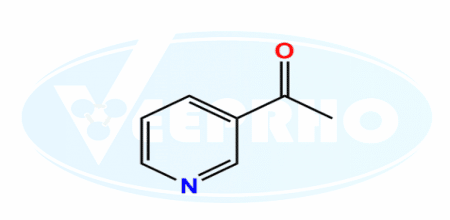 | Imatinib EP Impurity HCAS-Nr. 350-03-8 · VL272005 · Auf Lager |
| Imatinib Impurity 3CAS-Nr. 152459-96-6 · VL272006 · Auf Lager | |
| Imatinib Impurity 4CAS-Nr. 942514-62-7 · VE0015078 · Auf Lager | |
| Imatinib Impurity 5CAS-Nr. 1032314-73-0 · VE0015080 · Auf Lager | |
| Imatinib Impurity 6CAS-Nr. 112696-91-0 · VE0015081 · Auf Lager | |
| Imatinib Impurity 8CAS-Nr. 1356565-46-2 · VE0015086 · Auf Lager | |
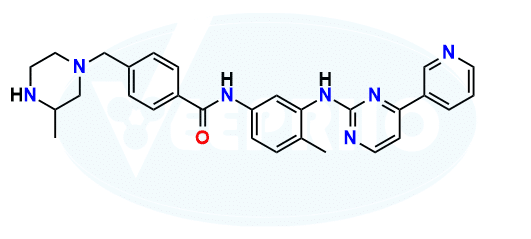 | Imatinib Impurity 12VE0015088 · Auf Lager |
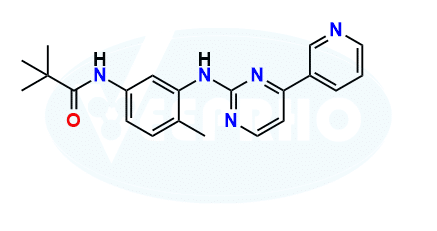 | Imatinib Impurity 14VE0015090 · Auf Lager |
| Imatinib Impurity 22CAS-Nr. 404844-11-7 · VE0015075 · Auf Lager | |
 | Imatinib Impurity 28VE0015076 · Auf Lager |
 | Imatinib Impurity 31VE0015091 · Auf Lager |
| Imatinib Impurity JCAS-Nr. 571186-91-9 · VL272009 · Auf Lager | |
| Imatinib meta-Methyl-Piperazine ImpurityCAS-Nr. 1246819-59-9 · VE0015074 · Auf Lager | |
| Imatinib N-Acetyl ImpurityCAS-Nr. 1321600-78-5 · VE009742 · Auf Lager | |
| Imatinib para-DiaminomethylbenzeneCAS-Nr. 1026753-54-7 · VE0015077 · Auf Lager | |
| Imatinib Piperazine-N,N-DiOxideCAS-Nr. 571186-93-1 · VE006650 · Auf Lager | |
| Imatinib pyridine N oxide ImpurityCAS-Nr. 571186-92-0 · VL272010 · Auf Lager | |
| Methyl 4-[(4-Methylpiperazin-1-yl)methyl]benzoateCAS-Nr. 314268-40-1 · VE0022856 · Auf Lager | |
| N-Nitroso BenzamideVE0024093 · Auf Lager | |
| N-Nitroso ImatinibVE0013972 | |
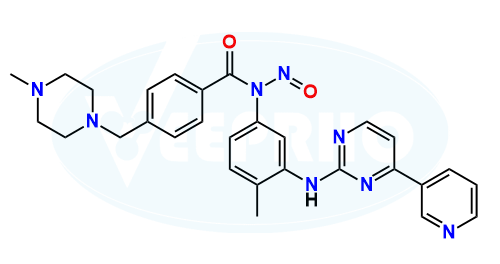
| N-Nitroso Imatinib EP Impurity CCAS-Nr. 2816369-80-7 · VE0015092 · Auf Lager | |
| p-Toluic AcidCAS-Nr. 99-94-5 · VE0020082 · Auf Lager | |
| 1,3-Bis(4-methyl-3-(4-(pyridin-3-yl)pyrimidin-2-ylamino)phenyl)ureaVE0021982 · Auf Lager | |
| 2-Methyl-5-nitro-N-[4-(pyridin-3-yl)pyrimidin-2-yl]benzenamineCAS-Nr. 152460-09-8 · VE0022663 · Auf Lager |
Imatinib Related Compound
Impurities in imatinib result from its multi-step chemical synthesis, including aryl-substituted piperazine and pyrimidine derivatives, and from degradation under acidic, basic, or oxidative conditions. Due to its chronic use in oncology, impurity control is highly stringent and regulated under ICH Q3A/B, USP, EP, and FDA oncology product guidelines.
Types of Impurities in Imatinib
Process-Related Impurities
- Unreacted starting materials like N-methylpiperazine, anilines, or substituted pyrimidines
- By-products from N-alkylation, acylation, or condensation reactions
- Residual solvents such as dimethylformamide (DMF), methanol, or acetonitrile
Degradation Impurities
- N-oxide derivatives and other oxidized forms
- Amide hydrolysis products under acidic or basic conditions
- Isomeric or rearranged structures formed under heat or light
- Photodegradation products affecting the aromatic rings
Elemental Impurities
- Trace metals like palladium, copper, or iron from cross-coupling catalysts or manufacturing equipment
- Controlled under ICH Q3D for chronic oral anticancer use
Analytical Techniques for Impurity Detection
- High-Performance Liquid Chromatography (HPLC) – for assay and related substance quantification
- LC-MS/MS (Liquid Chromatography–Tandem Mass Spectrometry) – for identifying unknown impurities
- Chiral HPLC – for enantiomeric purity (where applicable)
- Gas Chromatography (GC) – for residual solvent determination
- ICP-MS – for elemental impurity analysis
- Photostability and forced degradation studies – to assess stability profile
Häufige Fragen
What is Imatinib used for?
Imatinib is used to treat cancers like CML , GIST , Ph+ ALL , and other rare tyrosine kinase–driven tumors by blocking the abnormal signaling that promotes cancer cell growth.
How does Imatinib work?
It inhibits BCR-ABL , c-KIT , and PDGFR tyrosine kinases , which are responsible for uncontrolled cell proliferation in certain cancers.
What are common side effects of Imatinib?
Nausea and vomiting Edema (especially around the eyes) Muscle cramps Diarrhea Fatigue Myelosuppression (low blood counts)
Can Imatinib be taken long-term?
Yes. Imatinib is often taken for years , especially in CML, where it may achieve major molecular response (MMR) and complete cytogenetic response (CCyR) .
Is Imatinib chemically stable?
Imatinib is sensitive to moisture, heat, and light . It should be stored in tight containers at controlled room temperature , protected from humidity and direct sunlight .