
Impuretés de Caspofungin
Demander un devis pour un ensemble
- Demander un devis pour ce lot
Caspofungin : toutes les impuretés nitrosamines
4 produitsVoir les 4 produits


1–11 sur 11 résultats4 en stock
| Structure | Nom du produit |
|---|---|
| Caspofungin Acetate Amine ImpurityVE0021593 | |
| Caspofungin Acetate Des-methyl ImpurityN° CAS 1202167-57-4 · VE0021594 | |
| Caspofungin Acetate Impurity CVE0027319 · En stock | |
| Caspofungin Acetate Impurity EVE0027321 · En stock | |
| Caspofungin Acetate Isomer ImpurityVE0021595 | |
| Caspofungin C0 ImpurityN° CAS 251095-73-5 · VE0027324 · En stock | |
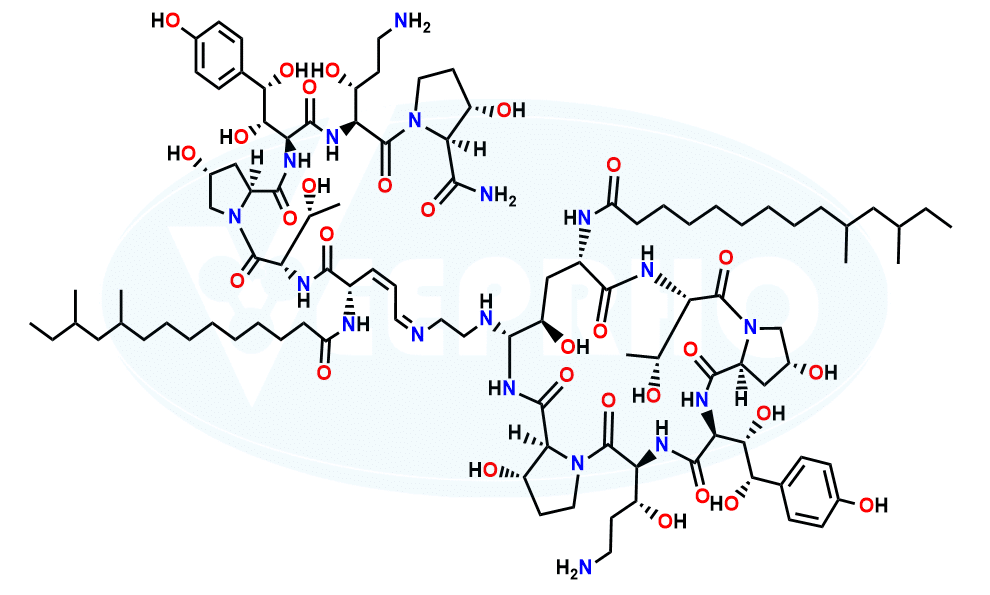 | Caspofungin Dimer IIVE0018386 · En stock |
| Caspofungin Dimer-1VE0021589 | |
| Caspofungin Dimer-2VE0021591 | |
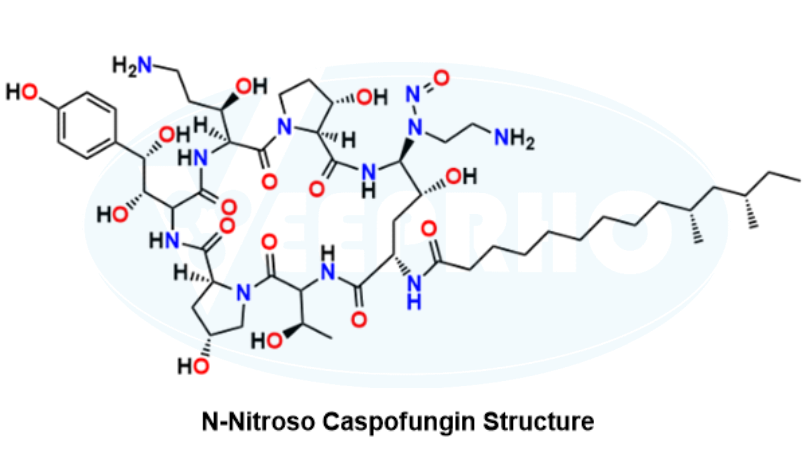
| N-Nitroso CaspofunginVE0014156 | |
| N-Nitroso Caspofungin (Ditrifluoroacetate Salt)VE0019181 |
Caspofungin and Related Compound
The impurity and related-compound profile for caspofungin drug substance and drug product is characterized by process- and degradation-related species including deacylated analogues, oxidized species, deamidation products, ring-opened hydrolysis products, and trace residual reagents from synthesis. Typical specification approaches used by manufacturers and regulators set limits to control safety and quality: individual related compounds are commonly controlled at or below 0.5% relative to the API, total impurities are commonly limited to around 2.0% relative to the API, and any identified mutagenic or genotoxic impurities are controlled to levels consistent with ICH M7 guidance, generally below 0.05% or at permitted daily exposure thresholds. Analytical control employs orthogonal methods such as LC with UV and MS detection to quantify known and unknown impurities, forced-degradation studies to identify likely degradation pathways, and system suitability criteria to ensure reproducible impurity measurement.
Questions fréquentes
What is caspofungin used to treat?
Caspofungin is used to treat invasive candidiasis including candidemia and other deep Candida infections, and as salvage therapy for invasive aspergillosis when patients are refractory to or intolerant of other agents; it is also indicated in some guidelines for esophageal candidiasis.
What is the difference between fluconazole and caspofungin?
Fluconazole is an azole that inhibits ergosterol biosynthesis and is active orally and IV against many Candida spp, whereas caspofungin is an echinocandin that inhibits (1→3)-β-D-glucan synthesis in the fungal cell wall and is administered IV; caspofungin retains activity against many azole-resistant Candida isolates but has limited activity against certain molds and Cryptococcus.
What is the mechanism of action of caspofungin?
Caspofungin noncompetitively inhibits the fungal enzyme complex that synthesizes (1→3)-β-D-glucan, an essential polysaccharide component of the fungal cell wall, leading to cell wall instability and osmotic lysis in susceptible fungi.
Is caspofungin IV or oral?
Caspofungin is administered intravenously.