

- 100% accuracy of data
- 24/7 scientific support
- 0% tolerance in quality of product
Stock Locations
- New Jersey, USA
- Czech Republic, EU
* Stock subject to availability.
Documentation
Includes: HPLC, MASS/LC-MS, 1H NMR, FT-IR, Potency, Structure Elucidation Report (SER), and additional analytical data depending on the product.
150194-52-8
Fluconazole EP Impurity H
● In Stock
| Catalogue No.: | VE0016257 |
|---|---|
| CAS No.: | 150194-52-8 |
| Mol. Formula: | C11H10BrF2N3O |
| Mol. Weight: | 318.12 g/mol |
For laboratory use only: analytical, development and regulatory purposes. Supplied in mg quantities. Not for human or veterinary use.
Request a quote for a set
- Request quote for this set
All EP impurities of Fluconazole
10 productsSee the 10 products
- Fluconazole EP Impurity A VL60005
CAS 89429-59-4 - Fluconazole EP Impurity B VL60001
CAS 871550-15-1 - Fluconazole EP Impurity C VL60003
CAS 514222-44-7 - Fluconazole EP Impurity E VL60008
CAS 86404-63-9 - Fluconazole EP Impurity F VE0016273
CAS 118689-07-9 - Fluconazole EP Impurity G VE0013448
CAS 86386-76-7 - Fluconazole EP Impurity G (Mesylate) VE0016259
CAS 86386-77-8 - Fluconazole EP Impurity H VE0016257
CAS 150194-52-8 - Fluconazole EP Impurity I VL60004
CAS 150168-54-0 - Fluconazole Related Compound B VL60002
CAS 81886-51-3
- Fluconazole EP Impurity A VL60005
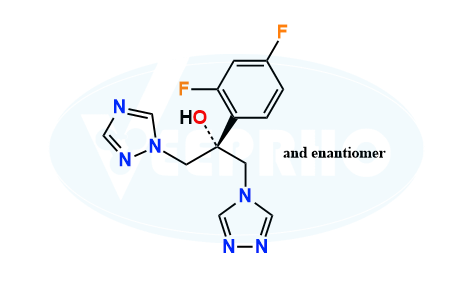


Additional information on CAS 150194-52-8
| Parent drug | Fluconazole |
|---|---|
| Product type | Impurity standards |
| IUPAC name | (2RS)-1-bromo-2-(2,4-difluorophenyl)-3-(1H-1,2,4- triazol-1-yl)propan-2-ol |
| EP name | Fluconazole EP Impurity H |
| SMILES | OC(CBr)(Cn1cncn1)c1ccc(F)cc1F |
| InChIKey | CFMLSIOEVNQGQY-UHFFFAOYSA-N |
| CHNS Ratio (%) (calculated) | C 41.53 · H 3.17 · N 13.21 · S 0.00 |
| References | - |
| Description | Fluconazole EP Impurity H, also designated Fluconazole Bromo Impurity, is a brominated process-related impurity associated with fluconazole manufacturing. The compound, CAS 150194-52-8, has molecular formula C11H10BrF2N3O and molecular weight 318.12 g/mol. Structurally, it reflects halogen substitution on the triazole-containing scaffold and may arise from incomplete nucleophilic substitution or bromination side reactions during synthesis. Because it is not a degradation marker in the classical sense, its regulatory relevance lies in process impurity control under pharmacopoeial and impurity qualification principles. Trace determination typically requires LC-MS/MS, LC-HRMS, and, where needed, HPLC with UV or diode-array detection. |
Request a Quote
"*" indicates required fields
Other products related to Fluconazole impurities
| Impurity structure | Name of Impurity | Catalogue No. |
|---|---|---|
| Fluconazole EP Impurity A | VL60005 | |
| Fluconazole EP Impurity B | VL60001 | |
| Fluconazole EP Impurity C | VL60003 | |
| Fluconazole EP Impurity E | VL60008 | |
| Fluconazole EP Impurity F | VE0016273 | |
| Fluconazole EP Impurity G | VE0013448 | |
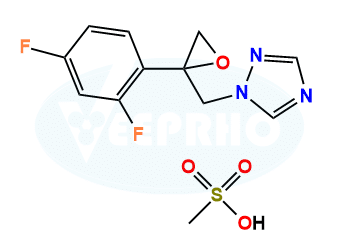 | Fluconazole EP Impurity G (Mesylate) | VE0016259 |
| Fluconazole EP Impurity I | VL60004 | |
| Fluconazole Related Compound B | VL60002 | |
| 4-Amino-1,2,4-triazole | VE0022421 | |
| Fluconazole Impurity 1 | VE0022362 | |
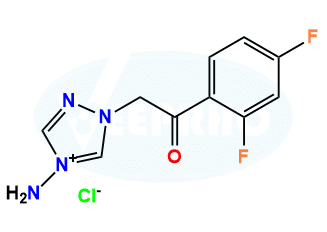 | Fluconazole Impurity 5 (Chloride) | VE0016277 |