

- 100% accuracy of data
- 24/7 scientific support
- 0% tolerance in quality of product
Stock Locations
- New Jersey, USA
- Czech Republic, EU
* Stock subject to availability.
Documentation
Includes: HPLC, MASS/LC-MS, 1H NMR, FT-IR, Potency, Structure Elucidation Report (SER), and additional analytical data depending on the product.
1638785-19-9
Bilastine Impurity 13
● In Stock
| Catalogue No.: | VE0012693 |
|---|---|
| CAS No.: | 1638785-19-9 |
| Mol. Formula: | C13H15ClO3 |
| Mol. Weight: | 254.71 g/mol |
For laboratory use only: analytical, development and regulatory purposes. Supplied in mg quantities. Not for human or veterinary use.
Packs and prices
| Pack | Price | Qty |
|---|---|---|
| 100 mg | USD 835.00 |
Prices shown are valid for issuing a purchase order.
Prices are subject to change depending on compound availability and the cost of synthesis based on current raw material costs. Veeprho reserves the right to change prices without notice.
Need another pack size or quantity? Request a custom quoteHow can we help?
Additional information on CAS 1638785-19-9
| Parent drug | Bilastine |
|---|---|
| Product type | Impurity standards |
| IUPAC name | methyl 2-(4-(2-chloroacetyl)phenyl)-2-methylpropanoate |
| SMILES | COC(=O)C(C)(C)c1ccc(C(=O)CCl)cc1 |
| InChIKey | RVPFIGIBHCQPHD-UHFFFAOYSA-N |
| CHNS Ratio (%) (calculated) | C 61.30 · H 5.94 · N 0.00 · S 0.00 |
| References | - |
| Description | Bilastine Impurity 13 (CAS 1638785-19-9) is a defined process-related and/or degradative impurity associated with the bilastine synthetic profile. With molecular formula C13H15ClO3 and molecular weight 254.71 g/mol, it represents a chlorinated oxygenated small molecule whose structural assignment is typically supported by high-resolution LC-MS/MS and orthogonal LC-UV or NMR characterization. Its occurrence may arise from incomplete side-chain construction, oxidative transformation, or hydrolytic rearrangement during manufacture or storage. In regulated impurity assessment, such species are evaluated for identity, persistence, and potential toxicological relevance under ICH impurity control principles. |
Request a Quote
"*" indicates required fields
Other products related to Bilastine impurities
| Impurity structure | Name of Impurity | Catalogue No. |
|---|---|---|
| Bilastine Related Compound A | VE0018238 | |
| 1-(2-ethoxyethyl)-2-(1-nitrosopiperidin-4-yl)-1H-benzo[d]imidazole | VE009494 | |
| 1’-Hydroxy Bilastine | VE0011468 | |
| Bilastine Impurity 4 | VE0012714 | |
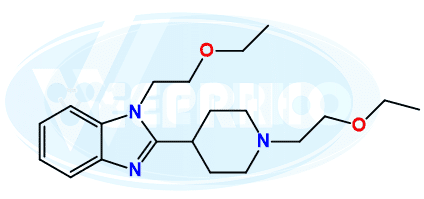 | Bilastine Impurity 5 | VE0012672 |
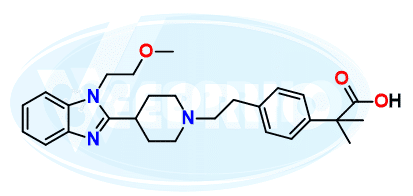 | Bilastine Impurity 6 | VE0012673 |
| Bilastine Impurity 7 | VE0012674 | |
| Bilastine Impurity 10 | VE0012685 | |
| Bilastine Impurity 11 | VE0012688 | |
| Bilastine Impurity 12 | VE0012692 | |
 | Bilastine Impurity 14 DiHCl | VE0012698 |
| Bilastine Impurity 15 | VE0012696 |
Show all related products N-Nitroso Bilastine impurities (3)