
- 100% accuracy of data
- 24/7 scientific support
- 0% tolerance in quality of product
Mutagenicity assessment (ICH M7)
Treated as a potentially non-mutagenic impurity (ICH M7 Class 4–5).
Computational (in silico) assessmentStock Locations
- New Jersey, USA
- Czech Republic, EU
* Stock subject to availability.
Documentation
Includes: HPLC, MASS/LC-MS, 1H NMR, FT-IR, Potency, Structure Elucidation Report (SER), and additional analytical data depending on the product.
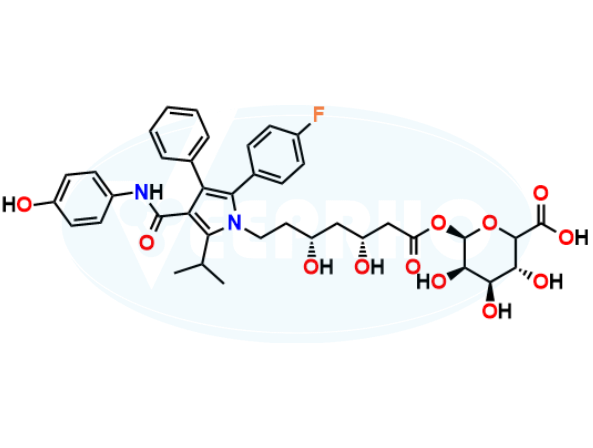
2-Hydroxy Atorvastatin Acyl-beta-D-Glucuronide
● In Stock
| Catalogue No.: | VE0026732 |
|---|---|
| CAS No.: | N/A |
| Mol. Formula: | C39H43FN2O12 |
| Mol. Weight: | 750.8 g/mol |
For laboratory use only: analytical, development and regulatory purposes. Supplied in mg quantities. Not for human or veterinary use.
Additional information on 2-Hydroxy Atorvastatin Acyl-beta-D-Glucuronide
| Parent drug | Atorvastatin |
|---|---|
| Product type | Impurity standards |
| IUPAC name | (3R,4R,5R,6R)-6-[(3R,5R)-7-[2-(4-fluorophenyl)-4-[(4-hydroxyphenyl)carbamoyl]-3-phenyl-5-propan-2-ylpyrrol-1-yl]-3,5-dihydroxyheptanoyl]oxy-3,4,5-trihydroxyoxane-2-carboxylic acid |
| SMILES | CC(C)C1=C(C(=C(N1CC[C@H](C[C@H](CC(=O)O[C@@H]2[C@@H]([C@@H]([C@H](C(O2)C(=O)O)O)O)O)O)O)C3=CC=C(C=C3)F)C4=CC=CC=C4)C(=O)NC5=CC=C(C=C5)O |
| InChI | InChI=1S/C39H43FN2O12/c1-20(2)31-30(37(50)41-24-12-14-25(43)15-13-24)29(21-6-4-3-5-7-21)32(22-8-10-23(40)11-9-22)42(31)17-16-26(44)18-27(45)19-28(46)53-39-35(49)33(47)34(48)36(54-39)38(51)52/h3-15,20,26-27,33-36,39,43-45,47-49H,16-19H2,1-2H3,(H,41,50)(H,51,52)/t26-,27-,33-,34-,35-,36?,39+/m1/s1 |
| InChIKey | JJFXECUFPSHKNX-XTWRIXKZSA-N |
| CHNS Ratio (%) (calculated) | C 62.39 · H 5.77 · N 3.73 · S 0.00 |
| Description | 2-Hydroxy Atorvastatin Acyl-beta-D-Glucuronide is a key glucuronide impurity encountered during atorvastatin synthesis and stability studies. This acyl-glucuronide species forms via Phase II conjugation or esterification of the 2-hydroxy intermediate and can affect drug substance purity and stability through potential covalent rearrangements. Accurate identification and quantification require high resolution LC-MS/MS and orthogonal HPLC methods with authentic reference standards and MS fragmentation profiling. Control strategies include optimized reaction quenching, pH control, and targeted purification to reduce carryover into finished material. Reporting and specification follow ICH impurity guidelines with validated methods for limit testing and forced degradation studies. |
Request a Quote
"*" indicates required fields
Other products related to Atorvastatin impurities
| Impurity structure | Name of Impurity | Catalogue No. |
|---|---|---|
| Atorvastatin EP Impurity A | VE008745 | |
| Atorvastatin EP Impurity A (Ca salt) | VL10004 | |
 | Atorvastatin EP Impurity A (Na Salt) | VE0020562 |
| Atorvastatin EP Impurity B (Free Base) | VE009319 | |
| Atorvastatin EP Impurity C | VE008906 | |
 | Atorvastatin EP Impurity C (Na Salt) | VE0012975 |
| Atorvastatin EP Impurity D (Impurity D1) | VL10003 | |
 | Atorvastatin EP Impurity D (Mixture of D1 & D2) | VE0022694 |
| Atorvastatin EP Impurity E (Ca Salt) | VL10006 | |
| Atorvastatin EP Impurity E (Free Base) | VE0012984 | |
| Atorvastatin EP Impurity E (Na Salt) | VE009244 | |
| Atorvastatin EP Impurity F (Ca Salt) | VL10011 |
Show all related products N-Nitroso Atorvastatin impurities (14)