
- 100% accuracy of data
- 24/7 scientific support
- 0% tolerance in quality of product
Stock Locations
- New Jersey, USA
- Czech Republic, EU
* Stock subject to availability.
Documentation
Includes: HPLC, MASS/LC-MS, 1H NMR, FT-IR, Potency, Structure Elucidation Report (SER), and additional analytical data depending on the product.
2452407-72-4
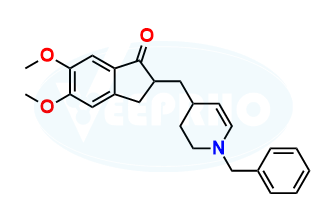
Donepezil EP Impurity G (Free base)
● In Stock
| Catalogue No.: | VE009253 |
|---|---|
| CAS No.: | 2452407-72-4 |
| Mol. Formula: | C24H27NO3 |
| Mol. Weight: | 377.5 g/mol |
For laboratory use only: analytical, development and regulatory purposes. Supplied in mg quantities. Not for human or veterinary use.
Request a quote for a set
- Request quote for this set
All EP impurities of Donepezil
8 productsSee the 8 products
- Donepezil EP Impurity A VE006102
CAS 120014-30-4 - Donepezil EP Impurity B VE005917
CAS 2107-69-9 - Donepezil EP Impurity C VE009893
CAS 2452407-76-8 - Donepezil EP Impurity D VL173003
CAS 4803-57-0 - Donepezil EP Impurity E VE000001
CAS 231283-82-2 - Donepezil EP Impurity G (Free base) VE009253
CAS 2452407-72-4 - Donepezil EP Impurity H (Free Base) VE0020762
CAS 608511-44-0 - Hydroxy Donepezil VL173002
CAS 197010-20-1
- Donepezil EP Impurity A VE006102


Additional information on CAS 2452407-72-4
| Parent drug | Donepezil |
|---|---|
| Product type | Impurity standards |
| IUPAC name | 2-((1-benzyl-1,2,3,4-tetrahydropyridin-4-yl)methyl)-5,6-dimethoxy-2,3-dihydro-1H-inden-1-one |
| EP name | Donepezil EP Impurity G |
| SMILES | COc1cc2c(cc1OC)C(=O)C(CC1C=CN(Cc3ccccc3)CC1)C2 |
| InChIKey | IMWZBSNYDVILDO-UHFFFAOYSA-N |
| CHNS Ratio (%) (calculated) | C 76.36 · H 7.21 · N 3.71 · S 0.00 |
| References | Birks, J. S., & Harvey, R. J. (2018). Donepezil for dementia due to Alzheimer’s disease. Cochrane Database of Systematic Reviews, 2018(6). https://doi.org/10.1002/14651858.cd001190.pub3 |
| Description | Donepezil EP Impurity G (Free base), CAS 2452407-72-4, is a defined related substance of donepezil with molecular formula C24H27NO3 and molecular weight 377.5 g/mol. Structurally, it is a tertiary amino arylalkyl ether impurity consistent with a synthetic intermediate-derived or process-related analog rather than a simple oxidation product. Its presence may arise from incomplete elaboration of the benzylpiperidine framework or alkylation side reactions during manufacture. Trace-level characterization generally requires LC-MS/MS for elemental composition confirmation, with HPLC-UV and LC-ELSD supporting assay determination. Where impurity profiling is required, orthogonal MS or high-resolution LC techniques are used to distinguish it from isomeric degradants. |
Request a Quote
"*" indicates required fields
Other products related to Donepezil impurities
| Impurity structure | Name of Impurity | Catalogue No. |
|---|---|---|
| Donepezil EP Impurity A | VE006102 | |
| Donepezil EP Impurity B | VE005917 | |
| Donepezil EP Impurity C | VE009893 | |
| Donepezil EP Impurity D | VL173003 | |
| Donepezil EP Impurity E | VE000001 | |
| Donepezil EP Impurity H (Free Base) | VE0020762 | |
| Donepezil Related Compound A | VL173010 | |
| N-Nitroso Donepezil EP Impurity A | VE0015851 | |
| 3-hydroxy donepezil | VL173021 | |
| 5-O-Desmethyl Donepezil Glucuronide (Mixture of Diastereomers) | VE0014534 | |
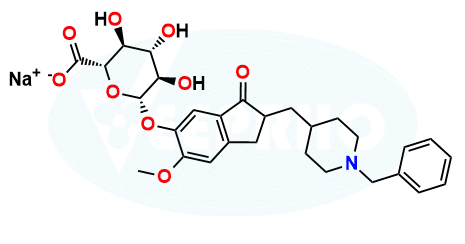 | 6-O-Desmethyl Donepezil Glucuronide (Na Salt) (Mixture of Diastereomers) | VE0014543 |
| Deoxy Donepezil Impurity | VL173006 |