
- 100% accuracy of data
- 24/7 scientific support
- 0% tolerance in quality of product
Stock Locations
- New Jersey, USA
- Czech Republic, EU
* Stock subject to availability.
Documentation
Includes: HPLC, MASS/LC-MS, 1H NMR, FT-IR, Potency, Structure Elucidation Report (SER), and additional analytical data depending on the product.
1242137-17-2
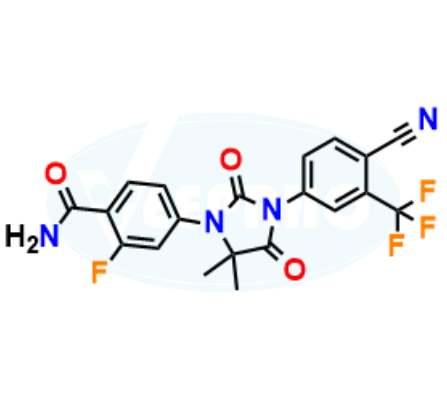
4-(3-(4-Cyano-3-(trifluoromethyl)phenyl)-5,5-dimethyl-2,4-dioxoimidazolidin-1-yl)-2-fluorobenzamide
● In Stock
| Catalogue No.: | VE0027129 |
|---|---|
| CAS No.: | 1242137-17-2 |
| Mol. Formula: | C20H14F4N4O3 |
| Mol. Weight: | 434.34 g/mol |
For laboratory use only: analytical, development and regulatory purposes. Supplied in mg quantities. Not for human or veterinary use.
Additional information on CAS 1242137-17-2
| Parent drug | Enzalutamide |
|---|---|
| Product type | Impurity standards |
| IUPAC name | 4-(3-(4-Cyano-3-(trifluoromethyl)phenyl)-5,5-dimethyl-2,4-dioxoimidazolidin-1-yl)-2-fluorobenzamide |
| Other Synonyms | Benzamide, 4-[3-[4-cyano-3-(trifluoromethyl)phenyl]-5,5-dimethyl-2,4-dioxo-1-imidazolidinyl]-2-fluoro |
| SMILES | O=C(N)C1=CC=C(N(C(N2C3=CC=C(C#N)C(C(F)(F)F)=C3)=O)C(C)(C)C2=O)C=C1F |
| InChI | InChI=1S/C20H14F4N4O3/c1-19(2)17(30)27(11-4-3-10(9-25)14(7-11)20(22,23)24)18(31)28(19)12-5-6-13(16(26)29)15(21)8-12/h3-8H,1-2H3,(H2,26,29) |
| InChIKey | YFFJYEGEYBPFEX-UHFFFAOYSA-N |
| CHNS Ratio (%) (calculated) | C 55.31 · H 3.25 · N 12.90 · S 0.00 |
| Description | 4-(3-(4-Cyano-3-(trifluoromethyl)phenyl)-5,5-dimethyl-2,4-dioxoimidazolidin-1-yl)-2-fluorobenzamide (CAS 1242137-17-2) is a structurally defined process-related impurity characterized by a cyano-substituted phenyl ring, trifluoromethyl and fluoro substituents, and a 2,4-dioxoimidazolidinone core. Relevant technical attributes include molecular mass, polarity, and low aqueous solubility that influence isolation and cleanup during API synthesis. Identification and quantification are reliably achieved by HPLC with UV detection, LC-MS and 19F NMR. Control strategies focus on reaction optimization, targeted purification steps and validated specification limits to mitigate potential safety and stability impacts on the final drug substance. |
Request a Quote
"*" indicates required fields
Other products related to Enzalutamide impurities


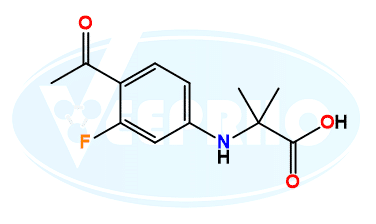
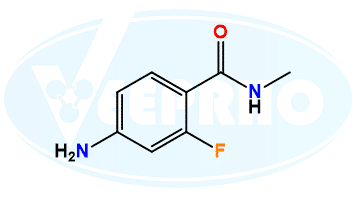
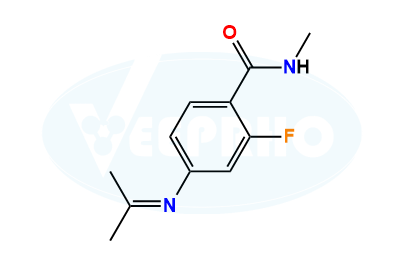
Show all related products N-Nitroso Enzalutamide impurities (5)