
- 100% accuracy of data
- 24/7 scientific support
- 0% tolerance in quality of product
Mutagenicity assessment (ICH M7)
Treated as a potentially non-mutagenic impurity (ICH M7 Class 4–5).
Computational (in silico) assessmentStock Locations
- New Jersey, USA
- Czech Republic, EU
* Stock subject to availability.
Documentation
Includes: HPLC, MASS/LC-MS, 1H NMR, FT-IR, Potency, Structure Elucidation Report (SER), and additional analytical data depending on the product.
693793-42-9
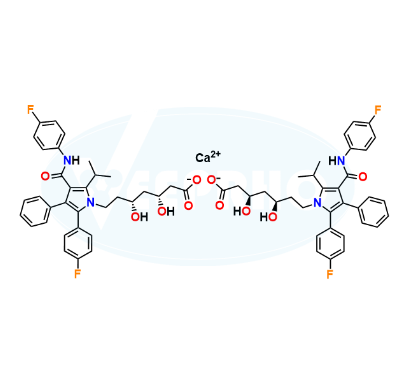
4-Fluoro Atorvastatin Calcium Salt
● In Stock
| Catalogue No.: | VE0026797 |
|---|---|
| CAS No.: | 693793-42-9 |
| Mol. Formula: | C66H66CaF4N4O10 |
| Mol. Weight: | 1191.32 g/mol |
For laboratory use only: analytical, development and regulatory purposes. Supplied in mg quantities. Not for human or veterinary use.
Additional information on CAS 693793-42-9
| Parent drug | Atorvastatin |
|---|---|
| Product type | Impurity standards |
| IUPAC name | calcium bis((3R,5R)-7-[2-(4-fluorophenyl)-4-[(4-fluorophenyl)carbamoyl]-3-phenyl-5-propan-2-ylpyrrol-1-yl]-3,5-dihydroxyheptanoate) |
| SMILES | O=C([O-])C[C@H](O)C[C@H](O)CCN1C(C(C)C)=C(C(NC2=CC=C(F)C=C2)=O)C(C3=CC=CC=C3)=C1C4=CC=C(F)C=C4.O=C([O-])C[C@H](O)C[C@H](O)CCN5C(C(C)C)=C(C(NC6=CC=C(F)C=C6)=O)C(C7=CC=CC=C7)=C5C8=CC=C(F)C=C8.[Ca+2] |
| InChI | InChI=1S/2C33H34F2N2O5.Ca/c2*1-20(2)31-30(33(42)36-25-14-12-24(35)13-15-25)29(21-6-4-3-5-7-21)32(22-8-10-23(34)11-9-22)37(31)17-16-26(38)18-27(39)19-28(40)41;/h2*3-15,20,26-27,38-39H,16-19H2,1-2H3,(H,36,42)(H,40,41);/q;;+2/p-2/t2*26-,27-;/m11./s1 |
| InChIKey | IKFQOZDZSAMVQL-MNSAWQCASA-L |
| CHNS Ratio (%) (calculated) | C 66.54 · H 5.58 · N 4.70 · S 0.00 |
| Description | 4-Fluoro Atorvastatin Calcium Salt (CAS 693793-42-9) is a positional fluoro-substituted impurity of atorvastatin calcium that can arise during synthesis or downstream processing. It affects API purity and must be identified, quantified and controlled to meet regulatory impurity thresholds. Characterization typically uses HPLC with UV detection for routine quantitation complemented by LC-MS and 1H and 19F NMR for structural confirmation. Risk assessment covers potential genotoxicity, stability under stress conditions, and impact on potency and dissolution. Control strategies include route optimization, enhanced purification steps such as recrystallization, and validated analytical methods for impurity profiling, batch release and stability testing. |
Request a Quote
"*" indicates required fields
Other products related to Atorvastatin impurities
| Impurity structure | Name of Impurity | Catalogue No. |
|---|---|---|
| Atorvastatin EP Impurity A | VE008745 | |
| Atorvastatin EP Impurity A (Ca salt) | VL10004 | |
 | Atorvastatin EP Impurity A (Na Salt) | VE0020562 |
| Atorvastatin EP Impurity B (Free Base) | VE009319 | |
| Atorvastatin EP Impurity C | VE008906 | |
 | Atorvastatin EP Impurity C (Na Salt) | VE0012975 |
| Atorvastatin EP Impurity D (Impurity D1) | VL10003 | |
 | Atorvastatin EP Impurity D (Mixture of D1 & D2) | VE0022694 |
| Atorvastatin EP Impurity E (Ca Salt) | VL10006 | |
| Atorvastatin EP Impurity E (Free Base) | VE0012984 | |
| Atorvastatin EP Impurity E (Na Salt) | VE009244 | |
| Atorvastatin EP Impurity F (Ca Salt) | VL10011 |
Show all related products N-Nitroso Atorvastatin impurities (14)