
- 100% accuracy of data
- 24/7 scientific support
- 0% tolerance in quality of product
Stock Locations
- New Jersey, USA
- Czech Republic, EU
* Stock subject to availability.
Documentation
Includes: HPLC, MASS/LC-MS, 1H NMR, FT-IR, Potency, Structure Elucidation Report (SER), and additional analytical data depending on the product.
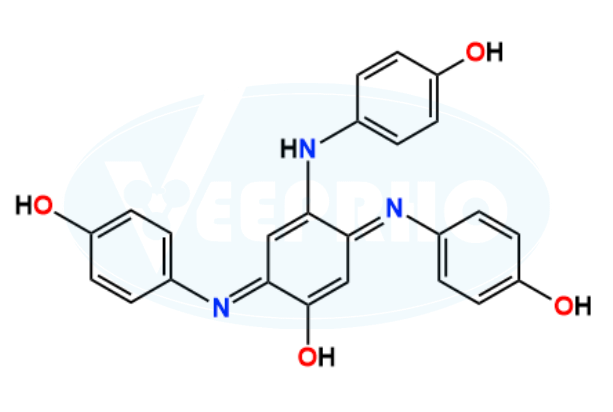
4,4'-((1E,1'E)-(2-hydroxy-5-((4-hydroxyphenyl)amino)cyclohexa-2,5-diene-1,4-diylidene)bis(azanylylidene))diphenol
● In Stock
| Catalogue No.: | VE0027485 |
|---|---|
| CAS No.: | N/A |
| Mol. Formula: | C24H19N3O4 |
| Mol. Weight: | 413.43 g/mol |
For laboratory use only: analytical, development and regulatory purposes. Supplied in mg quantities. Not for human or veterinary use.
Additional information on 4,4'-((1E,1'E)-(2-hydroxy-5-((4-hydroxyphenyl)amino)cyclohexa-2,5-diene-1,4-diylidene)bis(azanylylidene))diphenol
| Parent drug | Mesalazine |
|---|---|
| Product type | Impurity standards |
| IUPAC name | 4,4'-((1E,1'E)-(2-hydroxy-5-((4-hydroxyphenyl)amino)cyclohexa-2,5-diene-1,4-diylidene)bis(azanylylidene))diphenol |
| SMILES | OC1=CC=C(NC2=C/C(C(O)=C/C2=N\C3=CC=C(O)C=C3)=N\C4=CC=C(O)C=C4)C=C1 |
| InChI | InChI=1S/C24H19N3O4/c28-18-7-1-15(2-8-18)25-21-13-23(27-17-5-11-20(30)12-6-17)24(31)14-22(21)26-16-3-9-19(29)10-4-16/h1-14,25,28-31H/b26-22+,27-23+ |
| InChIKey | NELICXIWQXVDPM-GEECTANVSA-N |
| CHNS Ratio (%) (calculated) | C 69.72 · H 4.63 · N 10.16 · S 0.00 |
| Description | 4,4'-((1E,1'E)-(2-hydroxy-5-((4-hydroxyphenyl)amino)cyclohexa-2,5-diene-1,4-diylidene)bis(azanylylidene))diphenol is a conjugated phenolic impurity characterized by multiple hydroxyl and azanylylidene functionalities that confer strong UV absorbance and hydrogen bonding. Its presence can arise from over-oxidation or incomplete condensation during synthesis and may compromise assay accuracy, stability and formulation performance. Analytical identification relies on orthogonal methods: reversed-phase HPLC with PDA for quantitation, LC-MS for exact mass and fragmentation, and 1H and 13C NMR for structural confirmation. Control strategies include optimized reaction conditions, targeted purification, and stability testing with validated methods to ensure levels remain within specification. |
Request a Quote
"*" indicates required fields
Other products related to Mesalazine impurities
| Impurity structure | Name of Impurity | Catalogue No. |
|---|---|---|
| Mefenamic Acid EP Impurity C | VL2950002 | |
| Mesalamine EP Impurity K | VL98011 | |
| Mesalamine EP Impurity O | VL98012 | |
| Mesalazine EP Impurity C | VL98007 | |
 | Mesalazine EP Impurity D | VL98010 |
| Mesalazine EP Impurity E | VL98002 | |
| Mesalazine EP Impurity F | VL98008 | |
| Mesalazine EP Impurity G | VL98009 | |
| Mesalazine EP Impurity J | VL98019 | |
| Mesalazine EP Impurity K (HCl Salt) | VE0017818 | |
| Mesalazine EP Impurity M | VL98015 | |
| Mesalazine EP Impurity N | VL98016 |