
- 100% accuracy of data
- 24/7 scientific support
- 0% tolerance in quality of product
Stock Locations
- New Jersey, USA
- Czech Republic, EU
* Stock subject to availability.
Documentation
Includes: HPLC, MASS/LC-MS, 1H NMR, FT-IR, Potency, Structure Elucidation Report (SER), and additional analytical data depending on the product.
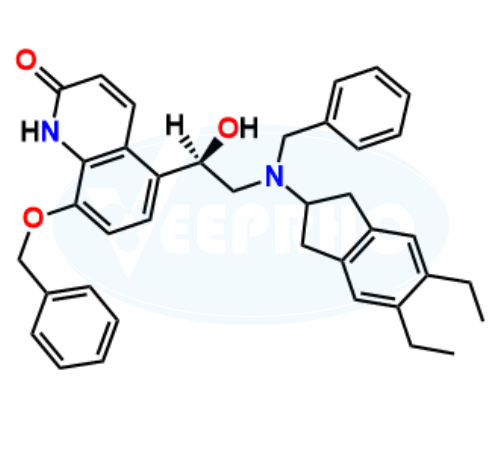
5-(2-(benzyl(5,6-diethyl-2,3-dihydro-1H-inden-2-yl)amino)-1-hydroxyethyl)-8-(benzyloxy)quinolin-2(1H)-one
● In Stock
| Catalogue No.: | VE0028885 |
|---|---|
| CAS No.: | N/A |
| Mol. Formula: | C38H40N2O3 |
| Mol. Weight: | 572.74 g/mol |
For laboratory use only: analytical, development and regulatory purposes. Supplied in mg quantities. Not for human or veterinary use.
Additional information on 5-(2-(benzyl(5,6-diethyl-2,3-dihydro-1H-inden-2-yl)amino)-1-hydroxyethyl)-8-(benzyloxy)quinolin-2(1H)-one
| Parent drug | Indacaterol |
|---|---|
| Product type | Impurity standards |
| IUPAC name | 5-(2-(benzyl(5,6-diethyl-2,3-dihydro-1H-inden-2-yl)amino)-1-hydroxyethyl)-8-(benzyloxy)quinolin-2(1H)-one |
| SMILES | O=C1NC2=C(C(C(O)([H])CN(CC3=CC=CC=C3)C4CC5=C(C=C(CC)C(CC)=C5)C4)=CC=C2OCC6=CC=CC=C6)C=C1 |
| InChI | InChI=1S/C38H40N2O3/c1-3-28-19-30-21-32(22-31(30)20-29(28)4-2)40(23-26-11-7-5-8-12-26)24-35(41)33-15-17-36(38-34(33)16-18-37(42)39-38)43-25-27-13-9-6-10-14-27/h5-20,32,35,41H,3-4,21-25H2,1-2H3,(H,39,42)/t35-/m0/s1 |
| InChIKey | FBSDMURTEMTJLJ-UHFFFAOYSA-N |
| CHNS Ratio (%) (calculated) | C 79.69 · H 7.04 · N 4.89 · S 0.00 |
| Description | 5-(2-(benzyl(5,6-diethyl-2,3-dihydro-1H-inden-2-yl)amino)-1-hydroxyethyl)-8-(benzyloxy)quinolin-2(1H)-one is a complex quinolinone-related impurity with an aryl ether, benzylic amine, and secondary alcohol motif. Its molecular formula, C38H40N2O3, and molecular weight, 572.74 g/mol, indicate a highly lipophilic, structurally elaborate species that is most plausibly formed as a synthetic intermediate carryover or route-related byproduct during assembly of the indenylamino side chain and benzyloxy-protected heterocycle. Owing to its size and aromatic density, characterization typically requires LC-MS/MS, high-resolution MS, and NMR confirmation, with chromatographic resolution often dependent on reversed-phase UHPLC. The impurity is assessed within impurity-control and ICH M7-based genotoxic risk frameworks when process relevance warrants. |
Request a Quote
"*" indicates required fields
Other products related to Indacaterol impurities
| Impurity structure | Name of Impurity | Catalogue No. |
|---|---|---|
| ((R)-5-(2-((5,6-diethyl-2,3-dihydro-1H-inden-2-yl)amino)-1-ethoxyethyl)-8- hydroxyquinolin-2(1H)-one) | VE0028610 | |
 | (R)-N-(5,6-diethyl-2,3-dihydro-1H-inden-2-yl)-N-(2-hydroxy-2-(8-hydroxy-2-oxo-1,2,3,4-tetrahydroquinolin-5-yl)ethyl)nitrous amide | VE0010555 |
| 1-Ethoxyethyl-Indacaterol | VE0015146 | |
| 5-Formyl-8-hydroxycarbostyril | VE0017798 | |
| 8-hydroxy-2-oxo-1,2-dihydroquinoline-5-carboxylic acid | VE0028887 | |
| Benzyl Indacaterol | VE0010487 | |
| Hydroxy Indacaterol | VE0015207 | |
 | Indacaterol 8-O-Glucuronide (Na Salt) | VE0015206 |
| Indacaterol Enantiomer HCl | VE0010070 | |
| Indacaterol Impurity 1 | VE0015145 | |
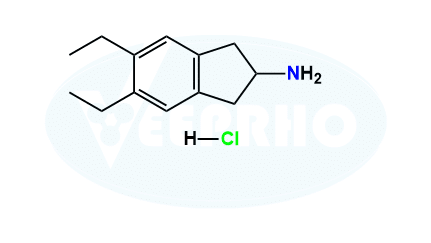 | Indacaterol Impurity 6 (HCl Salt) | VE0015148 |
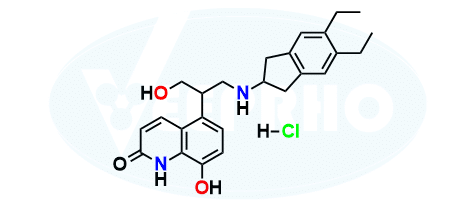 | Indacaterol Impurity 8 (HCl Salt) | VE0015203 |
Show all related products N-Nitroso Indacaterol impurities (3)