

- 100% accuracy of data
- 24/7 scientific support
- 0% tolerance in quality of product
Mutagenicity assessment (ICH M7)
Potentially mutagenic impurity (ICH M7 Class 1–3).
N-nitroso compound: ICH M7 cohort of concern.Stock Locations
- New Jersey, USA
- Czech Republic, EU
* Stock subject to availability.
Documentation
Includes: HPLC, MASS/LC-MS, 1H NMR, FT-IR, Potency, Structure Elucidation Report (SER), and additional analytical data depending on the product.
5-((4-nitrosopiperazin-1-yl)methyl)pyridin-2-amine
● In Stock
| Catalogue No.: | VE0028283 |
|---|---|
| CAS No.: | N/A |
| Mol. Formula: | C10H15N5O |
| Mol. Weight: | 221.26 g/mol |
For laboratory use only: analytical, development and regulatory purposes. Supplied in mg quantities. Not for human or veterinary use.
Request a quote for a set
- Request quote for this set
All nitrosamine impurities of Abemaciclib
5 productsSee the 5 products


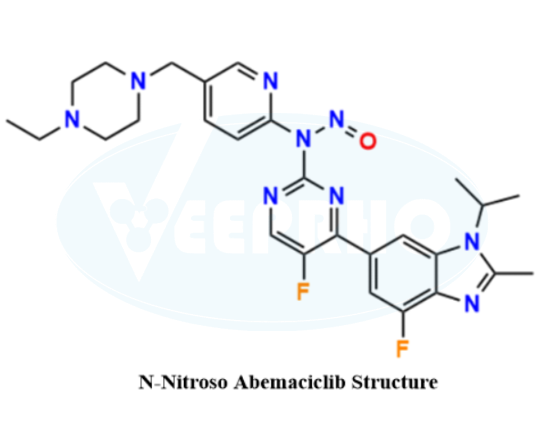
Additional information on 5-((4-nitrosopiperazin-1-yl)methyl)pyridin-2-amine
| Parent drug | Abemaciclib |
|---|---|
| Product type | Impurity standards, Nitroso impurities |
| IUPAC name | 5-((4-nitrosopiperazin-1-yl)methyl)pyridin-2-amine |
| SMILES | O=NN1CCN(CC2=CN=C(N)C=C2)CC1 |
| InChI | InChI=1S/C10H15N5O/c11-10-2-1-9(7-12-10)8-14-3-5-15(13-16)6-4-14/h1-2,7H,3-6,8H2,(H2,11,12) |
| InChIKey | ACFHOMXHTZMYKZ-UHFFFAOYSA-N |
| CHNS Ratio (%) (calculated) | C 54.28 · H 6.83 · N 31.65 · S 0.00 |
| Description | 5-((4-nitrosopiperazin-1-yl)methyl)pyridin-2-amine is a process-related impurity characterized by a nitrosated piperazine moiety attached to a 2-aminopyridine scaffold. It arises from nitrosation of piperazinyl intermediates during synthesis or storage under nitrosating conditions and presents analytical and regulatory challenges due to the nitroso functionality. Analytical identification employs HPLC with orthogonal confirmation by LC-MS and NMR, often requiring sensitive methods or derivatization for trace-level quantification. Control strategies focus on prevention of nitrosation through raw material quality, strict control of acidic and nitrosating residuals, in-process quenching and validated removal steps. Risk assessment and specification setting are critical to ensure impurity is controlled to acceptable limits. |
Request a Quote
"*" indicates required fields