
- 100% accuracy of data
- 24/7 scientific support
- 0% tolerance in quality of product
Mutagenicity assessment (ICH M7)
Treated as a potentially non-mutagenic impurity (ICH M7 Class 4–5).
Computational (in silico) assessmentStock Locations
- New Jersey, USA
- Czech Republic, EU
* Stock subject to availability.
Documentation
Includes: HPLC, MASS/LC-MS, 1H NMR, FT-IR, Potency, Structure Elucidation Report (SER), and additional analytical data depending on the product.
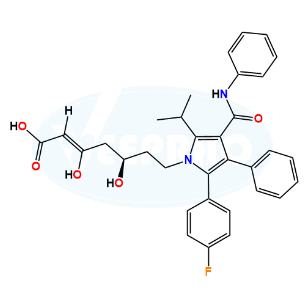
Atorvastatin Impurity 100
● In Stock
| Catalogue No.: | VE0026780 |
|---|---|
| CAS No.: | N/A |
| Mol. Formula: | C33H33FN2O5 |
| Mol. Weight: | 556.62 g/mol |
For laboratory use only: analytical, development and regulatory purposes. Supplied in mg quantities. Not for human or veterinary use.
Additional information on Atorvastatin Impurity 100
| Parent drug | Atorvastatin |
|---|---|
| Product type | Impurity standards |
| IUPAC name | (Z,5R)-7-[2-(4-fluorophenyl)-3-phenyl-4-(phenylcarbamoyl)-5-propan-2-ylpyrrol-1-yl]-3,5-dihydroxyhept-2-enoic acid |
| SMILES | O=C(NC1=CC=CC=C1)C2=C(C(C)C)N(CC[C@@H](O)C/C(O)=C([H])/C(O)=O)C(C3=CC=C(F)C=C3)=C2C4=CC=CC=C4 |
| InChI | InChI=1S/C33H33FN2O5/c1-21(2)31-30(33(41)35-25-11-7-4-8-12-25)29(22-9-5-3-6-10-22)32(23-13-15-24(34)16-14-23)36(31)18-17-26(37)19-27(38)20-28(39)40/h3-16,20-21,26,37-38H,17-19H2,1-2H3,(H,35,41)(H,39,40)/b27-20-/t26-/m1/s1 |
| InChIKey | MXZOBWLONCOBKQ-QJAFFKISSA-N |
| CHNS Ratio (%) (calculated) | C 71.21 · H 5.98 · N 5.03 · S 0.00 |
| Description | Atorvastatin Impurity 100 is a characterized process-related and degradation impurity observed during atorvastatin synthesis and stability testing. Detected by HPLC with a reproducible retention time and confirmed by LC-MS and NMR, it exhibits a distinctive molecular ion and fragmentation pattern enabling unambiguous identification. The impurity shows increased formation under oxidative and acidic stress conditions and displays altered polarity relative to the parent drug, affecting chromatographic behavior. Physicochemical properties such as solubility in common organic solvents and thermal stability have been documented. |
Request a Quote
"*" indicates required fields
Other products related to Atorvastatin impurities
| Impurity structure | Name of Impurity | Catalogue No. |
|---|---|---|
| Atorvastatin EP Impurity A | VE008745 | |
| Atorvastatin EP Impurity A (Ca salt) | VL10004 | |
 | Atorvastatin EP Impurity A (Na Salt) | VE0020562 |
| Atorvastatin EP Impurity B (Free Base) | VE009319 | |
| Atorvastatin EP Impurity C | VE008906 | |
 | Atorvastatin EP Impurity C (Na Salt) | VE0012975 |
| Atorvastatin EP Impurity D (Impurity D1) | VL10003 | |
 | Atorvastatin EP Impurity D (Mixture of D1 & D2) | VE0022694 |
| Atorvastatin EP Impurity E (Ca Salt) | VL10006 | |
| Atorvastatin EP Impurity E (Free Base) | VE0012984 | |
| Atorvastatin EP Impurity E (Na Salt) | VE009244 | |
| Atorvastatin EP Impurity F (Ca Salt) | VL10011 |
Show all related products N-Nitroso Atorvastatin impurities (14)