
- 100% accuracy of data
- 24/7 scientific support
- 0% tolerance in quality of product
Mutagenicity assessment (ICH M7)
Treated as a potentially non-mutagenic impurity (ICH M7 Class 4–5).
Computational (in silico) assessmentStock Locations
- New Jersey, USA
- Czech Republic, EU
* Stock subject to availability.
Documentation
Includes: HPLC, MASS/LC-MS, 1H NMR, FT-IR, Potency, Structure Elucidation Report (SER), and additional analytical data depending on the product.
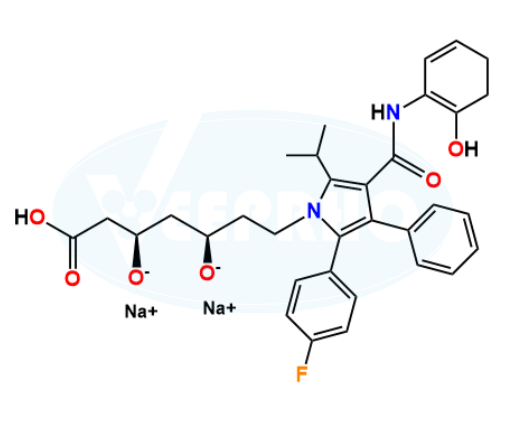
Atorvastatin Impurity 157 (Disodium Salt)
● In Stock
| Catalogue No.: | VE0026696 |
|---|---|
| CAS No.: | N/A |
| Mol. Formula: | C33H35FN2Na2O6 |
| Mol. Weight: | 620.62 g/mol |
For laboratory use only: analytical, development and regulatory purposes. Supplied in mg quantities. Not for human or veterinary use.
Additional information on Atorvastatin Impurity 157 (Disodium Salt)
| Parent drug | Atorvastatin |
|---|---|
| Product type | Impurity standards |
| IUPAC name | disodium;(3R,5R)-7-[2-(4-fluorophenyl)-4-[(2-hydroxycyclohexa-1,5-dien-1-yl)carbamoyl]-3-phenyl-5-propan-2-ylpyrrol-1-yl]-1-hydroxy-1-oxoheptane-3,5-diolate |
| Other Synonyms | 2-Hydroxy Atorvastatin Disodium Salt |
| SMILES | OC1=C(NC(C2=C(C(C)C)N(CC[C@@H]([O-])C[C@@H]([O-])CC(O)=O)C(C3=CC=C(F)C=C3)=C2C4=CC=CC=C4)=O)C=CCC1.[Na+].[Na+] |
| InChI | InChI=1S/C33H35FN2O6.2Na/c1-20(2)31-30(33(42)35-26-10-6-7-11-27(26)39)29(21-8-4-3-5-9-21)32(22-12-14-23(34)15-13-22)36(31)17-16-24(37)18-25(38)19-28(40)41;;/h3-6,8-10,12-15,20,24-25,39H,7,11,16-19H2,1-2H3,(H,35,42)(H,40,41);;/q-2;2*+1/t24-,25-;;/m1../s1 |
| InChIKey | MEZYWLNZBBQDRF-LBDKHHEASA-N |
| CHNS Ratio (%) (calculated) | C 63.86 · H 5.68 · N 4.51 · S 0.00 |
| Description | Atorvastatin Impurity 157, identified as 2-Hydroxy Atorvastatin disodium salt, is a hydroxylated structural analogue arising during synthesis or oxidative degradation of atorvastatin. This polar degradation product can alter impurity profile, solid-state properties, and analytical quantitation if not controlled. It is routinely monitored by HPLC-UV with orthogonal confirmation by LC-MS and NMR to establish identity and purity. Formation pathways include inadvertent oxidation or base-catalyzed hydrolysis under process or storage conditions. Effective control strategies include optimized reaction quenching, antioxidant use, targeted purification steps such as preparative chromatography, and validated analytical methods aligned with ICH impurity guidelines. |
Request a Quote
"*" indicates required fields
Other products related to Atorvastatin impurities
| Impurity structure | Name of Impurity | Catalogue No. |
|---|---|---|
| Atorvastatin EP Impurity A | VE008745 | |
| Atorvastatin EP Impurity A (Ca salt) | VL10004 | |
 | Atorvastatin EP Impurity A (Na Salt) | VE0020562 |
| Atorvastatin EP Impurity B (Free Base) | VE009319 | |
| Atorvastatin EP Impurity C | VE008906 | |
 | Atorvastatin EP Impurity C (Na Salt) | VE0012975 |
| Atorvastatin EP Impurity D (Impurity D1) | VL10003 | |
 | Atorvastatin EP Impurity D (Mixture of D1 & D2) | VE0022694 |
| Atorvastatin EP Impurity E (Ca Salt) | VL10006 | |
| Atorvastatin EP Impurity E (Free Base) | VE0012984 | |
| Atorvastatin EP Impurity E (Na Salt) | VE009244 | |
| Atorvastatin EP Impurity F (Ca Salt) | VL10011 |
Show all related products N-Nitroso Atorvastatin impurities (14)