

- 100% accuracy of data
- 24/7 scientific support
- 0% tolerance in quality of product
Stock Locations
- New Jersey, USA
- Czech Republic, EUIn stock
* Stock subject to availability.
Documentation
Includes: HPLC, MASS/LC-MS, 1H NMR, FT-IR, Potency, Structure Elucidation Report (SER), and additional analytical data depending on the product.
857233-13-7
Bupropion Related Compound F
● In Stock
| Catalogue No.: | VL25021 |
|---|---|
| CAS No.: | 857233-13-7 |
| Mol. Formula: | C9H9ClO2 |
| Mol. Weight: | 184.5 g/mol |
For laboratory use only: analytical, development and regulatory purposes. Supplied in mg quantities. Not for human or veterinary use.
Packs and prices
| Pack | Price | Qty |
|---|---|---|
| 100 mg | USD 230.00 |
Prices shown are valid for issuing a purchase order.
Prices are subject to change depending on compound availability and the cost of synthesis based on current raw material costs. Veeprho reserves the right to change prices without notice.
Need another pack size or quantity? Request a custom quoteHow can we help?
Request a quote for a set
- Request quote for this set
All USP impurities of Bupropion
6 productsSee the 6 products
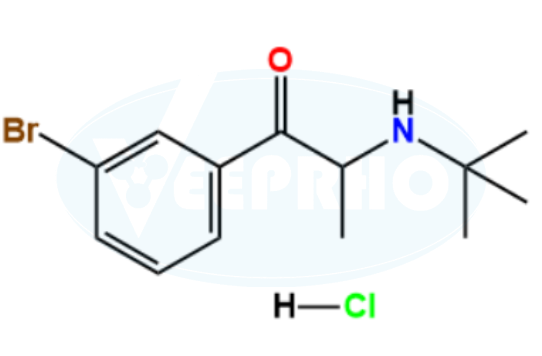
- Bupropion Related Compound A (HCl Salt) VL25015
CAS 1049718-72-0 - Bupropion Related Compound B (HCl Salt) VL25016
CAS 1049718-43-5 - Bupropion Related Compound C VL25014
CAS 152943-33-4 - Bupropion Related Compound D (HCl Salt) VL25001
CAS 63199-74-6 - Bupropion Related Compound E VL25002
CAS 10557-17-2 - Bupropion Related Compound F VL25021
CAS 857233-13-7
- Bupropion Related Compound A (HCl Salt) VL25015

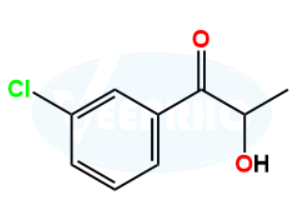
Additional information on CAS 857233-13-7
| Parent drug | Bupropion |
|---|---|
| Product type | Impurity standards |
| IUPAC name | 1-(3-Chlorophenyl)-1-hydroxy-2-propanone |
| USP name | Bupropion Related compound F |
| SMILES | CC(=O)C(O)c1cccc(Cl)c1 |
| InChIKey | HTTAEBUFKZSUKE-UHFFFAOYSA-N |
| CHNS Ratio (%) (calculated) | C 58.55 · H 4.91 · N 0.00 · S 0.00 |
| Description | Bupropion Related Compound F (CAS 857233-13-7) is a chlorinated aromatic impurity associated with the bupropion synthetic and degradation space, consistent with an oxidized aryl ketone fragment derived from pathway-specific side reactions or incomplete material conversion. With molecular formula C9H9ClO2 and molecular weight 184.5 g/mol, it presents as a structurally defined low-level constituent relevant to impurity profiling and structural elucidation. Its determination typically requires orthogonal high-resolution LC-MS/MS, GC-MS, and chromatographic separation with UV or diode-array detection, owing to closely related process impurities and matrix interferences. The compound merits control within impurity qualification strategies under current pharmacopeial and ICH impurity principles. |
Request a Quote
"*" indicates required fields
Other products related to Bupropion impurities
| Impurity structure | Name of Impurity | Catalogue No. |
|---|---|---|
| Bupropion Related Compound A (HCl Salt) | VL25015 | |
| Bupropion Related Compound B (HCl Salt) | VL25016 | |
| Bupropion Related Compound C | VL25014 | |
| Bupropion Related Compound D (HCl Salt) | VL25001 | |
| Bupropion Related Compound E | VL25002 | |
| N-Nitroso Bupropion Related Compound A | VE0024366 | |
| N-Nitroso Bupropion Related Compound B | VE0024367 | |
 | 1-(3-chlorophenyl)-2-(di-tert-butylamino) propan-1-one hydrochloride | VE0011093 |
 | 1-(3-chlorophenyl)-2-(diisopropylamino) propan-1-one hydrochloride | VE0011091 |
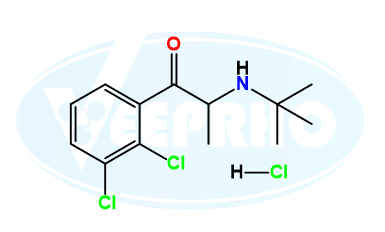 | 2-(tert-butyl amino)-1-(2′,3′-dichloro phenyl) propan-1-one hydrochloride | VE0011092 |
| 2-bromo-2-4-dichloropropiophenone | VE0011100 | |
| 2-Bromo-2′-chloropropiophenone | VE007503 |
Show all related products N-Nitroso Bupropion impurities (2)