
- 100% accuracy of data
- 24/7 scientific support
- 0% tolerance in quality of product
Stock Locations
- New Jersey, USA
- Czech Republic, EU
* Stock subject to availability.
Documentation
Includes: HPLC, MASS/LC-MS, 1H NMR, FT-IR, Potency, Structure Elucidation Report (SER), and additional analytical data depending on the product.
26560-38-3
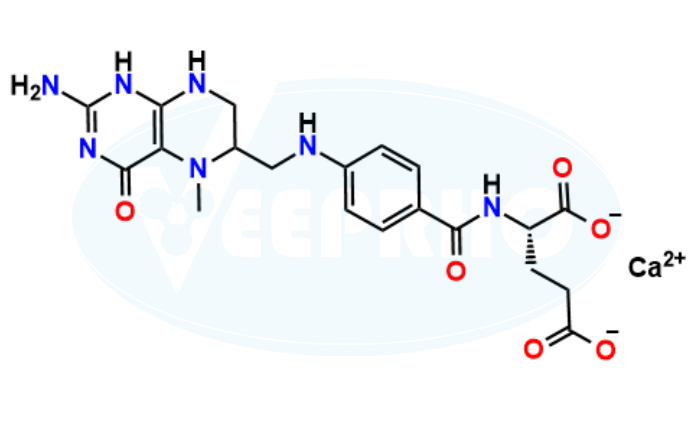
Calcium D,L-5-Methyltetrahydrofolate
● In Stock
| Catalogue No.: | VE0028867 |
|---|---|
| CAS No.: | 26560-38-3 |
| Mol. Formula: | C20H23CaN7O6 |
| Mol. Weight: | 497.52 g/mol |
For laboratory use only: analytical, development and regulatory purposes. Supplied in mg quantities. Not for human or veterinary use.
Request a quote for a set
- Request quote for this set
All USP impurities of Folic Acid
4 productsSee the 4 products
- Calcium D,L-5-Methyltetrahydrofolate VE0028867
CAS 26560-38-3 - Methyltetrahydrofolate Related Compound 4 VE008300
- Methyltetrahydrofolate Related Compound 6 VE008301
- Oxybuprocaine EP Impurity A (Free Base) VL3520007
CAS 150-13-0
- Calcium D,L-5-Methyltetrahydrofolate VE0028867
Additional information on CAS 26560-38-3
| Parent drug | Folic Acid |
|---|---|
| Product type | Impurity standards |
| IUPAC name | N[4-[[(2-Amino-1,4,5,6,7,8-hexahydro-5-methyl-4-oxo-6- pteridinyl)methyl]amino]benzoyl]-L-glutamic acid, calcium salt (1:1) |
| USP name | Calcium D,L-5-Methyltetrahydrofolate |
| SMILES | O=C([O-])CC[C@@H](C([O-])=O)NC(C1=CC=C(NCC2N(C)C3=C(NC(N)=NC3=O)NC2)C=C1)=O.[Ca+2] |
| InChI | InChI=1S/C20H25N7O6.Ca/c1-27-12(9-23-16-15(27)18(31)26-20(21)25-16)8-22-11-4-2-10(3-5-11)17(30)24-13(19(32)33)6-7-14(28)29;/h2-5,12-13,22H,6-9H2,1H3,(H,24,30)(H,28,29)(H,32,33)(H4,21,23,25,26,31);/q;+2/p-2/t12?,13-;/m0./s1 |
| InChIKey | VWBBRFHSPXRJQD-ZEDZUCNESA-L |
| CHNS Ratio (%) (calculated) | C 48.28 · H 4.66 · N 19.71 · S 0.00 |
| Description | Calcium D,L-5-methyltetrahydrofolate (CAS 26560-38-3) is the calcium salt of a reduced pteroylglutamate folate species, chemically classified as a stereoisomeric folate derivative rather than a reactive genotoxic impurity. With formula C20H23CaN7O6 and molecular weight 497.52 g/mol, it represents a labile one-carbon carrier prone to oxidative cleavage, photolysis, and interconversion among folate vitamers during synthesis or storage. Impurity assessment typically requires LC-MS/MS with polarity control and, where degradation profiling is needed, HILIC coupled to high-resolution MS. Quantification is generally supported by UV detection only as a secondary orthogonal approach because structural isomers can coelute. |
Request a Quote
"*" indicates required fields
Other products related to Folic Acid impurities
| Impurity structure | Name of Impurity | Catalogue No. |
|---|---|---|
| Folic Acid EP Impurity B (Free Base) | VE006816 | |
| Folic Acid EP Impurity B (Sulfate Salt) | VL3520002 | |
| Folic Acid EP Impurity C | VL3520003 | |
| Folic Acid EP Impurity D | VL3520004 | |
| Folic Acid EP Impurity E | VL3520005 | |
| Folic Acid EP Impurity F | VL3520006 | |
| Folic Acid EP Impurity G | VE0011870 | |
 | Methyltetrahydrofolate Related Compound 4 | VE008300 |
 | Methyltetrahydrofolate Related Compound 6 | VE008301 |
| Oxybuprocaine EP Impurity A (Free Base) | VL3520007 | |
| (6R)-Mefox | VE0027712 | |
| (6S)-Mefox | VE0027711 |
Show all related products N-Nitroso Folic Acid impurities (3)