
- 100% accuracy of data
- 24/7 scientific support
- 0% tolerance in quality of product
Stock Locations
- New Jersey, USA
- Czech Republic, EU
* Stock subject to availability.
Documentation
Includes: HPLC, MASS/LC-MS, 1H NMR, FT-IR, Potency, Structure Elucidation Report (SER), and additional analytical data depending on the product.
43197-33-7
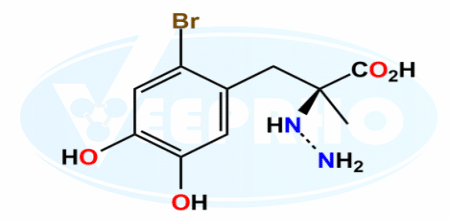
Carbidopa EP Impurity J
● In Stock
| Catalogue No.: | VE006053 |
|---|---|
| CAS No.: | 43197-33-7 |
| Mol. Formula: | C10H13BrN2O4 |
| Mol. Weight: | 305.13 g/mol |
For laboratory use only: analytical, development and regulatory purposes. Supplied in mg quantities. Not for human or veterinary use.
Request a quote for a set
- Request quote for this set
All EP impurities of Carbidopa
10 productsSee the 10 products
- Carbidopa EP Impurity A VL420005
CAS 555-30-6 - Carbidopa EP Impurity B VL420003
CAS 18181-08-3 - Carbidopa EP Impurity C VL420010
CAS 85933-19-3 - Carbidopa EP Impurity C (S)-Isomer VE0013212
CAS 84488-77-7 - Carbidopa EP Impurity E VL420006
CAS 52514-63-3 - Carbidopa EP Impurity F(Free Base) VL420007
CAS 91908-71-3 - Carbidopa EP Impurity H VL420013
CAS 1361017-74-4 - Carbidopa EP Impurity I VE006052
CAS 1246819-09-9 - Carbidopa EP Impurity J VE006053
CAS 43197-33-7 - N-Cyclohexylidene Carbidopa Methyl Ester VL420004
CAS 934371-48-9
- Carbidopa EP Impurity A VL420005
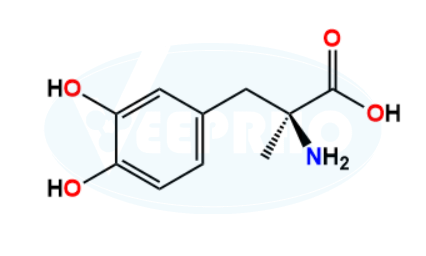

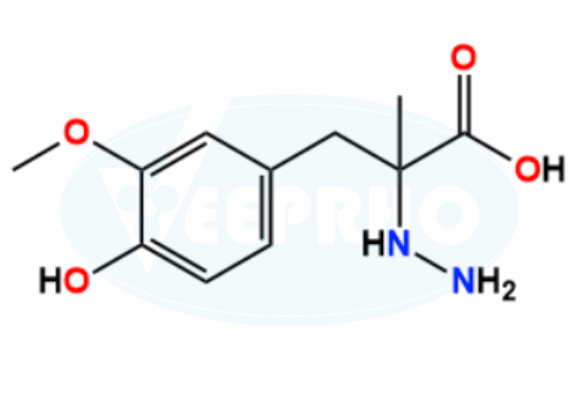
Additional information on CAS 43197-33-7
| Parent drug | Carbidopa |
|---|---|
| Product type | Impurity standards |
| IUPAC name | (2S)-3-(2-Bromo-4,5-dihydroxyphenyl)-2-hydrazino-2-methylpropanoic acid |
| EP name | Carbidopa EP Impurity J |
| SMILES | C[C@@](Cc1cc(O)c(O)cc1Br)(NN)C(=O)O |
| InChIKey | ZIBONFZRHFUWIX-JTQLQIEISA-N |
| CHNS Ratio (%) (calculated) | C 39.36 · H 4.29 · N 9.18 · S 0.00 |
| References | - |
| Description | Carbidopa EP Impurity J, identified as 2-Bromo-(S)-carbidopa, is a halogenated structural analog of the dopa decarboxylase inhibitor carbidopa, bearing bromine substitution on the aromatic nucleus. CAS 43197-33-7; molecular formula C10H13BrN2O4; molecular weight 305.13 g/mol. This impurity may arise as a synthesis-related byproduct during electrophilic bromination or from halogen exchange in upstream intermediates rather than from simple hydrolytic degradation. Owing to its close structural relationship to the active substance, trace-level control is typically addressed by chromatographic methods coupled to LC-MS/MS or high-resolution MS for identity confirmation and quantification. |
Request a Quote
"*" indicates required fields