

- 100% accuracy of data
- 24/7 scientific support
- 0% tolerance in quality of product
Stock Locations
- New Jersey, USA
- Czech Republic, EU
* Stock subject to availability.
Documentation
Includes: HPLC, MASS/LC-MS, 1H NMR, FT-IR, Potency, Structure Elucidation Report (SER), and additional analytical data depending on the product.
51997-51-4
Carvedilol Related Compound D
● In Stock
| Catalogue No.: | VL35002 |
|---|---|
| CAS No.: | 51997-51-4 |
| Mol. Formula: | C15H13NO2 |
| Mol. Weight: | 239.27 g/mol |
For laboratory use only: analytical, development and regulatory purposes. Supplied in mg quantities. Not for human or veterinary use.
Request a quote for a set
- Request quote for this set
All EP impurities of Carvedilol
8 productsSee the 8 products
- Carvedilol EP Impurity A VL35007
CAS 1198090-73-1 - Carvedilol EP Impurity B VL35005
CAS 918903-20-5 - Carvedilol EP Impurity C VL35003
CAS 72955-94-3 - Carvedilol EP Impurity D VE008077
CAS 1391052-16-6 - Carvedilol EP Impurity E (Free Base) VE006671
CAS 64464-07-9 - Carvedilol EP Impurity E (HCl Salt) VL35001
CAS 64464-07-9 - Carvedilol Related Compound D VL35002
CAS 51997-51-4 - Nitroso Carvedilol EP Impurity D VE007932
- Carvedilol EP Impurity A VL35007
- Request quote for this set
All USP impurities of Carvedilol
11 productsSee the 11 products
- Carvedilol Bisalkyl Pyro-Catechol Derivative VL35006
CAS 1346602-98-9 - Carvedilol EP Impurity A VL35007
CAS 1198090-73-1 - Carvedilol EP Impurity B VL35005
CAS 918903-20-5 - Carvedilol EP Impurity C VL35003
CAS 72955-94-3 - Carvedilol EP Impurity E (Free Base) VE006671
CAS 64464-07-9 - Carvedilol EP Impurity E (HCl Salt) VL35001
CAS 64464-07-9 - Carvedilol Impurity H VE0010955
- Carvedilol Related Compound D VL35002
CAS 51997-51-4 - Carvedilol Related Compound E (HCl Salt) (Monohydrate salt) VE0020353
CAS 2057412-43-6 - N-Isopropyl Carvedilol VL35010
CAS 1246819-01-1 - Nitroso Carvedilol EP Impurity D VE007932
- Carvedilol Bisalkyl Pyro-Catechol Derivative VL35006
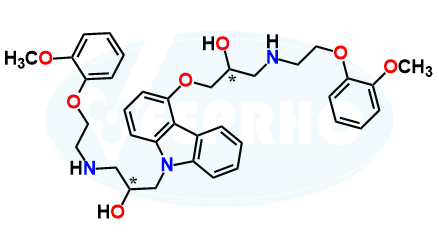


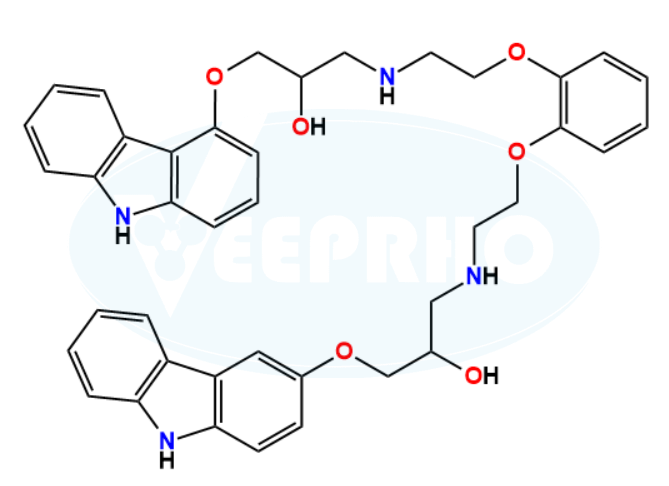
Additional information on CAS 51997-51-4
| Parent drug | Carvedilol |
|---|---|
| Product type | Impurity standards |
| IUPAC name | (4-(Oxiran-2-ylmethoxy)-9H-carbazole). |
| EP name | Carvedilol EP Impurity D |
| USP name | Carvedilol Related Compound D |
| Other Synonyms | 4-Oxiranylmethoxy-9H-carbazole; 4-(Oxiranylmethoxy)-9H-carbazole |
| SMILES | C1(NC2=C3C=CC=C2)=C3C(OCC4OC4)=CC=C1 |
| InChI | InChI=1S/C15H13NO2/c1-2-5-12-11(4-1)15-13(16-12)6-3-7-14(15)18-9-10-8-17-10/h1-7,10,16H,8-9H2 |
| InChIKey | SVWKIGRDISDRLO-UHFFFAOYSA-N |
| CHNS Ratio (%) (calculated) | C 75.30 · H 5.48 · N 5.85 · S 0.00 |
| References | Carvedilol: MedlinePlus Drug Information. Medlineplus.gov | Jan. 2022 | medlineplus.gov/druginfo/meds/a697042.html. |
| Description | Carvedilol Related Compound D, CAS 51997-51-4, is a structurally defined process-related impurity of the carbazole ether series, identified as 4-(oxiranylmethoxy)-9H-carbazole (4-oxiranylmethoxy-9H-carbazole). With molecular formula C15H13NO2 and molecular weight 239.27 g/mol, it contains an epoxide functional group that is chemically reactive and may arise from synthetic epoxidation or incomplete conversion of glycidyl intermediates during carvedilol manufacture. Its characterization typically requires orthogonal analysis by LC-MS/MS, high-resolution mass spectrometry, and chiral or achiral HPLC, with confirmatory NMR when needed. Because epoxide-bearing impurities can be associated with alkylating potential, assessment under impurity control and genotoxic risk frameworks is scientifically relevant. |
Request a Quote
"*" indicates required fields