
- 100% accuracy of data
- 24/7 scientific support
- 0% tolerance in quality of product
Mutagenicity assessment (ICH M7)
Treated as a potentially non-mutagenic impurity (ICH M7 Class 4–5).
Computational (in silico) assessmentStock Locations
- New Jersey, USA
- Czech Republic, EU
* Stock subject to availability.
Documentation
Includes: HPLC, MASS/LC-MS, 1H NMR, FT-IR, Potency, Structure Elucidation Report (SER), and additional analytical data depending on the product.
62084-35-9
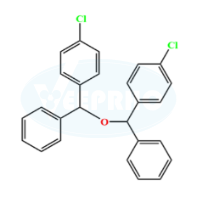
Cetirizine Impurity 29
● In Stock
| Catalogue No.: | VE0029127 |
|---|---|
| CAS No.: | 62084-35-9 |
| Mol. Formula: | C26H20Cl2O |
| Mol. Weight: | 419.34 g/mol |
For laboratory use only: analytical, development and regulatory purposes. Supplied in mg quantities. Not for human or veterinary use.
Additional information on CAS 62084-35-9
| Parent drug | Cetirizine |
|---|---|
| Product type | Impurity standards |
| IUPAC name | 4,4'-(oxybis(phenylmethylene))bis(chlorobenzene) |
| SMILES | ClC1=CC=C(C(OC(C2=CC=C(Cl)C=C2)C3=CC=CC=C3)C4=CC=CC=C4)C=C1 |
| InChI | InChI=1S/C26H20Cl2O/c27-23-15-11-21(12-16-23)25(19-7-3-1-4-8-19)29-26(20-9-5-2-6-10-20)22-13-17-24(28)18-14-22/h1-18,25-26H |
| InChIKey | QOOXFDNFHZHMET-UHFFFAOYSA-N |
| CHNS Ratio (%) (calculated) | C 74.47 · H 4.81 · N 0.00 · S 0.00 |
| Description | Cetirizine Impurity 29 (CAS 62084-35-9) is a structurally defined process-related impurity associated with cetirizine chemistry, consisting of a chlorinated aromatic ether framework with molecular formula C26H20Cl2O and molecular weight 419.34 g/mol. Its occurrence is typically traced to synthetic route variability, arylation side reactions, or incomplete control of substitution patterns during precursor assembly. Because minor structurally related impurities may affect assay specificity and safety qualification, characterization generally requires orthogonal methods such as LC-MS/MS, high-resolution LC-MS, and NMR spectroscopy, with UV detection alone often insufficient for definitive assignment. |
Request a Quote
"*" indicates required fields
Other products related to Cetirizine impurities
| Impurity structure | Name of Impurity | Catalogue No. |
|---|---|---|
| Cetirizine EP Impurity A | VL330001 | |
| Cetirizine EP Impurity B (Free Base) | VE006643 | |
| Cetirizine EP Impurity B (HCl Salt) | VL330002 | |
| Cetirizine EP Impurity C (2HCl Salt) | VL330003 | |
| Cetirizine EP Impurity D | VE005989 | |
 | Cetirizine EP Impurity D Dihydrochloride | VL330004 |
| Cetirizine EP Impurity E (Dihydrochloride Salt) | VE005990 | |
| Cetirizine EP Impurity E (Free Base) | VL330005 | |
| Cetirizine EP Impurity F (Free Base) | VE006644 | |
| Cetirizine EP Impurity F (HCl Salt) | VL330006 | |
| Cetirizine EP Impurity G (2HCl salt) | VL330007 | |
| Cetirizine EP Impurity G (Free Base) | VE006557 |
Show all related products N-Nitroso Cetirizine impurities (2)