

- 100% accuracy of data
- 24/7 scientific support
- 0% tolerance in quality of product
Stock Locations
- New Jersey, USA
- Czech Republic, EUIn stock
* Stock subject to availability.
Documentation
Includes: HPLC, MASS/LC-MS, 1H NMR, FT-IR, Potency, Structure Elucidation Report (SER), and additional analytical data depending on the product.
1396607-49-0
Clopidogrel Impurity 2
● In Stock
| Catalogue No.: | VL31013 |
|---|---|
| CAS No.: | 1396607-49-0 |
| Mol. Formula: | C16H15BrClNO2S |
| Mol. Weight: | 400.72 g/mol |
For laboratory use only: analytical, development and regulatory purposes. Supplied in mg quantities. Not for human or veterinary use.
Additional information on CAS 1396607-49-0
| Parent drug | Clopidogrel |
|---|---|
| Product type | Impurity standards |
| IUPAC name | 5-[1-(2-Chlorophenyl)-2-methoxy-2-oxoethyl]-6, 7-dihydrothieno[3, 2-c]pyridiniumBromide |
| SMILES | COC(=O)C(c1ccccc1Cl)[N+]1=Cc2ccsc2CC1.[Br-] |
| InChIKey | KEWLMQVQNGJIKW-UHFFFAOYSA-M |
| CHNS Ratio (%) (calculated) | C 47.96 · H 3.77 · N 3.50 · S 8.00 |
| References | Jain | Deepti | and Pawan Kumar Basniwal. “Forced Degradation and Impurity Profiling: Recent Trends in Analytical Perspectives.” Journal of Pharmaceutical and Biomedical Analysis | vol. 86 | Dec. 2013 | pp. 11–35 | https://doi.org/10.1016/j.jpba.2013.07.013. |
| Description | Clopidogrel Pyridinium Bromide, also designated Clopidogrel Impurity 2, is a quaternary pyridinium salt associated with the synthetic chemistry of clopidogrel and may arise as a process-related byproduct during pyridine alkylation or halide exchange steps. Its composition, C16H15BrClNO2S, with molecular weight 400.72 g/mol and CAS 1396607-49-0, reflects a bromide-associated cationic impurity distinct from the parent thienopyridine prodrug. Because ionic impurities of this type can persist through crystallization and salt formation, characterization commonly relies on LC-MS/MS, high-resolution LC-MS, and ion-pair or reversed-phase HPLC with UV detection. Regulatory assessment should consider impurity profile control under ICH Q3A/Q3B, with structural review for potential genotoxic concern. |
Request a Quote
"*" indicates required fields
Other products related to Clopidogrel impurities
| Impurity structure | Name of Impurity | Catalogue No. |
|---|---|---|
| Clopidogrel EP Impurity A | VL31007 | |
| Clopidogrel EP Impurity A (HCl salt) | VL31003 | |
| Clopidogrel EP Impurity B | VL31002 | |
| Clopidogrel EP Impurity C | VL31004 | |
| Clopidogrel EP Impurity C (Free Base) | VE0021266 | |
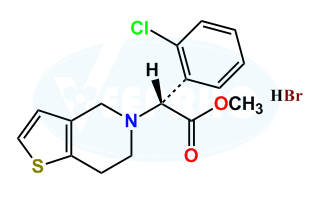 | Clopidogrel EP Impurity C (Hydrobromide Salt) | VE0021267 |
| Clopidogrel EP Impurity D | VL31011 | |
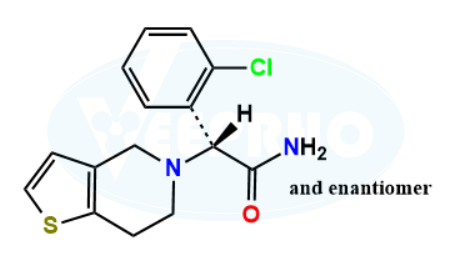 | Clopidogrel EP Impurity E | VE0011532 |
| Clopidogrel EP Impurity E | VE0013633 | |
 | Clopidogrel EP Impurity F (Bisulpate) | VE006553 |
| Clopidogrel EP Impurity F (Free Base) | VE0021265 | |
| Clopidogrel Related Compound B (HCl Salt) | VL31009 |
Show all related products N-Nitroso Clopidogrel impurities (2)