
- 100% accuracy of data
- 24/7 scientific support
- 0% tolerance in quality of product
Stock Locations
- New Jersey, USA
- Czech Republic, EU
* Stock subject to availability.
Documentation
Includes: HPLC, MASS/LC-MS, 1H NMR, FT-IR, Potency, Structure Elucidation Report (SER), and additional analytical data depending on the product.
1297537-37-1
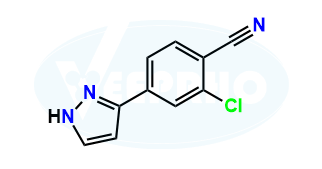
Darolutamide Pyrazol Benzonitrile Impurity
● In Stock
| Catalogue No.: | VE0023418 |
|---|---|
| CAS No.: | 1297537-37-1 |
| Mol. Formula: | C10H6ClN3 |
| Mol. Weight: | 203.6 g/mol |
For laboratory use only: analytical, development and regulatory purposes. Supplied in mg quantities. Not for human or veterinary use.
Packs and prices
| Pack | Price | Qty |
|---|---|---|
| 100 mg | USD 129.00 |
Prices shown are valid for issuing a purchase order.
Prices are subject to change depending on compound availability and the cost of synthesis based on current raw material costs. Veeprho reserves the right to change prices without notice.
Need another pack size or quantity? Request a custom quoteHow can we help?
Additional information on CAS 1297537-37-1
| Parent drug | Darolutamide |
|---|---|
| Product type | Impurity standards |
| IUPAC name | 2-Chloro-4(1H-pyrazol-3-yl) benzonitrile |
| Other Synonyms | 2-Chloro-4-(1H-pyrazol-3-yl)benzonitrile; 2-Chloro-4-(3-pyrazolyl)benzonitrile |
| SMILES | N#CC1=CC=C(C2=NNC=C2)C=C1Cl |
| InChI | InChI=1S/C10H6ClN3/c11-9-5-7(1-2-8(9)6-12)10-3-4-13-14-10/h1-5H, (H, 13, 14) |
| InChIKey | BCINLNFBTLIGBU-UHFFFAOYSA-N |
| CHNS Ratio (%) (calculated) | C 58.98 · H 2.97 · N 20.64 · S 0.00 |
| Shipping condition | Ambient Temperature |
| Description | Darolutamide Pyrazol Benzonitrile Impurity, CAS 1297537-37-1, is a heteroaromatic process-related impurity corresponding to 2-chloro-4-(1H-pyrazol-3-yl)benzonitrile, also described as 2-chloro-4-(3-pyrazolyl)benzonitrile. With molecular formula C10H6ClN3 and molecular weight 203.6 g/mol, it contains a chlorobenzonitrile core linked to a pyrazole ring, a structural motif consistent with coupling or cyclization byproducts in darolutamide-related synthesis. Its aromatic and heterocyclic character generally favors LC-MS/MS and LC-UV characterization, while confirmatory profiling may require HRMS or GC-MS after derivatization. As a low-molecular-weight impurity, it should be considered in impurity mapping and control strategies under ICH Q3A and, where structure alerts apply, ICH M7. |
Request a Quote
"*" indicates required fields