
- 100% accuracy of data
- 24/7 scientific support
- 0% tolerance in quality of product
Stock Locations
- New Jersey, USA
- Czech Republic, EU
* Stock subject to availability.
Documentation
Includes: HPLC, MASS/LC-MS, 1H NMR, FT-IR, Potency, Structure Elucidation Report (SER), and additional analytical data depending on the product.
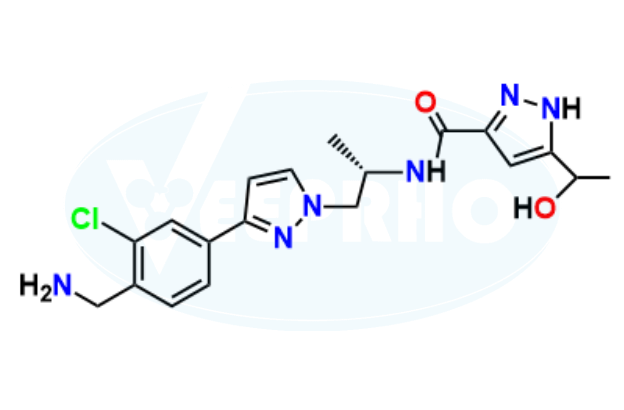
N-((S)-1-(3-(4-(aminomethyl)-3-chlorophenyl)-1H-pyrazol-1-yl)propan-2-yl)-5-(1-hydroxyethyl)-1H-pyrazole-3-carboxamide
● In Stock
| Catalogue No.: | VE0028480 |
|---|---|
| CAS No.: | N/A |
| Mol. Formula: | C19H23ClN6O2 |
| Mol. Weight: | 402.88 g/mol |
For laboratory use only: analytical, development and regulatory purposes. Supplied in mg quantities. Not for human or veterinary use.
Additional information on N-((S)-1-(3-(4-(aminomethyl)-3-chlorophenyl)-1H-pyrazol-1-yl)propan-2-yl)-5-(1-hydroxyethyl)-1H-pyrazole-3-carboxamide
| Parent drug | Darolutamide |
|---|---|
| Product type | Impurity standards |
| IUPAC name | N-((S)-1-(3-(4-(aminomethyl)-3-chlorophenyl)-1H-pyrazol-1-yl)propan-2-yl)-5-(1-hydroxyethyl)-1H-pyrazole-3-carboxamide |
| SMILES | NCC1=C(Cl)C=C(C2=NN(C[C@H](C)NC(C3=NNC(C(C)O)=C3)=O)C=C2)C=C1 |
| InChI | InChI=1S/C19H23ClN6O2/c1-11(22-19(28)18-8-17(12(2)27)23-24-18)10-26-6-5-16(25-26)13-3-4-14(9-21)15(20)7-13/h3-8,11-12,27H,9-10,21H2,1-2H3,(H,22,28)(H,23,24)/t11-,12?/m0/s1 |
| InChIKey | HGNKEGHAJBJMFF-PXYINDEMSA-N |
| CHNS Ratio (%) (calculated) | C 56.64 · H 5.75 · N 20.86 · S 0.00 |
| Description | N-((S)-1-(3-(4-(aminomethyl)-3-chlorophenyl)-1H-pyrazol-1-yl)propan-2-yl)-5-(1-hydroxyethyl)-1H-pyrazole-3-carboxamide is a structurally defined process-related impurity of the pyrazole carboxamide class, consistent with a side-chain or intermediate-derived analogue arising during route-dependent synthesis, partial deprotection, or regiochemical carryover. Its molecular formula is C19H23ClN6O2 and molecular weight 402.88 g/mol. The aminomethyl chlorophenyl motif and dual pyrazole scaffold confer polarity, basicity, and multiple ionization states, which can complicate chromatographic resolution. Trace-level characterization typically relies on LC-MS/MS, high-resolution mass spectrometry, and, where needed, LC-UV with orthogonal impurity profiling. Because this impurity is structurally related to an active pharmaceutical intermediate, toxicological relevance should be assessed within ICH M7 principles. |
Request a Quote
"*" indicates required fields