
- 100% accuracy of data
- 24/7 scientific support
- 0% tolerance in quality of product
Stock Locations
- New Jersey, USA
- Czech Republic, EU
* Stock subject to availability.
Documentation
Includes: HPLC, MASS/LC-MS, 1H NMR, FT-IR, Potency, Structure Elucidation Report (SER), and additional analytical data depending on the product.
910297-52-8
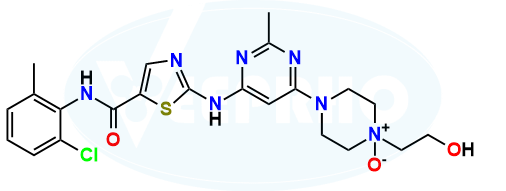
Dasatinib N-Oxide
● In Stock
| Catalogue No.: | VL4870001 |
|---|---|
| CAS No.: | 910297-52-8 |
| Mol. Formula: | C22H26ClN7O3S |
| Mol. Weight: | 504.00 g/mol |
For laboratory use only: analytical, development and regulatory purposes. Supplied in mg quantities. Not for human or veterinary use.
Request a quote for a set
- Request quote for this set
All USP impurities of Dasatinib
2 productsSee the 2 products
- Dasatinib Dehydroxy Ethyl Impurity VE009762
CAS 910297-51-7 - Dasatinib N-Oxide VL4870001
CAS 910297-52-8
- Dasatinib Dehydroxy Ethyl Impurity VE009762

Additional information on CAS 910297-52-8
| Parent drug | Dasatinib |
|---|---|
| Product type | Impurity standards |
| IUPAC name | 4-(6-((5-((2-chloro-6-methylphenyl)carbamoyl)thiazol-2-yl)amino)-2-methylpyrimidin-4-yl)-1-(2-hydroxyethyl)piperazine 1-oxide |
| USP name | Dasatinib Related Compound A |
| SMILES | Cc1nc(Nc2ncc(C(=O)Nc3c(C)cccc3Cl)s2)cc(N2CC[N+]([O-])(CCO)CC2)n1 |
| InChIKey | UEFNEEZCTQCRAW-UHFFFAOYSA-N |
| CHNS Ratio (%) (calculated) | C 52.43 · H 5.20 · N 19.45 · S 6.36 |
| References | Christopher | Lisa J. | et al. “Metabolism and Disposition of Dasatinib after Oral Administration to Humans.†Drug Metabolism and Disposition | vol. 36 | no. 7 | Apr. 2008 | pp. 1357–64 | https://doi.org/10.1124/dmd.107.018267.?McCormack | Paul L. | and Susan J. Keam. “Dasatinib.†Drugs | vol. 71 | no. 13 | Sept. 2011 | pp. 1771–95 | https://doi.org/10.2165/11207580-000000000-00000. |
| Description | Dasatinib N-oxide, also designated Dasatinib Related Compound A, is an oxidized process- and degradation-related impurity of the tyrosine kinase inhibitor dasatinib (CAS 910297-52-8). With molecular formula C22H26ClN7O3S and molecular weight 504.00 g/mol, it reflects oxygen insertion at the amine center, typically arising under oxidative stress during synthesis, storage, or formulation handling. The structure is monitored by LC-MS/MS and LC-UV, with confirmatory characterization by HRMS and NMR when needed. Although not a nitrosamine, its presence is relevant to impurity profiling and stability-indicating methods under ICH Q3A/Q3B expectations. |
Request a Quote
"*" indicates required fields
Other products related to Dasatinib impurities
| Impurity structure | Name of Impurity | Catalogue No. |
|---|---|---|
| 2-[4-(6-Chloro-2-methylpyrimidin-4-yl)piperazin-1-yl]ethanol | VE0022857 | |
| 2-Deschloro-2-Hydroxy Dasatinib | VE0014218 | |
| Dasatinib Carboxylic Acid | VE0014221 | |
| Dasatinib Dehydroxy Ethyl Impurity | VE009762 | |
| Dasatinib Dimer Impurity | VE0014217 | |
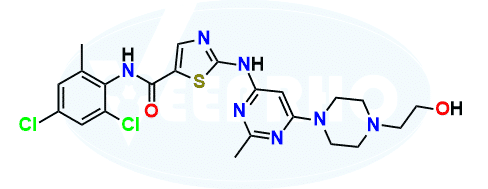 | Dasatinib Impurity 1 | VE0014226 |
| Dasatinib Impurity 2 | VE0014227 | |
| Dasatinib Impurity 3 | VE0014229 | |
| Dasatinib Impurity 5 | VE0014207 | |
| Dasatinib Impurity 6 | VE0014209 | |
| Dasatinib Impurity 7 | VE0014210 | |
| Dasatinib Impurity 13 | VE0014219 |