

- 100% accuracy of data
- 24/7 scientific support
- 0% tolerance in quality of product
Stock Locations
- New Jersey, USA
- Czech Republic, EU
* Stock subject to availability.
Documentation
Includes: HPLC, MASS/LC-MS, 1H NMR, FT-IR, Potency, Structure Elucidation Report (SER), and additional analytical data depending on the product.
86347-12-8
Hydroxymedetomidine
● In Stock
| Catalogue No.: | VL520001 |
|---|---|
| CAS No.: | 86347-12-8 |
| Mol. Formula: | C13H16N2O |
| Mol. Weight: | 216.28 g/mol |
For laboratory use only: analytical, development and regulatory purposes. Supplied in mg quantities. Not for human or veterinary use.
Request a quote for a set
- Request quote for this set
All USP impurities of Dexmedetomidine
7 productsSee the 7 products
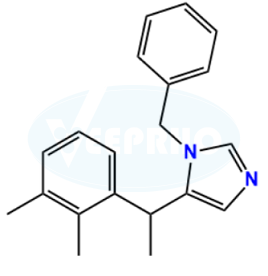
- Dexmedetomidine Impurity 2 VL520002
CAS 2250243-44-6 - Dexmedetomidine Impurity 3 VL520003
CAS 2250243-24-2 - Dexmedetomidine Impurity 4 VL520004
CAS 2250242-52-3 - Dexmedetomidine Impurity 5 VL520005
CAS 2250243-56-0 - Dexmedetomidine Ketone Impurity VL520008
CAS 91874-85-0 - Dexmedetomidine Related Compound B VE0017330
CAS 1021949-47-2 - Hydroxymedetomidine VL520001
CAS 86347-12-8
- Dexmedetomidine Impurity 2 VL520002


Additional information on CAS 86347-12-8
| Parent drug | Dexmedetomidine |
|---|---|
| Product type | Impurity standards |
| IUPAC name | 1-(2, 3-dimethylphenyl)-1-(1H-imidazol-5-yl)ethanol |
| USP name | Hydroxymedetomidine |
| Other Synonyms | Dexmedetomidine Impurity 1 |
| SMILES | CC(C1=CC=CC(C)=C1C)(O)C2=CN=CN2 |
| InChI | InChI=1S/C13H16N2O/c1-9-5-4-6-11(10(9)2)13(3,16)12-7-14-8-15-12/h4-8,16H,1-3H3,(H,14,15) |
| InChIKey | LBUFLYABQRDXQB-UHFFFAOYSA-N |
| CHNS Ratio (%) (calculated) | C 72.19 · H 7.46 · N 12.95 · S 0.00 |
| References | - |
| Description | Hydroxymedetomidine, designated Dexmedetomidine Impurity 1 (CAS 86347-12-8), is a primary oxidative and hydrolytic degradation product encountered during synthesis and stability of dexmedetomidine drug substance. Characterized by altered polarity and a hydroxylated imidazole side chain, it is routinely monitored by reversed-phase HPLC with UV detection and confirmed by LC-MS and proton NMR for mass and structural assignment. Its presence can affect assay accuracy and impurity profile compliance therefore tight specification setting and forced-degradation studies are recommended. Analytical method development should prioritize sensitivity and selectivity to meet ICH guidelines. Accurate quantitation supports impurity profiling, control strategy development, and stability-indicating method validation for regulatory submissions and quality assurance. |
Request a Quote
"*" indicates required fields
Other products related to Dexmedetomidine impurities
| Impurity structure | Name of Impurity | Catalogue No. |
|---|---|---|
| Dexmedetomidine Related Compound B | VE0017330 | |
| (S)-4-(1-(2,3-dimethylphenyl)ethyl)-1H-imidazole-2(3H)-thione | VE0017298 | |
| 3-Carboxy Detomidine | VE0020730 | |
| Dexmedetomidine Hydroxyphenyl Acetic Acid | VL520011 | |
| Dexmedetomidine Impurity 2 | VL520002 | |
| Dexmedetomidine Impurity 3 | VL520003 | |
| Dexmedetomidine Impurity 4 | VL520004 | |
| Dexmedetomidine Impurity 5 | VL520005 | |
 | Dexmedetomidine Impurity 6 | VL520006 |
| Dexmedetomidine Ketone Impurity | VL520008 | |
 | Dexmedetomidine Olefine Impurity | VL520009 |
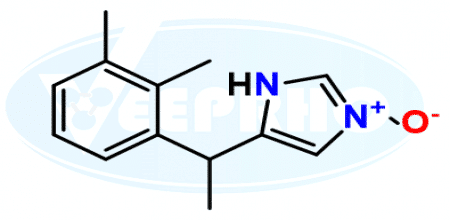 | Dexmedetomidine Oxide Impurity | VL520012 |