
- 100% accuracy of data
- 24/7 scientific support
- 0% tolerance in quality of product
Mutagenicity assessment (ICH M7)
Treated as a potentially non-mutagenic impurity (ICH M7 Class 4–5).
Computational (in silico) assessmentStock Locations
- New Jersey, USA
- Czech Republic, EU
* Stock subject to availability.
Documentation
Includes: HPLC, MASS/LC-MS, 1H NMR, FT-IR, Potency, Structure Elucidation Report (SER), and additional analytical data depending on the product.
141942-85-0
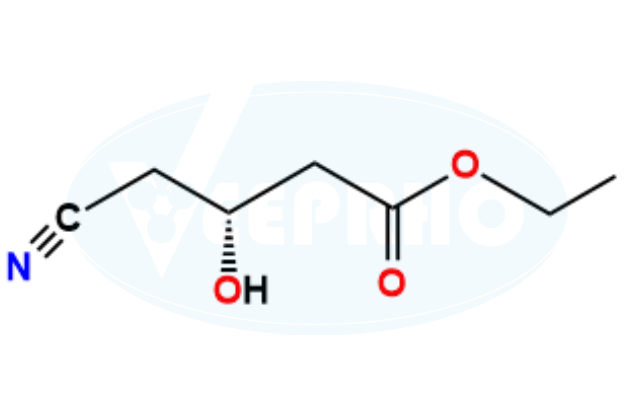
Ethyl (3R)-4-cyano-3-hydroxybutanoate
● In Stock
| Catalogue No.: | VE0026739 |
|---|---|
| CAS No.: | 141942-85-0 |
| Mol. Formula: | C7H11NO3 |
| Mol. Weight: | 157.17 g/mol |
For laboratory use only: analytical, development and regulatory purposes. Supplied in mg quantities. Not for human or veterinary use.
Additional information on CAS 141942-85-0
| Parent drug | Atorvastatin |
|---|---|
| Product type | Impurity standards |
| IUPAC name | Ethyl (3R)-4-cyano-3-hydroxybutanoate |
| SMILES | O=C(OCC)C[C@H](O)CC#N |
| InChI | InChI=1S/C7H11NO3/c1-2-11-7(10)5-6(9)3-4-8/h6,9H,2-3,5H2,1H3/t6-/m1/s1 |
| InChIKey | LOQFROBMBSKWQY-ZCFIWIBFSA-N |
| CHNS Ratio (%) (calculated) | C 53.49 · H 7.05 · N 8.91 · S 0.00 |
| Description | Ethyl (3R)-4-cyano-3-hydroxybutanoate (CAS 141942-85-0) presents as a polar chiral impurity arising from incomplete stereoselective synthesis or partial hydrolysis of corresponding esters. Characterization requires orthogonal methods such as chiral HPLC for enantiomeric excess, high resolution mass spectrometry for exact mass confirmation, and 1H and 13C NMR for stereochemical assignment and impurity profiling. It may affect downstream yield and catalytic performance and can increase impurity load through dehydration or cyanide migration under acidic or basic conditions. Routine control strategies include specification limits, stability-indicating HPLC methods, and forced-degradation studies to define acceptable limits in final API intermediates. |
Request a Quote
"*" indicates required fields
Other products related to Atorvastatin impurities
| Impurity structure | Name of Impurity | Catalogue No. |
|---|---|---|
| Atorvastatin EP Impurity A | VE008745 | |
| Atorvastatin EP Impurity A (Ca salt) | VL10004 | |
 | Atorvastatin EP Impurity A (Na Salt) | VE0020562 |
| Atorvastatin EP Impurity B (Free Base) | VE009319 | |
| Atorvastatin EP Impurity C | VE008906 | |
 | Atorvastatin EP Impurity C (Na Salt) | VE0012975 |
| Atorvastatin EP Impurity D (Impurity D1) | VL10003 | |
 | Atorvastatin EP Impurity D (Mixture of D1 & D2) | VE0022694 |
| Atorvastatin EP Impurity E (Ca Salt) | VL10006 | |
| Atorvastatin EP Impurity E (Free Base) | VE0012984 | |
| Atorvastatin EP Impurity E (Na Salt) | VE009244 | |
| Atorvastatin EP Impurity F (Ca Salt) | VL10011 |
Show all related products N-Nitroso Atorvastatin impurities (14)