

- 100% accuracy of data
- 24/7 scientific support
- 0% tolerance in quality of product
Stock Locations
- New Jersey, USA
- Czech Republic, EUIn stock
* Stock subject to availability.
Documentation
Includes: HPLC, MASS/LC-MS, 1H NMR, FT-IR, Potency, Structure Elucidation Report (SER), and additional analytical data depending on the product.
115066-03-0
Etodolac EP Impurity J
● In Stock
| Catalogue No.: | VL2000010 |
|---|---|
| CAS No.: | 115066-03-0 |
| Mol. Formula: | C16H21NO |
| Mol. Weight: | 243.34 g/mol |
For laboratory use only: analytical, development and regulatory purposes. Supplied in mg quantities. Not for human or veterinary use.
Request a quote for a set
- Request quote for this set
All EP impurities of Etodolac
11 productsSee the 11 products
- Etodolac EP Impurity A VL2000007
CAS 41339-67-7 - Etodolac EP Impurity B VL2000005
CAS 41340-19-6 - Etodolac EP Impurity C (Free Base) VL2000008
CAS 109518-50-5 - Etodolac EP Impurity D VL2000001
CAS 57917-63-2 - Etodolac EP Impurity E VL2000002
CAS 57817-27-3 - Etodolac EP Impurity F VL2000003
CAS 849630-65-5 - Etodolac EP Impurity G VL2000004
CAS 57816-83-8 - Etodolac EP Impurity H VL2000009
CAS 41340-36-7 - Etodolac EP Impurity I VE009267
- Etodolac EP Impurity J VL2000010
CAS 115066-03-0 - Etodolac EP Impurity K VL2000011
CAS 122188-02-7
- Etodolac EP Impurity A VL2000007

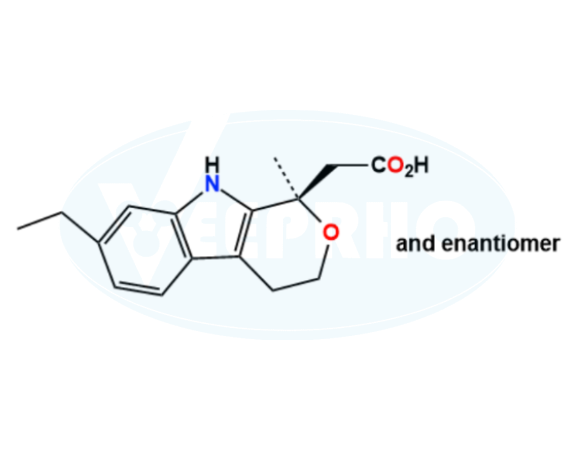
Additional information on CAS 115066-03-0
| Parent drug | Etodolac |
|---|---|
| Product type | Impurity standards |
| IUPAC name | 1,8-Diethyl-1,3,4,9-tetrahydro-1-methyl-pyrano[3,4-b]indole |
| EP name | Etodolac EP Impurity J |
| SMILES | CCc1cccc2c3c([nH]c12)C(C)(CC)OCC3 |
| InChIKey | IYMCQNNWNNRAQH-UHFFFAOYSA-N |
| CHNS Ratio (%) (calculated) | C 78.97 · H 8.70 · N 5.76 · S 0.00 |
| References | - |
| Description | Etodolac EP Impurity J, also known as decarboxy etodolac, CAS 115066-03-0, is a related substance arising from decarboxylative degradation of the pyranocarboxylic acid scaffold of etodolac. This neutral heteroaromatic impurity has molecular formula C16H21NO and molecular weight 243.34 g/mol. Its formation is typically associated with thermal stress, acidic or prolonged storage conditions, and process-related transformation of the parent drug. Because low-level occurrence may confound impurity profiling, characterization generally requires LC-MS/MS, LC-HRMS, and orthogonal HPLC with UV detection. The structure is not classically genotoxic, but its control supports pharmacopoeial specification setting and stability-indicating assessment. |
Request a Quote
"*" indicates required fields
Other products related to Etodolac impurities
| Impurity structure | Name of Impurity | Catalogue No. |
|---|---|---|
 | Etodolac EP Impurity A | VL2000007 |
| Etodolac EP Impurity B | VL2000005 | |
| Etodolac EP Impurity C (Free Base) | VL2000008 | |
| Etodolac EP Impurity D | VL2000001 | |
| Etodolac EP Impurity E | VL2000002 | |
| Etodolac EP Impurity F | VL2000003 | |
| Etodolac EP Impurity G | VL2000004 | |
 | Etodolac EP Impurity H | VL2000009 |
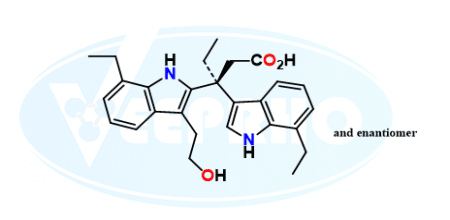 | Etodolac EP Impurity I | VE009267 |
| Etodolac EP Impurity K | VL2000011 | |
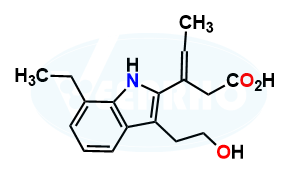 | Etodolac EP Impurity L (Free Base) | VE0025644 |
| 1-(1,8-diethyl-9-nitroso-1,3,4,9-tetrahydropyrano[3,4-b]indol-1-yl)propan-2-one | VE0023845 |