
- 100% accuracy of data
- 24/7 scientific support
- 0% tolerance in quality of product
Stock Locations
- New Jersey, USA
- Czech Republic, EU
* Stock subject to availability.
Documentation
Includes: HPLC, MASS/LC-MS, 1H NMR, FT-IR, Potency, Structure Elucidation Report (SER), and additional analytical data depending on the product.
2200281-00-9
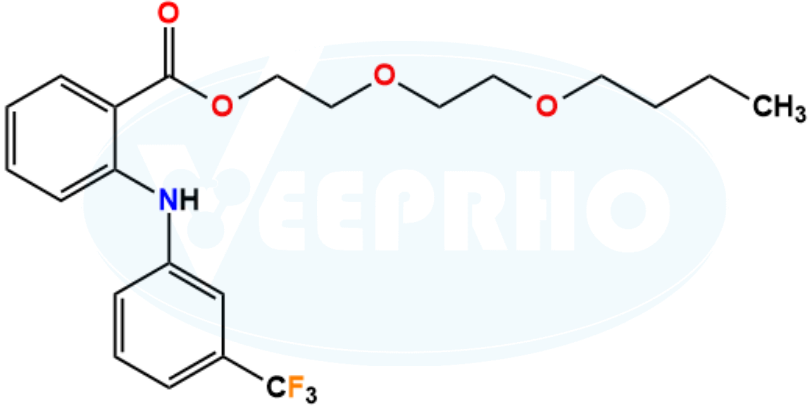
Etofenamate EP Impurity E (Free Base)
● In Stock
| Catalogue No.: | VE0025790 |
|---|---|
| CAS No.: | 2200281-00-9 |
| Mol. Formula: | C22H26F3NO4 |
| Mol. Weight: | 425.44 g/mol |
For laboratory use only: analytical, development and regulatory purposes. Supplied in mg quantities. Not for human or veterinary use.
Request a quote for a set
- Request quote for this set
All EP impurities of Etofenamate
7 productsSee the 7 products
- Etofenamate EP Impurity A (Free Base) VE0025787
CAS 530-78-9 - Etofenamate EP Impurity B VE0020070
CAS 67330-25-0 - Etofenamate EP Impurity C (Free Base) VE0025788
CAS 101-23-5 - Etofenamate EP Impurity D (Free Base) VE0025789
CAS 64352-84-7 - Etofenamate EP Impurity E (Free Base) VE0025790
CAS 2200281-00-9 - Etofenamate EP Impurity F VE0018044
CAS 111-46-6 - Etofenamate EP Impurity G VE0022423
CAS 32508-98-8
- Etofenamate EP Impurity A (Free Base) VE0025787


Additional information on CAS 2200281-00-9
| Parent drug | Etofenamate |
|---|---|
| Product type | Impurity standards |
| IUPAC name | 2-(2-Butoxyethoxy)ethyl 2-[[3-(trifluoromethyl)phenyl]amino]benzoate |
| EP name | Etofenamate EP Impurity E |
| SMILES | O=C(C1=CC=CC=C1NC2=CC(C(F)(F)F)=CC=C2)OCCOCCOCCCC |
| InChI | InChI=1S/C22H26F3NO4/c1-2-3-11-28-12-13-29-14-15-30-21(27)19-9-4-5-10-20(19)26-18-8-6-7-17(16-18)22(23,24)25/h4-10,16,26H,2-3,11-15H2,1H3 |
| InChIKey | BYJRRSFVIXWYCK-UHFFFAOYSA-N |
| CHNS Ratio (%) (calculated) | C 62.11 · H 6.16 · N 3.29 · S 0.00 |
| Description | Etofenamate EP Impurity E (Free Base), CAS 2200281-00-9, is a process-related and degradation impurity observed during synthesis and storage of etofenamate. This basic impurity exhibits distinct chromatographic retention and a characteristic mass fragmentation pattern enabling confident identification by validated HPLC-UV and LC-MS/MS methods. Left uncontrolled it can affect assay, purity and stability profiles of the active pharmaceutical ingredient and may necessitate dedicated control strategies including in-process purification, specification limits aligned with European Pharmacopoeia guidance, and forced-degradation studies. Routine monitoring, stability testing and reference standard qualification are recommended to ensure consistent API quality and regulatory compliance. |
Request a Quote
"*" indicates required fields