

- 100% accuracy of data
- 24/7 scientific support
- 0% tolerance in quality of product
Stock Locations
- New Jersey, USA
- Czech Republic, EU
* Stock subject to availability.
Documentation
Includes: HPLC, MASS/LC-MS, 1H NMR, FT-IR, Potency, Structure Elucidation Report (SER), and additional analytical data depending on the product.
91189-59-2
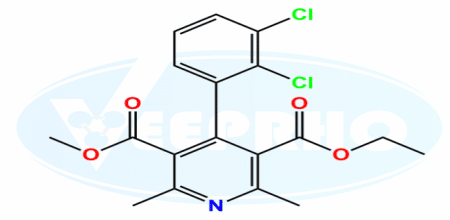
Felodipine EP Impurity B
● In Stock
| Catalogue No.: | VL3120001 |
|---|---|
| CAS No.: | 91189-59-2 |
| Mol. Formula: | C17H17Cl2NO4 |
| Mol. Weight: | 370.23 |
For laboratory use only: analytical, development and regulatory purposes. Supplied in mg quantities. Not for human or veterinary use.
Request a quote for a set
- Request quote for this set
All EP impurities of Felodipine
3 productsSee the 3 products
- Felodipine EP Impurity A VL3120003
CAS 96382-71-7 - Felodipine EP Impurity B VL3120001
CAS 91189-59-2 - Felodipine EP Impurity C VL3120002
CAS 79925-38-5
- Felodipine EP Impurity A VL3120003
- Request quote for this set
All USP impurities of Felodipine
3 productsSee the 3 products
- Felodipine EP Impurity A VL3120003
CAS 96382-71-7 - Felodipine EP Impurity B VL3120001
CAS 91189-59-2 - Felodipine EP Impurity C VL3120002
CAS 79925-38-5
- Felodipine EP Impurity A VL3120003

Additional information on CAS 91189-59-2
| Parent drug | Felodipine |
|---|---|
| Product type | Impurity standards |
| IUPAC name | Dimethyl 4-(2,3-dichlorophenyl)-2,6-dimethyl-1,4- dihydropyridine-3,5-dicarboxylate |
| EP name | Felodipine EP Impurity B |
| USP name | Felodipine Related Compound B |
| SMILES | COC(=O)C1=C(C)NC(C)=C(C(=O)OC)C1c1cccc(Cl)c1Cl |
| InChIKey | VEACAIASCBTOFS-UHFFFAOYSA-N |
| CHNS Ratio (%) (calculated) | C 55.15 · H 4.63 · N 3.78 · S 0.00 |
| Description | Felodipine EP Impurity B, also designated felodipine dimethyl ester and felodipine related compound B, is a diester structural variant of the dihydropyridine calcium channel blocker scaffold. CAS 91189-59-2 corresponds to C17H17Cl2NO4 with molecular weight 370.23, reflecting methyl esterification of the carboxyl functionality. The impurity is consistent with synthetic over-esterification or ester exchange during route-specific manufacture, rather than oxidative degradation. Its separation commonly requires reversed-phase LC with photodiode array detection, while definitive identification benefits from LC-MS/MS and, where volatility permits, GC-MS. The compound is relevant to impurity profiling under pharmacopeial and ICH impurity control frameworks. |
Request a Quote
"*" indicates required fields