

- 100% accuracy of data
- 24/7 scientific support
- 0% tolerance in quality of product
Stock Locations
- New Jersey, USA
- Czech Republic, EU
* Stock subject to availability.
Documentation
Includes: HPLC, MASS/LC-MS, 1H NMR, FT-IR, Potency, Structure Elucidation Report (SER), and additional analytical data depending on the product.
3086-91-7
Furosemide EP Impurity C
● In Stock
| Catalogue No.: | VL61004 |
|---|---|
| CAS No.: | 3086-91-7 |
| Mol. Formula: | C7H7ClN2O4S |
| Mol. Weight: | 250.66 g/mol |
For laboratory use only: analytical, development and regulatory purposes. Supplied in mg quantities. Not for human or veterinary use.
Request a quote for a set
- Request quote for this set
All EP impurities of Furosemide
5 productsSee the 5 products
- Furosemide EP Impurity A (Free Base) VL61003
CAS 4818-59-1 - Furosemide EP Impurity B VL61005
CAS 2736-23-4 - Furosemide EP Impurity C VL61004
CAS 3086-91-7 - Furosemide EP Impurity D VL61001
CAS 5046-19-5 - Furosemide EP Impurity E VL61002
CAS 50-84-0
- Furosemide EP Impurity A (Free Base) VL61003
- Request quote for this set
All USP impurities of Furosemide
2 productsSee the 2 products
- Furosemide EP Impurity A (Free Base) VL61003
CAS 4818-59-1 - Furosemide EP Impurity C VL61004
CAS 3086-91-7
- Furosemide EP Impurity A (Free Base) VL61003
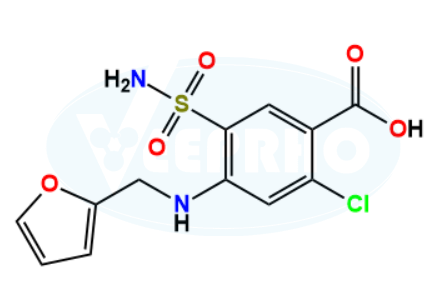

Additional information on CAS 3086-91-7
| Parent drug | Furosemide |
|---|---|
| Product type | Impurity standards |
| IUPAC name | 2-Amino-4-chloro-5-sulfamoylbenzoic acid |
| EP name | Furosemide EP Impurity C |
| USP name | Furosemide Related Compound B |
| SMILES | Nc1cc(Cl)c(S(N)(=O)=O)cc1C(=O)O |
| InChIKey | QQLJBZFXGDHSRU-UHFFFAOYSA-N |
| CHNS Ratio (%) (calculated) | C 33.54 · H 2.82 · N 11.18 · S 12.79 |
| Description | Furosemide EP Impurity C, also designated Furosemide Related Compound B (free base), CAS 3086-91-7, is a chlorinated aromatic sulfonamide impurity with molecular formula C7H7ClN2O4S and molecular weight 250.66 g/mol. Structurally, it is consistent with a process related variant of the parent loop diuretic, arising from synthetic intermediate carryover, hydrolytic transformation, or incomplete cyclization during manufacture. Its polar, heteroatom rich profile typically requires orthogonal characterization by LC-MS/MS, LC-HRMS, and ion chromatography coupled with UV or MS detection. In pharmacopeial control, it is monitored as a specified related substance because minor structural changes can alter impurity fate and degradation behavior. |
Request a Quote
"*" indicates required fields
Other products related to Furosemide impurities
| Impurity structure | Name of Impurity | Catalogue No. |
|---|---|---|
| Furosemide EP Impurity A (Free Base) | VL61003 | |
| Furosemide EP Impurity B | VL61005 | |
| Furosemide EP Impurity D | VL61001 | |
| Furosemide EP Impurity E | VL61002 | |
| 2-Chloro-5-chlorosulfonylbenzoic Acid | VE0024411 | |
| 4-Amino-2-chlorobenzoic acid | VE0024413 | |
| Ethyl 2,4-Dichloro-5-sulphamoylbenzoate | VE0022740 | |
 | Furosemide Acyl Glucuronide | VE0016429 |
| Furosemide Impurity 2 | VE0016423 | |
| Furosemide Impurity 4 (Sodium Salt) | VE0016424 | |
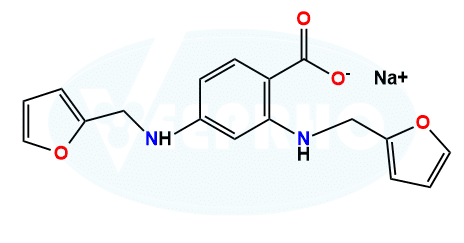 | Furosemide Impurity 7 (Sodium Salt) | VE0016425 |
| Furosemide Impurity 10 | VE0016426 |
Show all related products N-Nitroso Furosemide impurities (2)