

- 100% accuracy of data
- 24/7 scientific support
- 0% tolerance in quality of product
Stock Locations
- New Jersey, USA
- Czech Republic, EU
* Stock subject to availability.
Documentation
Includes: HPLC, MASS/LC-MS, 1H NMR, FT-IR, Potency, Structure Elucidation Report (SER), and additional analytical data depending on the product.
65-85-0
Glycopyrronium Bromide EP Impurity D
● In Stock
| Catalogue No.: | VL2410003 |
|---|---|
| CAS No.: | 65-85-0 |
| Mol. Formula: | C7H6O2 |
| Mol. Weight: | 122.1 |
For laboratory use only: analytical, development and regulatory purposes. Supplied in mg quantities. Not for human or veterinary use.
Request a quote for a set
- Request quote for this set
All EP impurities of Glycopyrrolate
6 productsSee the 6 products
- Glycopyrrolate EP Impurity I VE000100
CAS 1404453-68-4 - Glycopyrrolate EP Impurity L (S-Isomer) VE0014809
CAS 860644-54-8 - Glycopyrrolate Related Compound B (Free Base) VL3880001
CAS 13118-11-1 - Glycopyrrolate Related compound L VL3880003
CAS 19833-96-6 - Glycopyrronium Bromide EP Impurity D VL2410003
CAS 65-85-0 - Mefenamic Acid EP Impurity D VL2950003
CAS 65-85-0
- Glycopyrrolate EP Impurity I VE000100
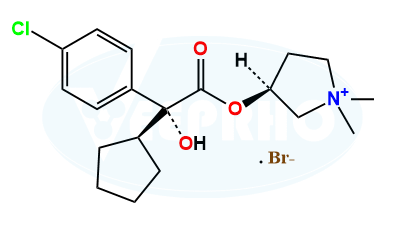
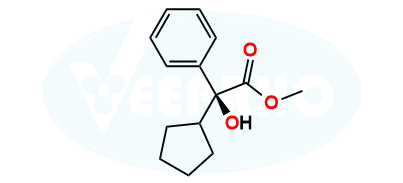
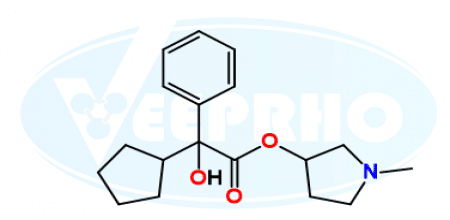
Additional information on CAS 65-85-0
| Parent drug | Glycopyrronium |
|---|---|
| Product type | Impurity standards |
| IUPAC name | benzoic acid |
| EP name | Glycopyrronium Bromide EP Impurity D |
| SMILES | O=C(O)c1ccccc1 |
| InChIKey | WPYMKLBDIGXBTP-UHFFFAOYSA-N |
| CHNS Ratio (%) (calculated) | C 68.85 · H 4.95 · N 0.00 · S 0.00 |
| Shipping condition | Ambient Temperature |
| Description | Glycopyrronium Bromide EP Impurity D is benzoic acid, a simple aromatic carboxylic acid classified as an oxidative or synthetic-process impurity rather than a structural analog of the quaternary ammonium active substance. With CAS 65-85-0, molecular formula C7H6O2, and molecular weight 122.1, it may arise from benzoate-containing reagents, solvent or excipient carryover, or aromatic oxidation pathways. Because of its volatility profile and UV absorbance, quantification commonly relies on HPLC-UV, LC-MS/MS for specificity, and GC-MS when trace residual contamination must be differentiated from related aromatic acids. |
Request a Quote
"*" indicates required fields
Other products related to Glycopyrrolate impurities
| Impurity structure | Name of Impurity | Catalogue No. |
|---|---|---|
| Glycopyrrolate Related compound L | VL3880003 | |
| 1-nitrosopyrrolidin-3-yl 2-cyclopentyl-2-hydroxy-2-phenylacetate | VE0010557 | |
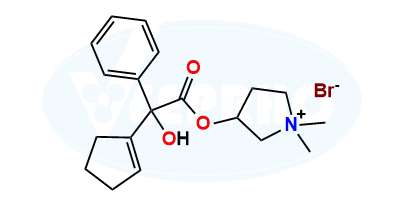 | Dehydro Glycopyrrolate Bromide (Mixture of Diastereomers) | VE0014807 |
 | Didehydroglycopyrrolate (Bromide Salt) | VL3880006 |
 | Erythro glycopyrrolate | VL3880005 |
| Glycopyrrolate EP Impurity I | VE000100 | |
| Glycopyrrolate EP Impurity L (S-Isomer) | VE0014809 | |
| Glycopyrrolate Impurity 1 | VE006544 | |
| Glycopyrrolate Impurity 4 | VE0014803 | |
| Glycopyrrolate Impurity 6 | VE0014804 | |
| Glycopyrrolate Impurity 10 | VE0014805 | |
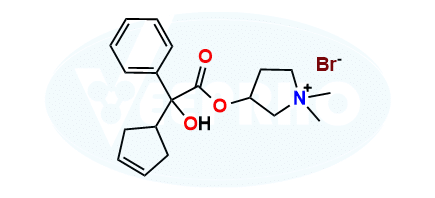 | Glycopyrrolate Impurity 12 (Bromide) | VE0014806 |