
- 100% accuracy of data
- 24/7 scientific support
- 0% tolerance in quality of product
Stock Locations
- New Jersey, USA
- Czech Republic, EU
* Stock subject to availability.
Documentation
Includes: HPLC, MASS/LC-MS, 1H NMR, FT-IR, Potency, Structure Elucidation Report (SER), and additional analytical data depending on the product.
358629-47-7
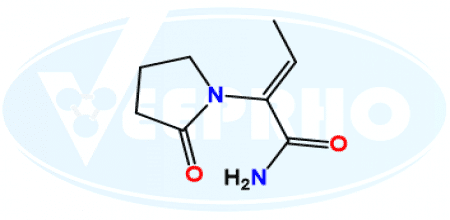
Levetiracetam EP Impurity B
● In Stock
| Catalogue No.: | VL1280008 |
|---|---|
| CAS No.: | 358629-47-7 |
| Mol. Formula: | C8H12N2O2 |
| Mol. Weight: | 168.19 g/mol |
For laboratory use only: analytical, development and regulatory purposes. Supplied in mg quantities. Not for human or veterinary use.
Packs and prices
| Pack | Price | Qty |
|---|---|---|
| 50 mg | USD 731.00 |
Prices shown are valid for issuing a purchase order.
Prices are subject to change depending on compound availability and the cost of synthesis based on current raw material costs. Veeprho reserves the right to change prices without notice.
Need another pack size or quantity? Request a custom quoteHow can we help?
Request a quote for a set
- Request quote for this set
All EP impurities of Levetiracetam
6 productsSee the 6 products
- Levetiracetam EP Impurity A VL1280003
CAS 67118-31-4 - Levetiracetam EP Impurity B VL1280008
CAS 358629-47-7 - Levetiracetam EP Impurity C VL1280009
CAS 142-08-5 - Levetiracetam EP Impurity D VL1280001
CAS 103765-01-1 - Levetiracetam Related Compound B VL1280013
CAS 7682-20-4 - Levetiracetam Related Compound B (Free Base) VE006674
CAS 7324-11-0
- Levetiracetam EP Impurity A VL1280003

Additional information on CAS 358629-47-7
| Parent drug | Levetiracetam |
|---|---|
| Product type | Impurity standards |
| IUPAC name | (2Z)-2-(2-Oxopyrrolidin-1-yl)but-2-enamide |
| EP name | Levetiracetam EP Impurity B |
| SMILES | C/C=C(/C(N)=O)N1CCCC1=O |
| InChIKey | ZGHRUXLFLIMTAG-KXFIGUGUSA-N |
| CHNS Ratio (%) (calculated) | C 57.13 · H 7.19 · N 16.66 · S 0.00 |
| Description | Levetiracetam EP Impurity B, CAS 358629-47-7, corresponds to a defined process- or degradation-related constituent associated with the pyrrolidone-based anticonvulsant scaffold of levetiracetam. With molecular formula C8H12N2O2 and molecular weight 168.19 g/mol, it is a neutral, polar heterocycle whose physicochemical profile supports reversed-phase LC separation but may require orthogonal mass confirmation because of close structural similarity to related analogues. In pharmacopeial and impurity-profile studies, its assignment typically relies on LC-MS/MS, high-resolution LC-MS, and, where necessary, NMR corroboration. Regulatory evaluation focuses on impurity qualification, route-specific origin, and potential accumulation during synthesis or storage. |
Request a Quote
"*" indicates required fields