
- 100% accuracy of data
- 24/7 scientific support
- 0% tolerance in quality of product
Stock Locations
- New Jersey, USA
- Czech Republic, EUIn stock
* Stock subject to availability.
Documentation
Includes: HPLC, MASS/LC-MS, 1H NMR, FT-IR, Potency, Structure Elucidation Report (SER), and additional analytical data depending on the product.
117678-38-3
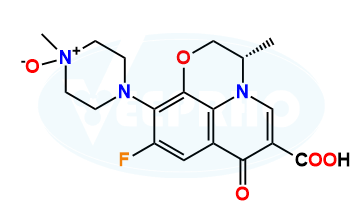
Levofloxacin EP Impurity C
● In Stock
| Catalogue No.: | VL86002 |
|---|---|
| CAS No.: | 117678-38-3 |
| Mol. Formula: | C18H20FN3O5 |
| Mol. Weight: | 377.37 g/mol |
For laboratory use only: analytical, development and regulatory purposes. Supplied in mg quantities. Not for human or veterinary use.
Packs and prices
| Pack | Price | Qty |
|---|---|---|
| 100 mg | USD 376.00 |
Prices shown are valid for issuing a purchase order.
Prices are subject to change depending on compound availability and the cost of synthesis based on current raw material costs. Veeprho reserves the right to change prices without notice.
Need another pack size or quantity? Request a custom quoteHow can we help?
Request a quote for a set
- Request quote for this set
All EP impurities of Levofloxacin
11 productsSee the 11 products
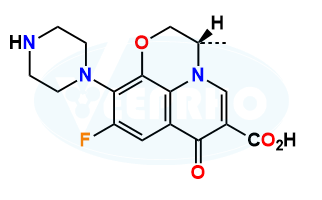
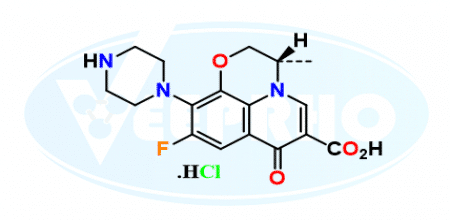
- Levofloxacin 9-piperazino Isomer VL86018
CAS 178912-62-4 - Levofloxacin EP Impurity A VL860015
CAS 100986-86-5 - Levofloxacin EP Impurity B (Free base) VE008178
CAS 117707-40-1 - Levofloxacin EP Impurity B (HCl salt) VL86001
CAS 2254176-11-7 - Levofloxacin EP Impurity C VL86002
CAS 117678-38-3 - Levofloxacin EP Impurity D VL86010
CAS 117620-85-6 - Levofloxacin EP Impurity E VL86011
CAS 178964-53-9 - Levofloxacin EP Impurity F VL86005
CAS 100986-89-8 - Levofloxacin EP Impurity G VE009304
CAS 151250-76-9 - Levofloxacin EP Impurity H VL86006
CAS 177472-30-9 - Levofloxacin Related Compound E VL86003
CAS 1346603-62-0
- Levofloxacin 9-piperazino Isomer VL86018
- Request quote for this set
All USP impurities of Levofloxacin
10 productsSee the 10 products
- Levofloxacin EP Impurity A VL860015
CAS 100986-86-5 - Levofloxacin EP Impurity B (Free base) VE008178
CAS 117707-40-1 - Levofloxacin EP Impurity B (HCl salt) VL86001
CAS 2254176-11-7 - Levofloxacin EP Impurity C VL86002
CAS 117678-38-3 - Levofloxacin EP Impurity D VL86010
CAS 117620-85-6 - Levofloxacin EP Impurity E VL86011
CAS 178964-53-9 - Levofloxacin EP Impurity F VL86005
CAS 100986-89-8 - Levofloxacin EP Impurity G VE009304
CAS 151250-76-9 - Levofloxacin EP Impurity H VL86006
CAS 177472-30-9 - Levofloxacin Related Compound E VL86003
CAS 1346603-62-0
- Levofloxacin EP Impurity A VL860015


Additional information on CAS 117678-38-3
| Parent drug | Levofloxacin |
|---|---|
| Product type | Impurity standards |
| IUPAC name | (-)-(S)-9-Fluoro-2,3-dihydro-3-methyl-10-(4-methyl-1-piperazinyl)-7-oxo-7H-pyrido[1,2,3-de]-1,4-benzoxazine-6-carboxylic acid N-oxide |
| EP name | Levofloxacin EP Impurity C |
| USP name | Levofloxacin N-Oxide |
| SMILES | C[C@H]1COc2c(N3CC[N+](C)([O-])CC3)c(F)cc3c(=O)c(C(=O)O)cn1c23 |
| InChIKey | MVLAUMUQGRQERL-JTQLQIEISA-N |
| CHNS Ratio (%) (calculated) | C 57.29 · H 5.34 · N 11.14 · S 0.00 |
| References | - |
| Description | Levofloxacin N-oxide, also designated Levofloxacin EP Impurity C, is the N-oxidized derivative of the fluoroquinolone scaffold, consistent with oxidative degradation of the tertiary amine nitrogen during manufacture or storage. The substance, CAS 117678-38-3, has molecular formula C18H20FN3O5 and molecular weight 377.37 g/mol. As an oxidation impurity rather than a structural genotoxic alert, it is generally evaluated within impurity profiling and stability studies. Determination typically requires reversed-phase LC-MS/MS, LC-HRMS, and orthogonal HPLC with diode-array or fluorescence detection, given its polar N-oxide functionality and chromatographic behavior. |
Request a Quote
"*" indicates required fields
Other products related to Levofloxacin impurities
| Impurity structure | Name of Impurity | Catalogue No. |
|---|---|---|
 | Bis-Nitroso Levofloxacin EP Impurity G | VE0020784 |
| Levofloxacin EP Impurity A | VL860015 | |
| Levofloxacin EP Impurity B (Free base) | VE008178 | |
| Levofloxacin EP Impurity B (HCl salt) | VL86001 | |
| Levofloxacin EP Impurity D | VL86010 | |
| Levofloxacin EP Impurity E | VL86011 | |
| Levofloxacin EP Impurity F | VL86005 | |
| Levofloxacin EP Impurity G | VE009304 | |
| Levofloxacin EP Impurity H | VL86006 | |
| Levofloxacin Related Compound E | VL86003 | |
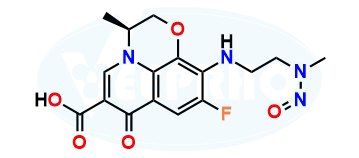 | N-Nitroso Levofloxacin EP Impurity G (Isomer-1) | VE0020782 |
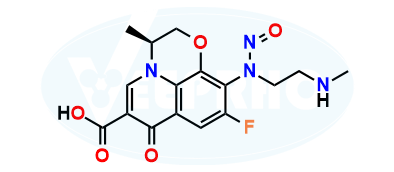 | N-Nitroso Levofloxacin EP Impurity G (Isomer-2) | VE0020783 |
Show all related products N-Nitroso Levofloxacin impurities (2)