
- 100% accuracy of data
- 24/7 scientific support
- 0% tolerance in quality of product
Stock Locations
- New Jersey, USA
- Czech Republic, EU
* Stock subject to availability.
Documentation
Includes: HPLC, MASS/LC-MS, 1H NMR, FT-IR, Potency, Structure Elucidation Report (SER), and additional analytical data depending on the product.
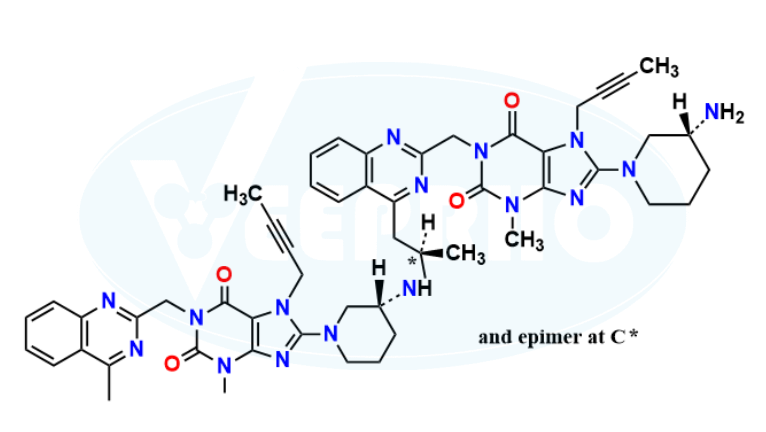
Linagliptin EP Impurity F
● In Stock
| Catalogue No.: | VE0029009 |
|---|---|
| CAS No.: | N/A |
| Mol. Formula: | C52H58N16O4 |
| Mol. Weight: | 971.12 g/mol |
For laboratory use only: analytical, development and regulatory purposes. Supplied in mg quantities. Not for human or veterinary use.
Request a quote for a set
- Request quote for this set
All EP impurities of Linagliptin
2 productsSee the 2 products
- Linagliptin EP Impurity E VE0028976
CAS 2803370-12-7 - Linagliptin EP Impurity F VE0029009
- Linagliptin EP Impurity E VE0028976
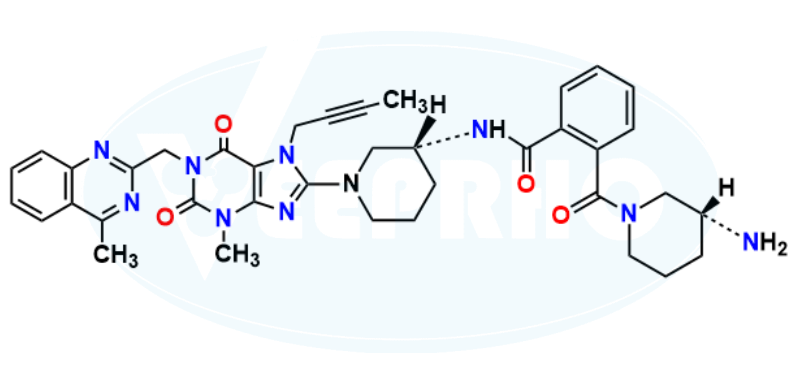
Additional information on Linagliptin EP Impurity F
| Parent drug | Linagliptin |
|---|---|
| Product type | Impurity standards |
| IUPAC name | 8-((R)-3-aminopiperidin-1-yl)-7-(but-2-yn-1-yl)-1-((4-((R)-2-(((R)-1-(7-(but-2-yn-1-yl)-3-methyl-1-((4-methylquinazolin-2-yl)methyl)-2,6-dioxo-2,3,6,7-tetrahydro-1H-purin-8-yl)piperidin-3-yl)amino)propyl)quinazolin-2-yl)methyl)-3-methyl-1H-purine-2,6(3H,7H)-dione |
| EP name | Linagliptin EP Impurity F |
| SMILES | O=C(N(C)C(N=C(N1CCC[C@@]([H])(N[C@@](C)([H])CC2=NC(CN3C(N(C)C(N=C(N4CCC[C@](N)([H])C4)N5CC#CC)=C5C3=O)=O)=NC6=C2C=CC=C6)C1)N7CC#CC)=C7C8=O)N8CC9=NC%10=C(C(C)=N9)C=CC=C%10 |
| InChI | InChI=1S/C52H58N16O4/c1-7-9-25-65-43-45(59-49(65)63-23-15-17-34(53)28-63)61(5)52(72)68(48(43)70)31-42-57-39-22-14-12-20-37(39)40(58-42)27-32(3)54-35-18-16-24-64(29-35)50-60-46-44(66(50)26-10-8-2)47(69)67(51(71)62(46)6)30-41-55-33(4)36-19-11-13-21-38(36)56-41/h11-14,19-22,32,34-35,54H,15-18,23-31,53H2,1-6H3/t32-,34-,35-/m1/s1 |
| InChIKey | VDVYWAVGJXVALY-GJJQDPDKSA-N |
| CHNS Ratio (%) (calculated) | C 64.31 · H 6.02 · N 23.08 · S 0.00 |
| Description | Linagliptin EP Impurity F is a structurally defined related substance of linagliptin with molecular formula C52H58N16O4 and molecular weight 971.12 g/mol. Its high heteroatom content and extended nitrogen-rich scaffold indicate a process-related dimeric or condensation-derived impurity rather than a simple degradation product. Such species typically arise from synthetic coupling inefficiency, incomplete deprotection, or side reactions during heterocycle assembly. Characterization generally requires LC-MS/MS, high-resolution MS, and orthogonal LC-UV methods, with NMR confirmation when isolation is feasible. In a regulatory context, this impurity is relevant to impurity profiling under ICH Q3A/Q3B principles. |
Request a Quote
"*" indicates required fields
Other products related to Linagliptin impurities
| Impurity structure | Name of Impurity | Catalogue No. |
|---|---|---|
| Linagliptin EP Impurity B | VE0028975 | |
| Linagliptin EP Impurity E | VE0028976 | |
| Linagliptin Related Compound A | VL870007 | |
| Linagliptin Related Compound B (Inhouse) | VE0010133 | |
 | Linagliptin Related Compound C | VL870009 |
| (2E)-1,3-Dibromo-2-butene | VE0011520 | |
| (2Z)-1,3-Dibromo-2-butene | VE0011518 | |
 | (R)-7-(but-2-yn-1-yl)-8-(3-(hydroxyamino)piperidin-1-yl)-3-methyl-1-((4-methylquinazolin-2-yl)methyl)-1H-purine-2,6(3H,7H)-dione | VE0011094 |
 | (R)-N-(1-(7-(but-2-yn-1-yl)-3-methyl-1-((4-methylquinazolin-2-yl)methyl)-2,6-dioxo-2,3,6,7-tetrahydro-1H-purin-8-yl)piperidin-3-yl)formamide | VE0010229 |
| (S)-3-(Boc-amino)piperidine | VE0010729 | |
| 1-[(4-Methylquinazolin-2-yl)methyl]-3-methyl-7-(2-butyn-1-yl)-8-bromoxanthine | VE007277 | |
| 2-(Chloromethyl)quinazoline | VE0011521 |
Show all related products N-Nitroso Linagliptin impurities (13)