
- 100% accuracy of data
- 24/7 scientific support
- 0% tolerance in quality of product
Stock Locations
- New Jersey, USA
- Czech Republic, EUIn stock
* Stock subject to availability.
Documentation
Includes: HPLC, MASS/LC-MS, 1H NMR, FT-IR, Potency, Structure Elucidation Report (SER), and additional analytical data depending on the product.
856307-27-2
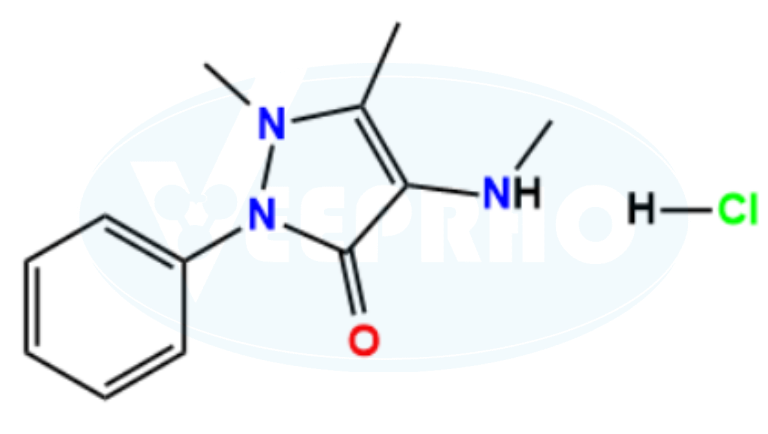
Metamizole EP Impurity C (HCl salt)
● In Stock
| Catalogue No.: | VE006664 |
|---|---|
| CAS No.: | 856307-27-2 |
| Mol. Formula: | C12H16ClN3O |
| Mol. Weight: | 253.73 g/mol |
For laboratory use only: analytical, development and regulatory purposes. Supplied in mg quantities. Not for human or veterinary use.
Request a quote for a set
- Request quote for this set
All EP impurities of Metamizole
6 productsSee the 6 products
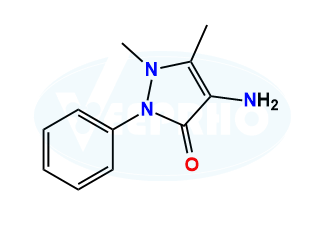
- Metamizole EP Impurity A VL105003
CAS 1672-58-8 - Metamizole EP Impurity B VL105002
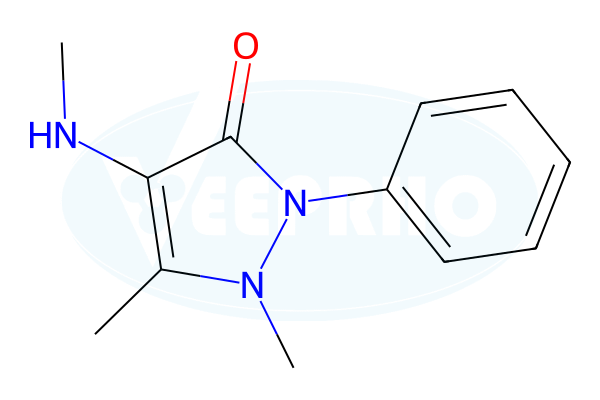
CAS 83-07-8 - Metamizole EP Impurity C VL105001
CAS 519-98-2 - Metamizole EP Impurity C (HCl salt) VE006664
CAS 856307-27-2 - Metamizole EP Impurity C (Hydrate Salt) VE0021405
CAS 1619981-09-7 - Metamizole EP Impurity E VE006135
CAS 117-38-4
- Metamizole EP Impurity A VL105003

Additional information on CAS 856307-27-2
| Parent drug | Metamizole |
|---|---|
| Product type | Impurity standards |
| IUPAC name | 1,5-Dimethyl-4-(methylamino)-2-phenyl-2,3-dihydro-1H-pyrazol-3-one HCl |
| EP name | Metamizole EP Impurity C |
| Other Synonyms | 4-Methylamino Antipyrine (HCl salt) |
| SMILES | O=C1N(C2=CC=CC=C2)N(C)C(C)=C1NC.[H]Cl |
| InChI | InChI=1S/C12H15N3O.ClH/c1-9-11(13-2)12(16)15(14(9)3)10-7-5-4-6-8-10;/h4-8,13H,1-3H3;1H |
| InChIKey | NNONRTWOIVTAHL-UHFFFAOYSA-N |
| CHNS Ratio (%) (calculated) | C 56.81 · H 6.36 · N 16.56 · S 0.00 |
| Description | Metamizole EP Impurity C, identified as 4-Methylamino Antipyrine hydrochloride, is a structurally defined pyrazolone-related impurity with CAS 856307-27-2, molecular formula C12H16ClN3O, and molecular weight 253.73 g/mol. It corresponds to the hydrochloride salt of 4-methylamino antipyrine, a biotransformation and degradation product associated with dipyrone cleavage pathways and intermediate process chemistry. Because its presence reflects precursor degradation and synthetic carryover, it is evaluated under impurity control principles rather than as a pharmacologically inert species. Quantification typically requires chromatographic separation by LC-MS/MS or LC-UV, with confirmatory characterization by HRMS and, when needed, NMR. |
Request a Quote
"*" indicates required fields