
- 100% accuracy of data
- 24/7 scientific support
- 0% tolerance in quality of product
Stock Locations
- New Jersey, USA
- Czech Republic, EU
* Stock subject to availability.
Documentation
Includes: HPLC, MASS/LC-MS, 1H NMR, FT-IR, Potency, Structure Elucidation Report (SER), and additional analytical data depending on the product.
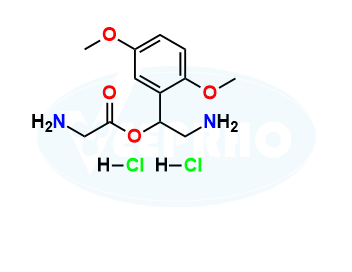
Midodrine Related Compound B
● In Stock
| Catalogue No.: | VL2870002 |
|---|---|
| CAS No.: | N/A |
| Mol. Formula: | C12H18N2O4 . 2HCl |
| Mol. Weight: | 254.29 . 72.92 g/mol |
For laboratory use only: analytical, development and regulatory purposes. Supplied in mg quantities. Not for human or veterinary use.
Additional information on Midodrine Related Compound B
| Parent drug | Midodrine |
|---|---|
| Product type | Impurity standards |
| IUPAC name | 2-Amino-1-(2,5-dimethoxyphenyl)ethyl-2-aminoacetate dihydrochloride |
| References | Janjua | Muhammad Ramzan Saeed Ashraf. “Structural Properties and Nonlinear Optical Responses of Halogenated Compounds: A DFT Investigation on Molecular Modelling.†Open Chemistry | vol. 16 | no. 1 | Oct. 2018 | pp. 978–85 | https://doi.org/10.1515/chem-2018-0113.?Zhu | Y. Isabel. | and Matthew J. Stiller. “Dapsone and Sulfones in Dermatology: Overview and Update.†Journal of the American Academy of Dermatology | vol. 45 | no. 3 | Sept. 2001 | pp. 420–34 | https://doi.org/10.1067/mjd.2001.114733.? |
| Description | Midodrine Related Compound B (2HCl salt) is a structurally defined process- and degradation-related impurity associated with the 2-aminoethanol side chain of the midodrine scaffold, represented as C12H18N2O4 · 2HCl with a molecular weight of 254.29 · 72.92 g/mol. Its ionic hydrochloride form increases polarity and may alter chromatographic retention, making trace assignment dependent on orthogonal methods such as LC-MS/MS and high-resolution LC-MS, with confirmatory NMR where needed. In regulatory impurity profiling, such analogues are evaluated for origin from incomplete synthesis, salt exchange, or hydrolytic transformation, and interpreted within impurity control strategies consistent with ICH Q3A/Q3B principles. |
Request a Quote
"*" indicates required fields
Other products related to Midodrine impurities
| Impurity structure | Name of Impurity | Catalogue No. |
|---|---|---|
| Midodrine Related Compound A | VL2870001 | |
| Midodrine Related Compound A (HCl Salt) | VE0021722 | |
 | Midodrine Related compound C | VE0020163 |
| (2-Isopropyl-4,5-dimethoxyphenyl) methanol | VE0021993 | |
| (2,4-Diisopropyl-3,5-dimethoxyphenyl)methanol | VE0021986 | |
| (3,5-Dimethoxyphenyl)methanol | VE0021724 | |
| (4-Ethyl-3,5-dimethoxyphenyl)methanol | VE0021995 | |
| (4-Isopropyl-3-methoxyphenyl)methanol | VE0021994 | |
| 2-((2-(2,5-Dimethoxyphenyl)-2-hydroxyethyl)amino)-2-oxoethyl tert-butylcarbamate | VE0021996 | |
 | 2-Amino-2-bromo-1-(2,5-dimethoxyphenyl)ethan-1-ol | VE009249 |
| 2-Bromo-2′,5′-dimethoxyacetophenone | VE009247 | |
 | 2,2-Diamino-1-(2,5-dimethoxyphenyl)ethan-1-ol | VE009248 |
Show all related products N-Nitroso Midodrine impurities (2)