

- 100% accuracy of data
- 24/7 scientific support
- 0% tolerance in quality of product
Stock Locations
- New Jersey, USA
- Czech Republic, EUIn stock
* Stock subject to availability.
Documentation
Includes: HPLC, MASS/LC-MS, 1H NMR, FT-IR, Potency, Structure Elucidation Report (SER), and additional analytical data depending on the product.
3600-87-1
Midodrine Related Compound A
● In Stock
| Catalogue No.: | VL2870001 |
|---|---|
| CAS No.: | 3600-87-1 |
| Mol. Formula: | C10H15NO3 |
| Mol. Weight: | 197.23 |
For laboratory use only: analytical, development and regulatory purposes. Supplied in mg quantities. Not for human or veterinary use.
Request a quote for a set
- Request quote for this set
All USP impurities of Midodrine
3 productsSee the 3 products
- Midodrine Related Compound A VL2870001
CAS 3600-87-1 - Midodrine Related Compound A (HCl Salt) VE0021722
CAS 60407-53-6 - Midodrine Related compound C VE0020163
- Midodrine Related Compound A VL2870001

Additional information on CAS 3600-87-1
| Parent drug | Midodrine |
|---|---|
| Product type | Impurity standards |
| IUPAC name | 2-Amino-1-(2,5-dimethoxyphenyl)ethanol |
| USP name | Midodrine Related Compound A |
| SMILES | COc1ccc(OC)c(C(O)CN)c1 |
| InChIKey | VFRCNXKYZVQYLX-UHFFFAOYSA-N |
| CHNS Ratio (%) (calculated) | C 60.90 · H 7.67 · N 7.10 · S 0.00 |
| References | - |
| Description | Midodrine Related Compound A (CAS 3600-87-1) is a structurally defined process- and degradant-related impurity associated with the midodrine scaffold, bearing the molecular formula C10H15NO3 and molecular weight 197.23. Its polar hydroxy and amine functionality indicates appreciable chromatographic retention variability and possible salt-forming behavior, requiring orthogonal characterization by LC-MS/MS, high-resolution MS, and, where necessary, NMR confirmation. In impurity profiling, such compounds are evaluated for origin from synthetic side reactions or biotransformational degradation rather than as discrete active species. Regulatory assessment typically considers identity, specification limits, and potential toxicological relevance under impurity control frameworks. |
Request a Quote
"*" indicates required fields
Other products related to Midodrine impurities
| Impurity structure | Name of Impurity | Catalogue No. |
|---|---|---|
| Midodrine Related Compound A (HCl Salt) | VE0021722 | |
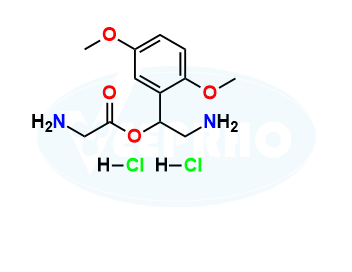 | Midodrine Related Compound B | VL2870002 |
 | Midodrine Related compound C | VE0020163 |
| (2-Isopropyl-4,5-dimethoxyphenyl) methanol | VE0021993 | |
| (2,4-Diisopropyl-3,5-dimethoxyphenyl)methanol | VE0021986 | |
| (3,5-Dimethoxyphenyl)methanol | VE0021724 | |
| (4-Ethyl-3,5-dimethoxyphenyl)methanol | VE0021995 | |
| (4-Isopropyl-3-methoxyphenyl)methanol | VE0021994 | |
| 2-((2-(2,5-Dimethoxyphenyl)-2-hydroxyethyl)amino)-2-oxoethyl tert-butylcarbamate | VE0021996 | |
 | 2-Amino-2-bromo-1-(2,5-dimethoxyphenyl)ethan-1-ol | VE009249 |
| 2-Bromo-2′,5′-dimethoxyacetophenone | VE009247 | |
 | 2,2-Diamino-1-(2,5-dimethoxyphenyl)ethan-1-ol | VE009248 |
Show all related products N-Nitroso Midodrine impurities (2)