
- 100% accuracy of data
- 24/7 scientific support
- 0% tolerance in quality of product
Stock Locations
- New Jersey, USA
- Czech Republic, EU
* Stock subject to availability.
Documentation
Includes: HPLC, MASS/LC-MS, 1H NMR, FT-IR, Potency, Structure Elucidation Report (SER), and additional analytical data depending on the product.
1955514-80-3
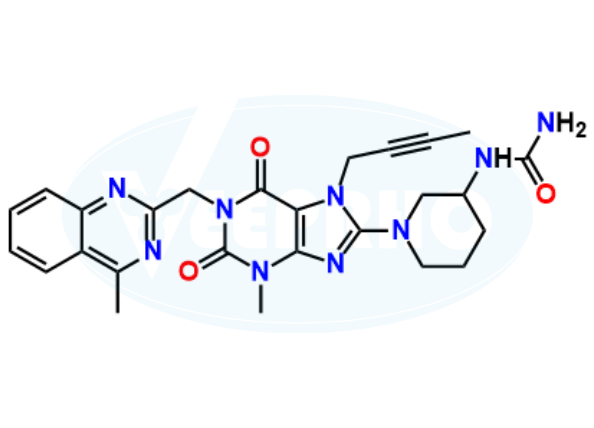
N-Aminoacyl Linagliptin (Racemic)
● In Stock
| Catalogue No.: | VE0028996 |
|---|---|
| CAS No.: | 1955514-80-3 |
| Mol. Formula: | C26H29N9O3 |
| Mol. Weight: | 515.58 g/mol |
For laboratory use only: analytical, development and regulatory purposes. Supplied in mg quantities. Not for human or veterinary use.
Additional information on CAS 1955514-80-3
| Parent drug | Linagliptin |
|---|---|
| Product type | Impurity standards |
| IUPAC name | 1-(1-(7-(But-2-yn-1-yl)-3-methyl-1-((4-methylquinazolin-2-yl)methyl)-2,6-dioxo-2,3,6,7-tetrahydro-1H-purin-8-yl)piperidin-3-yl)urea |
| Other Synonyms | N-Carbamoyl Linagliptin; Linagliptin Urea Impurity (Racemic) |
| SMILES | O=C(N)NC1CN(C(N2CC#CC)=NC(N(C)C(N3CC4=NC(C)=C5C=CC=CC5=N4)=O)=C2C3=O)CCC1 |
| InChI | InChI=1S/C26H29N9O3/c1-4-5-13-34-21-22(31-25(34)33-12-8-9-17(14-33)29-24(27)37)32(3)26(38)35(23(21)36)15-20-28-16(2)18-10-6-7-11-19(18)30-20/h6-7,10-11,17H,8-9,12-15H2,1-3H3,(H3,27,29,37) |
| InChIKey | QWRPIDPNVOGFFM-UHFFFAOYSA-N |
| CHNS Ratio (%) (calculated) | C 60.57 · H 5.67 · N 24.45 · S 0.00 |
| Description | N-Aminoacyl Linagliptin (Racemic), CAS 1955514-80-3, is a structural process impurity of linagliptin belonging to the urea-carbamoylated analog class, also described as N-Carbamoyl Linagliptin or Linagliptin Urea Impurity (Racemic). With formula C26H29N9O3 and molecular weight 515.58 g/mol, it reflects overcarbamoylation or rearrangement during synthesis or amidation chemistry rather than oxidative degradation. The racemate may complicate stereochemical assignment in impurity profiling. Quantification typically requires LC-MS/MS with high-resolution MS confirmation, and orthogonal UPLC with UV or CAD, because closely related diacylurea and amidine species can show similar chromatographic behavior. Its regulatory relevance is mainly as a specified related substance rather than a genotoxic impurity. |
Request a Quote
"*" indicates required fields
Other products related to Linagliptin impurities
| Impurity structure | Name of Impurity | Catalogue No. |
|---|---|---|
| Linagliptin EP Impurity B | VE0028975 | |
| Linagliptin EP Impurity E | VE0028976 | |
| Linagliptin EP Impurity F | VE0029009 | |
| Linagliptin Related Compound A | VL870007 | |
| Linagliptin Related Compound B (Inhouse) | VE0010133 | |
 | Linagliptin Related Compound C | VL870009 |
| (2E)-1,3-Dibromo-2-butene | VE0011520 | |
| (2Z)-1,3-Dibromo-2-butene | VE0011518 | |
 | (R)-7-(but-2-yn-1-yl)-8-(3-(hydroxyamino)piperidin-1-yl)-3-methyl-1-((4-methylquinazolin-2-yl)methyl)-1H-purine-2,6(3H,7H)-dione | VE0011094 |
 | (R)-N-(1-(7-(but-2-yn-1-yl)-3-methyl-1-((4-methylquinazolin-2-yl)methyl)-2,6-dioxo-2,3,6,7-tetrahydro-1H-purin-8-yl)piperidin-3-yl)formamide | VE0010229 |
| (S)-3-(Boc-amino)piperidine | VE0010729 | |
| 1-[(4-Methylquinazolin-2-yl)methyl]-3-methyl-7-(2-butyn-1-yl)-8-bromoxanthine | VE007277 |
Show all related products N-Nitroso Linagliptin impurities (13)