
- 100% accuracy of data
- 24/7 scientific support
- 0% tolerance in quality of product
Mutagenicity assessment (ICH M7)
Potentially mutagenic impurity (ICH M7 Class 1–3).
N-nitroso compound: ICH M7 cohort of concern.Stock Locations
- New Jersey, USA
- Czech Republic, EU
* Stock subject to availability.
Documentation
Includes: HPLC, MASS/LC-MS, 1H NMR, FT-IR, Potency, Structure Elucidation Report (SER), and additional analytical data depending on the product.
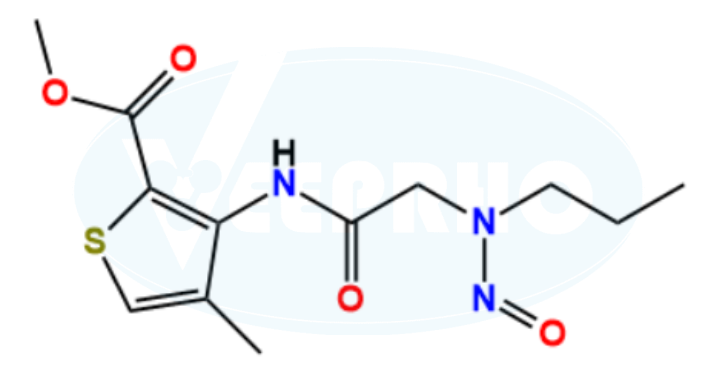
N-Nitroso Articaine EP Impurity A
● In Stock
| Catalogue No.: | VE0025786 |
|---|---|
| CAS No.: | N/A |
| Mol. Formula: | C12H17N3O4S |
| Mol. Weight: | 299.35 g/mol |
For laboratory use only: analytical, development and regulatory purposes. Supplied in mg quantities. Not for human or veterinary use.
Request a quote for a set
- Request quote for this set
All nitrosamine impurities of Articaine
4 productsSee the 4 products
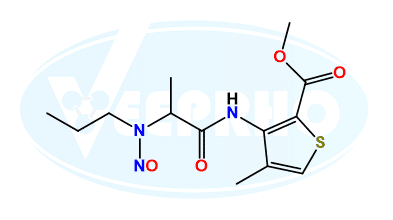
- N-Nitroso Articaine VE0010623
- N-Nitroso Articaine EP Impurity A VE0025786
- N-Nitroso Articaine EP Impurity B VE0024327
- N2-Nitroso Articaine VE0013877

Additional information on N-Nitroso Articaine EP Impurity A
| Parent drug | Articaine |
|---|---|
| Product type | Impurity standards, Nitroso impurities |
| IUPAC name | methyl 4-methyl-3-(2-(nitroso(propyl)amino)acetamido)thiophene-2-carboxylate |
| SMILES | O=C(OC)C1=C(NC(CN(N=O)CCC)=O)C(C)=CS1 |
| InChI | InChI=1S/C12H17N3O4S/c1-4-5-15(14-18)6-9(16)13-10-8(2)7-20-11(10)12(17)19-3/h7H,4-6H2,1-3H3,(H,13,16) |
| InChIKey | LLGQUGHIWDEGNS-UHFFFAOYSA-N |
| CHNS Ratio (%) (calculated) | C 48.15 · H 5.72 · N 14.04 · S 10.71 |
| Description | N-Nitroso Articaine EP Impurity A, Methyl 4-methyl-3-(2-(nitroso(propyl)amino)acetamido)thiophene-2-carboxylate, is an N-nitroso impurity of high regulatory concern that can form via nitrosation of secondary amine intermediates during synthesis or storage. Its nitroso functional group imparts a characteristic mass spectral and UV profile that facilitates LC-MS/MS and HPLC-UV monitoring, yet low-level quantification is challenging due to potential co-elution and matrix effects. Analytical control strategies include validated trace-level LC-MS methods, use of isotopically labeled internal standards, and targeted stability studies. Process controls, exclusion of nitrosating agents, and adherence to ICH M7 risk assessment are essential for robust impurity management. |
Request a Quote
"*" indicates required fields
Other products related to Articaine and Nitroso impurities
| Impurity structure | Name of Impurity | Catalogue No. |
|---|---|---|
| Articaine EP Impurity A | VE009448 | |
| Articaine EP Impurity A (HCl Salt) | VE0022338 | |
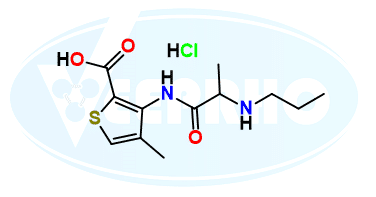 | Articaine EP Impurity B (HCl Salt) | VE0012359 |
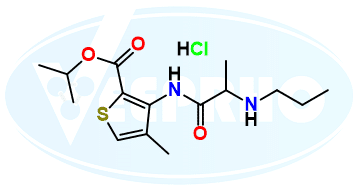 | Articaine EP Impurity C (HCl Salt) | VE0012360 |
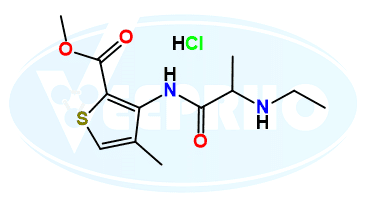 | Articaine EP Impurity D (HCl Salt) | VE0012361 |
| Articaine EP Impurity E | VE009449 | |
| Articaine EP Impurity E (HCl Salt) | VE0022360 | |
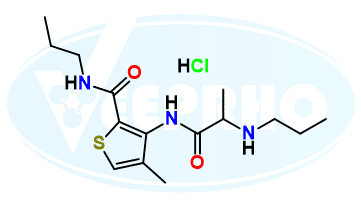 | Articaine EP Impurity F (HCl Salt) | VE0012362 |
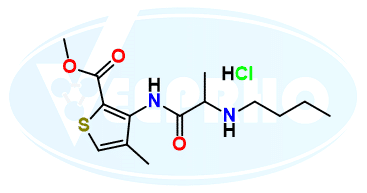 | Articaine EP Impurity G (HCl Salt) | VE0012363 |
| Articaine EP Impurity H (HCl Salt) | VE0012364 | |
| Articaine EP Impurity I | VE0012365 | |
| Articaine EP Impurity J | VE0012366 |
Show all related products N-Nitroso Articaine impurities (3)