
- 100% accuracy of data
- 24/7 scientific support
- 0% tolerance in quality of product
Mutagenicity assessment (ICH M7)
Potentially mutagenic impurity (ICH M7 Class 1–3).
N-nitroso compound: ICH M7 cohort of concern.Stock Locations
- New Jersey, USA
- Czech Republic, EU
* Stock subject to availability.
Documentation
Includes: HPLC, MASS/LC-MS, 1H NMR, FT-IR, Potency, Structure Elucidation Report (SER), and additional analytical data depending on the product.
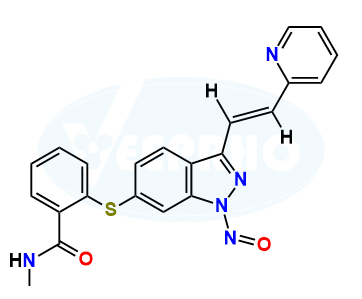
N-Nitroso Axitinib
● Report Available Immediately
| Catalogue No.: | VE0024341 |
|---|---|
| CAS No.: | N/A |
| Mol. Formula: | C22H17N5O2S |
| Mol. Weight: | 415.5 g/mol |
For laboratory use only: analytical, development and regulatory purposes. Supplied in mg quantities. Not for human or veterinary use.
Request a quote for a set
- Request quote for this set
All nitrosamine impurities of Axitinib
2 productsSee the 2 products
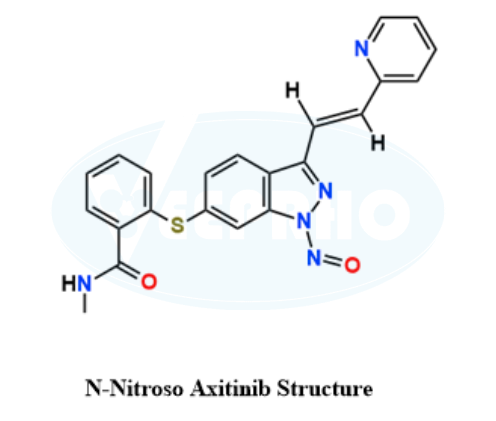
Additional information on N-Nitroso Axitinib
| Parent drug | Axitinib |
|---|---|
| Product type | Impurity standards, Nitroso impurities |
| IUPAC name | (E)-N-methyl-2-((1-nitroso-3-(2-(pyridin-2-yl)vinyl)-1H-indazol-6-yl)thio)benzamide |
| SMILES | [H]/C(C1=NN(N=O)C2=C1C=CC(SC3=CC=CC=C3C(NC)=O)=C2)=C(C4=CC=CC=N4)/[H] |
| InChI | InChI=1S/C22H17N5O2S/c1-23-22(28)18-7-2-3-8-21(18)30-16-10-11-17-19(25-27(26-29)20(17)14-16)12-9-15-6-4-5-13-24-15/h2-14H, 1H3, (H, 23, 28)/b12-9+ |
| InChIKey | WIBRKIQKRROHEO-FMIVXFBMSA-N |
| CHNS Ratio (%) (calculated) | C 63.60 · H 4.12 · N 16.86 · S 7.72 |
| Description | N-Nitroso Axitinib is the N-nitroso derivative of axitinib, belonging to the nitrosamine class and therefore of heightened regulatory concern because many nitrosamines are assessed as potential genotoxic impurities under ICH M7 principles. With molecular formula C22H17N5O2S and molecular weight 415.5 g/mol, this species is structurally consistent with nitrosation of the parent secondary amine during synthesis, workup, or storage under nitrosating conditions. Trace-level determination generally requires highly selective mass spectrometric methods such as LC-MS/MS, often complemented by high-resolution LC-MS or GC-MS following suitable derivatization or enrichment, due to low abundance and matrix interference. |
Request a Quote
"*" indicates required fields
Other products related to Axitinib and Nitroso impurities
| Impurity structure | Name of Impurity | Catalogue No. |
|---|---|---|
| Axitinib 2-Mercapto N-Methyl Benzamide | VL4110009 | |
| Axitinib 6-Iodo-1H-indazole | VL4110001 | |
| Axitinib Impurity 1 | VE0012463 | |
| Axitinib Impurity 2 | VE0012465 | |
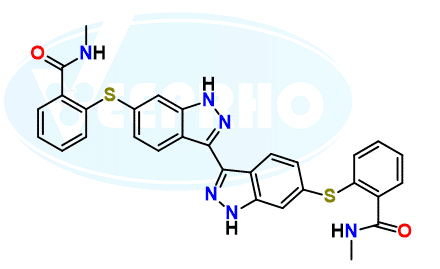 | Axitinib Impurity 3 | VE0012470 |
| Axitinib Impurity 5 | VE0012473 | |
| Axitinib Impurity 6 | VE0012474 | |
| Axitinib Impurity 7 | VE0012476 | |
| Axitinib Impurity 29 | VL4110002 | |
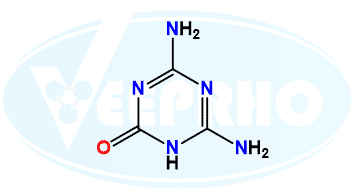 | Axitinib Impurity 30 | VE0012493 |
| Axitinib Impurity B | VL4110003 | |
| Axitinib Impurity C | VL4110004 |