

- 100% accuracy of data
- 24/7 scientific support
- 0% tolerance in quality of product
Mutagenicity assessment (ICH M7)
Potentially mutagenic impurity (ICH M7 Class 1–3).
N-nitroso compound: ICH M7 cohort of concern.Stock Locations
- New Jersey, USA
- Czech Republic, EUIn stock
* Stock subject to availability.
Documentation
Includes: HPLC, MASS/LC-MS, 1H NMR, FT-IR, Potency, Structure Elucidation Report (SER), and additional analytical data depending on the product.
29291-35-8
N-Nitroso Folic acid
● In Stock
| Catalogue No.: | VE007631 |
|---|---|
| CAS No.: | 29291-35-8 |
| Mol. Formula: | C19H18N8O7 |
| Mol. Weight: | 470.4 g/mol |
For laboratory use only: analytical, development and regulatory purposes. Supplied in mg quantities. Not for human or veterinary use.
Request a quote for a set
- Request quote for this set
All nitrosamine impurities of Folic Acid
5 productsSee the 5 products
- L-Tetrahydrofolic Acid Nitroso Impurity VE0028644
CAS 77313-99-6 - N-Nitroso Folic acid VE007631
CAS 29291-35-8 - N10-Nitroso Folic Acid VE008029
CAS 26360-21-4 - (S)-2-(4-((((S)-2-amino-4-oxo-3,4,5,6,7,8-hexahydropteridin-6-yl)methyl)(nitroso)amino)benzamido)pentanedioic acid VE0023919
- (S)-2-(4-((((S)-2-amino-5-methyl-4-oxo-3,4,5,6,7,8-hexahydropteridin-6-yl)methyl)(nitroso)amino)benzamido)pentanedioic acid VE0023920
- L-Tetrahydrofolic Acid Nitroso Impurity VE0028644
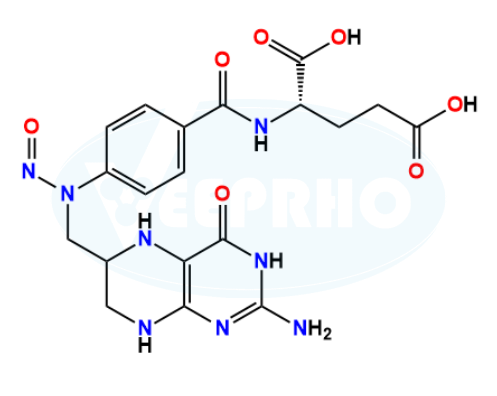
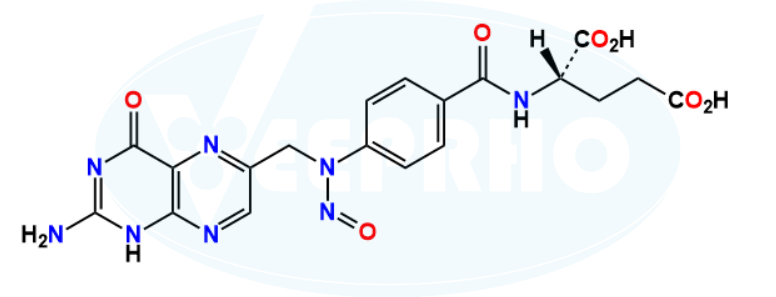
Additional information on CAS 29291-35-8
| Parent drug | Folic acid |
|---|---|
| Product type | Impurity standards, Nitroso impurities |
| IUPAC name | N-[4-[[(2-Amino-1,4-dihydro-4-oxopteridin-6-yl)methyl]amino]benzoyl]-N-nitroso-L-glutamic acid |
| SMILES | Nc1nc2ncc(CNc3ccc(C(=O)N(N=O)C(CCC(=O)O)C(=O)O)cc3)nc2c(=O)[nH]1 |
| InChIKey | QPQDSWYBXPBZPJ-UHFFFAOYSA-N |
| CHNS Ratio (%) (calculated) | C 48.51 · H 3.86 · N 23.82 · S 0.00 |
| References | - |
| Description | N-Nitroso Folic acid, CAS 29291-35-8, is a nitrosated derivative of folic acid and is classified as a nitrosamine impurity with potential genotoxic concern. The molecular formula C19H18N8O7 and molecular weight 470.4 g/mol indicate a highly heteroatom-rich pteroyl-type scaffold capable of chromatographic suppression and variable ionization. It may arise through nitrosative stress, process contamination, or secondary degradation under acidic nitrite exposure. Regulatory evaluation commonly follows ICH M7 principles. Trace-level determination typically requires LC-MS/MS with high selectivity, often supported by HRMS confirmation and, where volatility permits, GC-MS. Its structural assignment is complicated by isomeric nitroso species and matrix-associated decomposition. |
Request a Quote
"*" indicates required fields
Other products related to Folic Acid and Nitroso impurities
| Impurity structure | Name of Impurity | Catalogue No. |
|---|---|---|
| Folic Acid EP Impurity B (Free Base) | VE006816 | |
| Folic Acid EP Impurity B (Sulfate Salt) | VL3520002 | |
| Folic Acid EP Impurity C | VL3520003 | |
| Folic Acid EP Impurity D | VL3520004 | |
| Folic Acid EP Impurity E | VL3520005 | |
| Folic Acid EP Impurity F | VL3520006 | |
| Folic Acid EP Impurity G | VE0011870 | |
 | Methyltetrahydrofolate Related Compound 4 | VE008300 |
 | Methyltetrahydrofolate Related Compound 6 | VE008301 |
| Oxybuprocaine EP Impurity A (Free Base) | VL3520007 | |
| (6R)-Mefox | VE0027712 | |
| (6S)-Mefox | VE0027711 |
Show all related products N-Nitroso Folic Acid impurities (3)