

- 100% accuracy of data
- 24/7 scientific support
- 0% tolerance in quality of product
Mutagenicity assessment (ICH M7)
Potentially mutagenic impurity (ICH M7 Class 1–3).
N-nitroso compound: ICH M7 cohort of concern.FDA100 ng/dayTable 1 updated 9/24/2026
Stock Locations
- New Jersey, USA
- Czech Republic, EU
* Stock subject to availability.
Documentation
Includes: HPLC, MASS/LC-MS, 1H NMR, FT-IR, Potency, Structure Elucidation Report (SER), and additional analytical data depending on the product.
3050754-68-9
N-Nitroso N-Desmethyl Neratinib
● In Stock
| Catalogue No.: | VE0024694 |
|---|---|
| CAS No.: | 3050754-68-9 |
| Mol. Formula: | C29H26ClN7O4 |
| Mol. Weight: | 572 g/mol |
For laboratory use only: analytical, development and regulatory purposes. Supplied in mg quantities. Not for human or veterinary use.
Request a quote for a set
- Request quote for this set
All nitrosamine impurities of Neratinib
3 productsSee the 3 products
- N-Nitroso N-Desmethyl Neratinib VE0024694
CAS 3050754-68-9 - N-Nitroso Neratinib VE0024988
- N-Nitroso Neratinib; Synthesis Attempts and Failure Report (NAP Test) VE0027801
- N-Nitroso N-Desmethyl Neratinib VE0024694

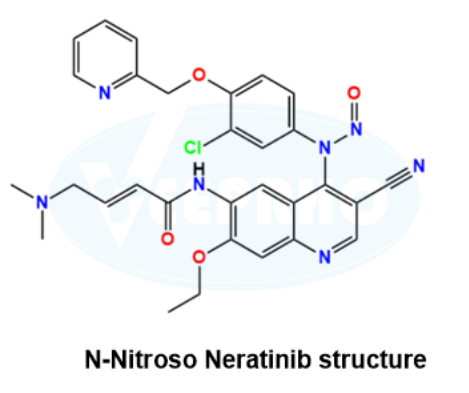
Additional information on CAS 3050754-68-9
| Parent drug | Neratinib |
|---|---|
| Product type | Impurity standards |
| IUPAC name | (E)-N-(4-((3-chloro-4-(pyridin-2-ylmethoxy)phenyl)amino)-3-cyano-7-ethoxyquinolin-6-yl)-4-(methyl(nitroso)amino)but-2-enamide |
| SMILES | CCOc1cc2ncc(C#N)c(Nc3ccc(OCc4ccccn4)c(Cl)c3)c2cc1NC(=O)/C=C/CN(C)N=O |
| InChIKey | CFKCEZQMDLWFGH-SOFGYWHQSA-N |
| CHNS Ratio (%) (calculated) | C 60.89 · H 4.58 · N 17.14 · S 0.00 |
| Description | N-Nitroso N-Desmethyl Neratinib (CAS 3050754-68-9) is a structurally specific nitrosamine impurity derived from the neratinib scaffold by N-demethylation followed by N-nitrosation of the secondary amino nitrogen. With molecular formula C29H26ClN7O4 and molecular weight 572 g/mol, it retains the kinase-inhibitor heteroaromatic core while introducing the N-nitroso functional group associated with elevated mutagenic concern. Formation may occur during nitrosating-excipient exposure, process carryover, or oxidative degradation under nitrosamine-forming conditions. Because nitrosamines are commonly assessed under ICH M7 principles and related regulatory expectations, characterization typically requires LC-MS/MS with targeted MS/MS transitions, and orthogonal LC-HRMS or GC-MS methods for confirmation at trace levels. |
Request a Quote
"*" indicates required fields