
- 100% accuracy of data
- 24/7 scientific support
- 0% tolerance in quality of product
Mutagenicity assessment (ICH M7)
Potentially mutagenic impurity (ICH M7 Class 1–3).
N-nitroso compound: ICH M7 cohort of concern.Stock Locations
- New Jersey, USA
- Czech Republic, EU
* Stock subject to availability.
Documentation
Includes: HPLC, MASS/LC-MS, 1H NMR, FT-IR, Potency, Structure Elucidation Report (SER), and additional analytical data depending on the product.
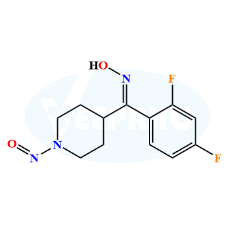
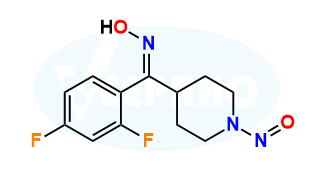
N-Nitroso Paliperidone Impurity 3
● In Stock
| Catalogue No.: | VE0029085 |
|---|---|
| CAS No.: | N/A |
| Mol. Formula: | C12H13F2N3O2 |
| Mol. Weight: | 269.24 g/mol |
For laboratory use only: analytical, development and regulatory purposes. Supplied in mg quantities. Not for human or veterinary use.
Request a quote for a set
- Request quote for this set
All nitrosamine impurities of Paliperidone
4 productsSee the 4 products
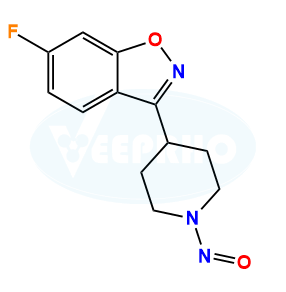
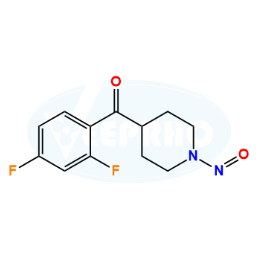
- N-Nitroso Paliperidone VE006599
CAS 2416230-38-9 - N-Nitroso Paliperidone Impurity 1 VE0028406
- N-Nitroso Paliperidone Impurity 2 VE0024767
- N-Nitroso Paliperidone Impurity 3 VE0029085
- N-Nitroso Paliperidone VE006599
Additional information on N-Nitroso Paliperidone Impurity 3
| Parent drug | Paliperidone |
|---|---|
| Product type | Impurity standards, Nitroso impurities |
| IUPAC name | (E)-(2,4-difluorophenyl)(1-nitrosopiperidin-4-yl)methanone oxime |
| SMILES | O=NN1CCC(/C(C2=CC=C(F)C=C2F)=N\O)CC1 |
| InChI | InChI=1S/C12H13F2N3O2/c13-9-1-2-10(11(14)7-9)12(15-18)8-3-5-17(16-19)6-4-8/h1-2,7-8,18H,3-6H2/b15-12+ |
| InChIKey | CCEVGEURVJPPIP-NTCAYCPXSA-N |
| CHNS Ratio (%) (calculated) | C 53.53 · H 4.87 · N 15.61 · S 0.00 |
| Description | N-Nitroso Paliperidone Impurity 3 is a nitrosamine-related process impurity derived from paliperidone chemistry, structurally defined by the introduction of an N-nitroso functionality onto the piperidyl nitrogen. Its molecular formula is C12H13F2N3O2 and molecular weight is 269.24 g/mol. Such species are evaluated under ICH M7 principles because nitrosamines are commonly regarded as potentially genotoxic, with risk emerging from nitrosating conditions during synthesis, workup, or storage. Trace-level determination typically requires LC-MS/MS, often supported by high-resolution mass spectrometry and orthogonal chromatographic separation, due to the expected low abundance and structurally related matrix interferences. |
Request a Quote
"*" indicates required fields