

- 100% accuracy of data
- 24/7 scientific support
- 0% tolerance in quality of product
Mutagenicity assessment (ICH M7)
Potentially mutagenic impurity (ICH M7 Class 1–3).
N-nitroso compound: ICH M7 cohort of concern.Stock Locations
- New Jersey, USA
- Czech Republic, EU
* Stock subject to availability.
Documentation
Includes: HPLC, MASS/LC-MS, 1H NMR, FT-IR, Potency, Structure Elucidation Report (SER), and additional analytical data depending on the product.
N-Nitroso Ranitidine-2
● Under Development
| Catalogue No.: | VE0027208 |
|---|---|
| CAS No.: | N/A |
| Mol. Formula: | C13H21N5O4S |
| Mol. Weight: | 343.40 g/mol |
For laboratory use only: analytical, development and regulatory purposes. Supplied in mg quantities. Not for human or veterinary use.
Request a quote for a set
- Request quote for this set
All nitrosamine impurities of Ranitidine
3 productsSee the 3 products
- N-Nitroso Desmethyl Ranitidine VE0015916
- N-Nitroso Ranitidine-1 VE0014169
- N-Nitroso Ranitidine-2 VE0027208


Additional information on N-Nitroso Ranitidine-2
| Parent drug | Ranitidine |
|---|---|
| Product type | Impurity standards, Nitroso impurities |
| IUPAC name | (Z)-N-(1-((2-(((5-((dimethylamino)methyl)furan-2-yl)methyl)thio)ethyl)amino)-2-nitrovinyl)-N-methylnitrous amide |
| SMILES | CN(C)CC1=CC=C(CSCCN/C(N(C)N=O)=C/[N+]([O-])=O)O1 |
| InChI | InChI=1S/C13H21N5O4S/c1-16(2)8-11-4-5-12(22-11)10-23-7-6-14-13(9-18(20)21)17(3)15-19/h4-5,9,14H,6-8,10H2,1-3H3/b13-9- |
| InChIKey | JYXJBCCAMBFQGO-LCYFTJDESA-N |
| CHNS Ratio (%) (calculated) | C 45.47 · H 6.16 · N 20.39 · S 9.34 |
| Description | N-Nitroso Ranitidine-2 is a nitrosamine impurity of concern characterized by high genotoxic potential and strict regulatory scrutiny. It can arise from reaction of secondary amines with nitrosating agents during synthesis, storage or API degradation, and is chemically stable under acidic conditions. Analytical control requires trace-level monitoring using validated LC-MS/MS or GC-MS methods with isotopic internal standards and low ng/g detection limits. Risk mitigation focuses on precursor control, nitrite limitation, solvent selection and robust stability testing. Release specifications and impurity profiling must demonstrate absence or control to meet current regulatory expectations for mutagenic impurities. |
Request a Quote
"*" indicates required fields
Other products related to Ranitidine and Nitroso impurities
| Impurity structure | Name of Impurity | Catalogue No. |
|---|---|---|
| Ranitidine BP Impurity B | VE006670 | |
| Ranitidine EP Impurity A | VL220001 | |
| Ranitidine EP Impurity B | VL220003 | |
| Ranitidine EP Impurity B(Fumarate Salt) | VE0022924 | |
| Ranitidine EP Impurity C | VL220002 | |
| Ranitidine EP Impurity D | VL220009 | |
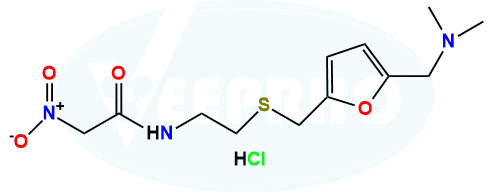 | Ranitidine EP Impurity D (HCl) | VE0017882 |
| Ranitidine EP Impurity D (Sodium Salt) | VE0022806 | |
| Ranitidine EP Impurity E | VL220008 | |
| Ranitidine EP Impurity F | VL220010 | |
| Ranitidine EP Impurity G | VL220011 | |
| Ranitidine EP Impurity H | VL220012 |
Show all related products N-Nitroso Ranitidine impurities (3)