

- 100% accuracy of data
- 24/7 scientific support
- 0% tolerance in quality of product
Mutagenicity assessment (ICH M7)
Potentially mutagenic impurity (ICH M7 Class 1–3).
N-nitroso compound: ICH M7 cohort of concern.Stock Locations
- New Jersey, USA
- Czech Republic, EU
* Stock subject to availability.
Documentation
Includes: HPLC, MASS/LC-MS, 1H NMR, FT-IR, Potency, Structure Elucidation Report (SER), and additional analytical data depending on the product.
N-Nitroso Upadacitinib (Possibility 1)
● Under Development
| Catalogue No.: | VE0024986 |
|---|---|
| CAS No.: | N/A |
| Mol. Formula: | C17H18F3N7O2 |
| Mol. Weight: | 409.4 g/mol |
For laboratory use only: analytical, development and regulatory purposes. Supplied in mg quantities. Not for human or veterinary use.
Request a quote for a set
- Request quote for this set
All nitrosamine impurities of Upadacitinib
2 productsSee the 2 products
- N-Nitroso Upadacitinib (Possibility 1) VE0024986
- N-Nitroso Upadacitinib (Possibility 2) VE0024987
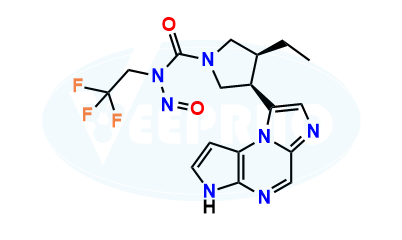
Additional information on N-Nitroso Upadacitinib (Possibility 1)
| Parent drug | Upadacitinib |
|---|---|
| Product type | Impurity standards, Nitroso impurities |
| IUPAC name | (3S,4R)-3-Ethyl-4-(3-nitroso-3H-imidazo[1,2-a]pyrrolo[2,3-e]pyrazin-8-yl)-N-(2,2,2-trifluoroethyl)pyrrolidine-1-carboxamide |
| SMILES | CC[C@@H]1CN(C(=O)NCC(F)(F)F)C[C@@H]1c1cnc2cnc3c(ccn3N=O)n12 |
| InChIKey | QCNULZHGHQQWQR-MNOVXSKESA-N |
| CHNS Ratio (%) (calculated) | C 49.88 · H 4.43 · N 23.95 · S 0.00 |
| Description | N-Nitroso Upadacitinib (Possibility 1) is a nitrosamine-related process impurity of upadacitinib, arising plausibly from nitrosation of the piperidine or amide-associated nitrogen under conditions that generate nitrosating species during synthesis, storage, or reagent carryover. With molecular formula C17H18F3N7O2 and molecular weight 409.4 g/mol, it falls within the class of potentially mutagenic impurities addressed by ICH M7 principles because N-nitroso functionalities are commonly associated with genotoxic concern. Structural confirmation and trace-level quantification typically require LC-MS/MS, high-resolution MS, and, where volatility permits, GC-MS, often with selective reaction monitoring and isotope-dilution strategies. |
Request a Quote
"*" indicates required fields