
- 100% accuracy of data
- 24/7 scientific support
- 0% tolerance in quality of product
Mutagenicity assessment (ICH M7)
Potentially mutagenic impurity (ICH M7 Class 1–3).
N-nitroso compound: ICH M7 cohort of concern.FDA96 ng/dayTable 2 updated 9/24/2026
Stock Locations
- New Jersey, USA
- Czech Republic, EUIn stock
* Stock subject to availability.
Documentation
Batch COA on file. The batch COA includes HPLC, MASS/LC-MS, 1H NMR, FT-IR, Potency, and Structure Elucidation Report (SER)..
2932441-73-9
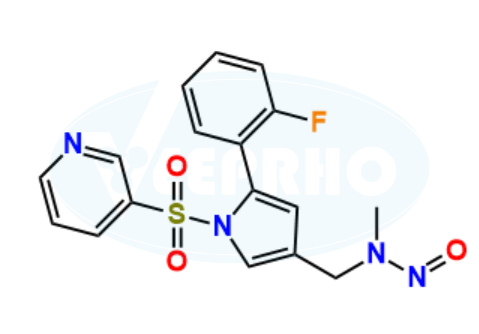
Nitroso Vonoprazan
● In Stock
| Catalogue No.: | VE0010741 |
|---|---|
| CAS No.: | 2932441-73-9 |
| Mol. Formula: | C17H15FN4O3S |
| Mol. Weight: | 374.39 g/mol |
For laboratory use only: analytical, development and regulatory purposes. Supplied in mg quantities. Not for human or veterinary use.
Request a quote for a set
- Request quote for this set
All nitrosamine impurities of Vonoprazan
5 productsSee the 5 products
- N-Nitroso 1,4,5,6-tetrahydropyridin Vonoprazan VE0024319
- N-Nitroso N-des(3-pyridinylsulfonyl) Vonoprazan VE0024750
- Nitroso Vonoprazan VE0010741
CAS 2932441-73-9 - 5-(2-fluorophenyl)-1-nitroso-1H-pyrrole-3-carbaldehyde VE0029048
- 6-Hydroxy-1-nitroso-1,4,5,6-tetrahydropyridin Vonoprazan VE0024239


Additional information on CAS 2932441-73-9
| Parent drug | Vonoprazan |
|---|---|
| Product type | Impurity standards, Nitroso impurities |
| IUPAC name | N-((5-(2-fluorophenyl)-1-(pyridin-3-ylsulfonyl)-1H-pyrrol-3-yl)methyl)-N-methylnitrous amide |
| Other Synonyms | N-[[5-(2-Fluorophenyl)-1-(3-pyridylsulfonyl)-3-pyrrolyl]methyl]-N-methylnitrous Amide |
| SMILES | O=NN(CC1=CN(S(=O)(C2=CC=CN=C2)=O)C(C3=CC=CC=C3F)=C1)C |
| InChI | InChI=1S/C17H15FN4O3S/c1-21(20-23)11-13-9-17(15-6-2-3-7-16(15)18)22(12-13)26(24,25)14-5-4-8-19-10-14/h2-10,12H,11H2,1H3 |
| InChIKey | XEITYWHMJMTWQY-UHFFFAOYSA-N |
| CHNS Ratio (%) (calculated) | C 54.54 · H 4.04 · N 14.97 · S 8.56 |
| Shipping condition | Ambient Temperature |
| References | - |
| Additional characterisation data | QNMR, D2O Exchange, 13C NMR, 13C APT, COSY NMR, NOESY NMR, 15N NMR, HSQC NMR, HMQC NMR, and HMBC NMR. These are available upon request and may be free or subject to additional charges. |
| Description | N-Nitroso Vonoprazan (CAS 2932441-73-9) is an N-nitrosamine impurity arising from nitrosation of vonoprazan-related secondary amines during synthesis or storage. Due to the nitrosamine class's potential genotoxicity, it is treated as a controlled trace genotoxic impurity under current regulatory frameworks such as ICH M7, requiring sensitive identification and quantification. Analytical control typically employs LC-MS/MS or GC-MS with high resolution mass spectrometry and isotopically labeled internal standards to achieve low parts-per-billion detection. Mitigation focuses on nitrite exclusion, reaction condition optimization, scavengers, and validated in-process monitoring and stability testing to prevent formation and ensure compliance with impurity limits. |
Request a Quote
"*" indicates required fields
Other products related to Vonoprazan and Nitroso impurities

Show all related products N-Nitroso Vonoprazan impurities (2)