
- 100% accuracy of data
- 24/7 scientific support
- 0% tolerance in quality of product
Stock Locations
- New Jersey, USA
- Czech Republic, EU
* Stock subject to availability.
Documentation
Includes: HPLC, MASS/LC-MS, 1H NMR, FT-IR, Potency, Structure Elucidation Report (SER), and additional analytical data depending on the product.
1331822-32-2
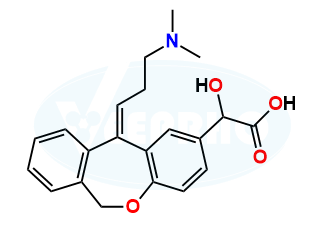
Olopatadine Related Compound A
● In Stock
| Catalogue No.: | VL720001 |
|---|---|
| CAS No.: | 1331822-32-2 |
| Mol. Formula: | C21H23NO4 |
| Mol. Weight: | 353.41 g/mol |
For laboratory use only: analytical, development and regulatory purposes. Supplied in mg quantities. Not for human or veterinary use.
Request a quote for a set
- Request quote for this set
All USP impurities of Olopatadine
8 productsSee the 8 products
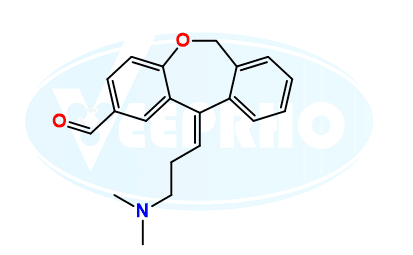
- Olopatadine Carbaldehyde Impurity VL720003
CAS 2519517-77-0 - Olopatadine E-Isomer VL720002
CAS 113806-06-7 - Olopatadine N-Oxide VL720007
CAS 173174-07-7 - Olopatadine Related Compound A VL720001
CAS 1331822-32-2 - Olopatadine Related Compound A VE0018452
- Olopatadine Related Compound A (HCl Salt) VE009470
CAS 1331668-21-3 - Olopatadine Related Compound B VE0018457
- Olopatadine Related Compound C VL720004
CAS 55453-87-7
- Olopatadine Carbaldehyde Impurity VL720003


Additional information on CAS 1331822-32-2
| Parent drug | Olopatadine |
|---|---|
| Product type | Impurity standards |
| IUPAC name | (Z)-2-{11-[3-(Dimethylamino) propylidene]-6,11-dihydrodibenzo[b,e] oxepin-2-yl}-2-hydroxyacetic acid. |
| USP name | Olopatadine Related Compound A |
| SMILES | CN(C)CC/C=C1/c2ccccc2COc2ccc(C(O)C(=O)O)cc21 |
| InChIKey | WPDCFRNNHUYQGW-IUXPMGMMSA-N |
| CHNS Ratio (%) (calculated) | C 71.37 · H 6.56 · N 3.96 · S 0.00 |
| References | Munjas Jurkic | L. | et al. “UHPLC Study on the Degradation Profiles of Olopatadine Hydrochloride in Eye Drops Subjected to Heat and Filtration Methods of Sterilisation.†Chromatographia | vol. 77 | no. 15-16 | July 2014 | pp. 1067–80 | https://doi.org/10.1007/s10337-014-2712-y.? |
| Description | Olopatadine Related Compound A, also designated alpha hydroxy olopatadine, is a defined process-related impurity and oxidative transformation product of the olopatadine scaffold rather than a separate pharmacological entity. CAS 1331822-32-2; molecular formula C21H23NO4; molecular weight 353.41 g/mol. The structure contains the benzhydryl ether motif and a benzoic acid side chain with an alpha hydroxy substitution, consistent with hydroxylation during synthesis or metabolic oxidation. Its polarity and ionizable carboxyl group favor reversed-phase LC with MS or MS/MS detection, while LC-HRMS and NMR are used for structural confirmation and impurity profiling. Regulatory assessment follows impurity qualification principles and may require fate, stability, and threshold-based evaluation. |
Request a Quote
"*" indicates required fields
Other products related to Olopatadine impurities
| Impurity structure | Name of Impurity | Catalogue No. |
|---|---|---|
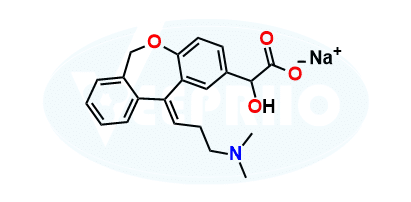 | Olopatadine Related Compound A | VE0018452 |
| Olopatadine Related Compound A (HCl Salt) | VE009470 | |
 | Olopatadine Related Compound B | VE0018457 |
| Olopatadine Related Compound C | VL720004 | |
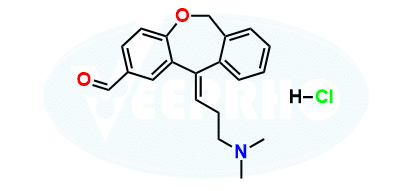 | (E)-Olopatadine Carbaldehyde (HCl Salt) | VE0018450 |
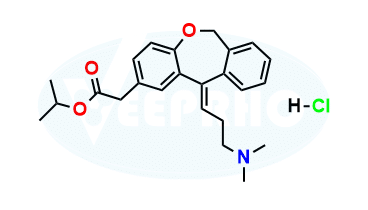 | (E)-Olopatadine Isopropyl Ester (HCl Salt) | VE0018449 |
| (Z)-2-(11-(3-(dimethylamino)-1-(4-(2-methoxy-2-oxoethyl)phenoxy)propylidene)-6,11-dihydrodibenzo[b,e]oxepin-2-yl)acetic acid | VE0021718 | |
 | (Z)-Olopatadine Carbaldehyde (HCl Salt) | VE0016826 |
| 1-Hydroxybenzotriazole hydrate | VE008406 | |
| 2-[(11Z)-11-[3-(dimethylamino)propylidene]-6H-benzo[c][1]benzoxepin-2-yl]-2-hydroxyacetic acid | VZA000099 | |
 | Alpha Butyl Olopatadine | VE008904 |
| Butoxy Olopatadine Hydrochloride | VE0028809 |
Show all related products N-Nitroso Olopatadine impurities (3)