
- 100% accuracy of data
- 24/7 scientific support
- 0% tolerance in quality of product
Mutagenicity assessment (ICH M7)
Treated as a potentially non-mutagenic impurity (ICH M7 Class 4–5).
Computational (in silico) assessmentStock Locations
- New Jersey, USA
- Czech Republic, EU
* Stock subject to availability.
Documentation
Batch COA on file. The batch COA includes HPLC, MASS/LC-MS, 1H NMR, FT-IR, Potency, and Structure Elucidation Report (SER)..
764667-65-4
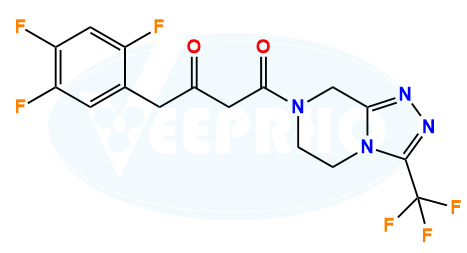
Sitagliptin Keto Amide Impurity
● In Stock
| Catalogue No.: | VL201015 |
|---|---|
| CAS No.: | 764667-65-4 |
| Mol. Formula: | C16H12F6N4O2 |
| Mol. Weight: | 406.28 g/mol |
For laboratory use only: analytical, development and regulatory purposes. Supplied in mg quantities. Not for human or veterinary use.
Additional information on CAS 764667-65-4
| Parent drug | Sitagliptin |
|---|---|
| Product type | Impurity standards |
| IUPAC name | 1-(3-(trifluoromethyl)-5,6-dihydro-[1,2,4]triazolo[4,3-a]pyrazin-7(8H)-yl)-4-(2,4,5-trifluorophenyl)butane-1,3-dione |
| USP name | Sitagliptin Ketone |
| SMILES | O=C(CC(=O)N1CCn2c(nnc2C(F)(F)F)C1)Cc1cc(F)c(F)cc1F |
| InChIKey | QAEDTLFWHIEVPK-UHFFFAOYSA-N |
| CHNS Ratio (%) (calculated) | C 47.30 · H 2.98 · N 13.79 · S 0.00 |
| Shipping condition | Ambient Temperature |
| References | By Sohita Dhillon Container: Drugs Year: 2010 Volume: 70 Issue: 4 DOI: 10.2165/11203790-000000000-00000 URL: https://link.springer.com/article/10.2165/11203790-000000000-00000 |
| Additional characterisation data | QNMR, D2O Exchange, 13C NMR, 13C APT, COSY NMR, NOESY NMR, 15N NMR, HSQC NMR, HMQC NMR, and HMBC NMR. These are available upon request and may be free or subject to additional charges. |
| Description | Sitagliptin Keto Amide Impurity, also designated rac-Sitagliptin 3-ketone or Sitagliptin Ketone (CAS 764667-65-4), is a non-volatile process-related structural analog of the DPP-4 inhibitor sitagliptin formed by oxidation at the 3-position to the corresponding ketone. With molecular formula C16H12F6N4O2 and molecular weight 406.28 g/mol, it retains the fluorinated triazolopiperazine core while lacking the parent amide side-chain oxidation state. Its occurrence is typically associated with synthetic degradation or over-oxidation during manufacturing. Characterization and quantification generally rely on LC-MS/MS, high-resolution LC-MS, and chromatographic separation with UV or PDA detection; GC-MS may be used after derivatization when needed. |
Request a Quote
"*" indicates required fields