
- 100% accuracy of data
- 24/7 scientific support
- 0% tolerance in quality of product
Stock Locations
- New Jersey, USA
- Czech Republic, EU
* Stock subject to availability.
Documentation
Includes: HPLC, MASS/LC-MS, 1H NMR, FT-IR, Potency, Structure Elucidation Report (SER), and additional analytical data depending on the product.
31350-27-3
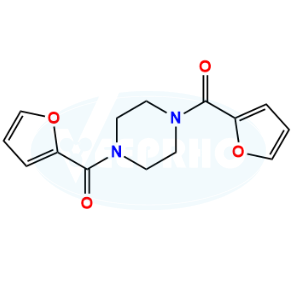
Terazosin EP Impurity M
● In Stock
| Catalogue No.: | VL4370004 |
|---|---|
| CAS No.: | 31350-27-3 |
| Mol. Formula: | C14H14N2O4 |
| Mol. Weight: | 274.27 g/mol |
For laboratory use only: analytical, development and regulatory purposes. Supplied in mg quantities. Not for human or veterinary use.
Request a quote for a set
- Request quote for this set
All EP impurities of Prazosin
6 productsSee the 6 products
- Alfuzosin EP Impurity B VL259008
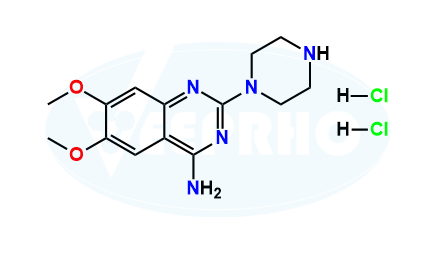
CAS 23680-84-4 - Prazosin Related Compound D (HCl salt) VL4370007
CAS 60548-09-6 - Terazosin EP Impurity C (2HCl Salt) VE0020003
CAS 60548-08-5 - Terazosin EP Impurity L VL4370005
CAS 40172-95-0 - Terazosin EP Impurity L (Oxalate Salt) VE0023058
CAS 2668266-50-8 - Terazosin EP Impurity M VL4370004
CAS 31350-27-3
- Alfuzosin EP Impurity B VL259008


Additional information on CAS 31350-27-3
| Parent drug | Terazosin / Prazosin |
|---|---|
| Product type | Impurity standards |
| IUPAC name | (piperazin-1,4-dtyl)bis[(furan-2-yl)methanone] |
| EP name | Terazosin EP Impurity M / Prazosin EP Impurity B |
| Pharmacopeial synonyms | Prazosin EP Impurity B |
| Other Synonyms | 1,4-Di-2-furoyl-piperazine; 2-furyl 4-(2-furylcarbonyl)piperazinyl ketone |
| SMILES | O=C(N1CCN(C(C2=CC=CO2)=O)CC1)C3=CC=CO3 |
| InChI | InChI=1S/C14H14N2O4/c17-13(11-3-1-9-19-11)15-5-7-16(8-6-15)14(18)12-4-2-10-20-12/h1-4,9-10H,5-8H2 |
| InChIKey | UPBRPYUDDNJOLW-UHFFFAOYSA-N |
| CHNS Ratio (%) (calculated) | C 61.31 · H 5.15 · N 10.21 · S 0.00 |
| Description | 1,4-Di-2-furoyl-piperazine (Prazosin EP Impurity B, CAS 31350-27-3) is a process-related impurity observed in synthesis routes for Terazosin and related quinazoline APIs. This diketone piperazine derivative exhibits moderate polarity, UV activity and thermal stability that influence chromatographic retention and mass spectral fragmentation patterns. Identification and quantification require optimized reversed-phase HPLC with diode array detection and LC-MS confirmation, supported by 1H and 13C NMR for structural assignment. Control strategies focus on reaction condition optimization, purification by preparative HPLC or crystallization and validated limits in specifications to mitigate safety and potency risks in the final drug substance. |
Request a Quote
"*" indicates required fields
Other products related to Prazosin impurities
| Impurity structure | Name of Impurity | Catalogue No. |
|---|---|---|
| N-Nitroso Prazosin EP Impurity C | VE0016808 | |
| N-Nitroso Prazosin EP Impurity D | VE0024161 | |
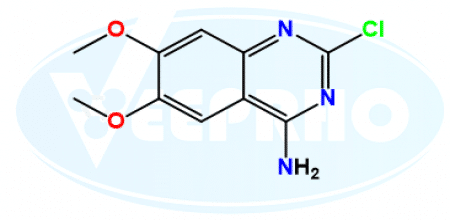 | Prazosin EP Impurity A | VL1410001 |
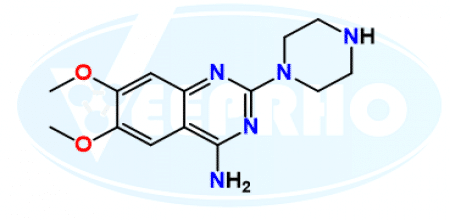 | Prazosin EP Impurity C | VL1410003 |
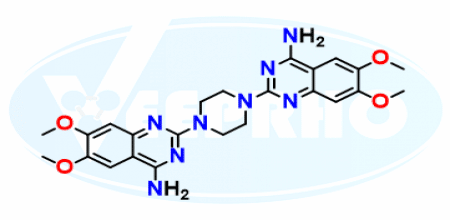 | Prazosin EP Impurity E | VL1410005 |
| Prazosin Related Compound D (HCl salt) | VL4370007 | |
| Terazosin EP Impurity C (2HCl Salt) | VE0020003 | |
| Terazosin EP Impurity L | VL4370005 | |
| Terazosin EP Impurity L (Oxalate Salt) | VE0023058 | |
| 4-(Benzyloxy)-5-methoxy-2-nitrobenzaldehyde | VE008949 | |
| 4-(Benzyloxy)-5-methoxy-2-nitrobenzoic Acid | VE008951 | |
| 6-O-demethyl Prazosin | VE008940 |