

- 100% accuracy of data
- 24/7 scientific support
- 0% tolerance in quality of product
Stock Locations
- New Jersey, USA
- Czech Republic, EU
* Stock subject to availability.
Documentation
Includes: HPLC, MASS/LC-MS, 1H NMR, FT-IR, Potency, Structure Elucidation Report (SER), and additional analytical data depending on the product.
58-08-2
Theophylline EP Impurity A
● In Stock
| Catalogue No.: | VL3710002 |
|---|---|
| CAS No.: | 58-08-2 |
| Mol. Formula: | C8H10N4O2 |
| Mol. Weight: | 194.19 g/mol |
For laboratory use only: analytical, development and regulatory purposes. Supplied in mg quantities. Not for human or veterinary use.
Request a quote for a set
- Request quote for this set
All EP impurities of Theophylline
6 productsSee the 6 products
- Theophylline EP Impurity A VL3710002
CAS 58-08-2 - Theophylline EP Impurity B VE006962
CAS 1076-22-8 - Theophylline EP Impurity C VE008571
CAS 7597-60-6 - Theophylline EP Impurity D (HCl Salt) VE0023640
CAS 116131-08-9 - Theophylline EP Impurity E VE006974
CAS 944-73-0 - Theophylline EP Impurity F VE009294
CAS 519-37-9
- Theophylline EP Impurity A VL3710002


Additional information on CAS 58-08-2
| Parent drug | Theophylline |
|---|---|
| Product type | Impurity standards |
| IUPAC name | 1,3,7-trimethyl-3,7-dihydro-1H-purine-2,6-dione |
| EP name | Theophylline EP Impurity A / Dimenhydrinate EP Impurity C / Pentoxifylline EP Impurity F |
| SMILES | Cn1c(=O)c2c(ncn2C)n(C)c1=O |
| InChIKey | RYYVLZVUVIJVGH-UHFFFAOYSA-N |
| CHNS Ratio (%) (calculated) | C 49.48 · H 5.19 · N 28.85 · S 0.00 |
| Description | CAS 58-08-2 identifies caffeine, 1,3,7-trimethylxanthine, a methylxanthine of formula C8H10N4O2 and molecular weight 194.19 g/mol. Within impurity profiling, it is relevant as a structurally related xanthine alkaloid that may appear as a related substance, process carryover, or compositional marker in matrices associated with theophylline, pentoxifylline, and dimenhydrinate reference materials. Its planar heteroaromatic core yields UV activity but limited chromatographic selectivity, so confirmation commonly relies on HPLC coupled to diode-array detection and LC-MS/MS, with GC-MS used where derivatization is appropriate. Regulatory interpretation focuses on identity, relative response, and separation from closely related methylxanthines. |
Request a Quote
"*" indicates required fields
Other products related to Theophylline impurities
| Impurity structure | Name of Impurity | Catalogue No. |
|---|---|---|
| Theophylline EP Impurity B | VE006962 | |
| Theophylline EP Impurity C | VE008571 | |
| Theophylline EP Impurity D (HCl Salt) | VE0023640 | |
| Theophylline EP Impurity E | VE006974 | |
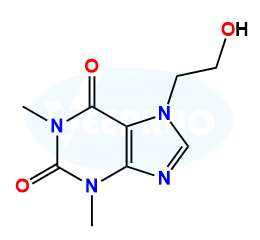 | Theophylline EP Impurity F | VE009294 |
| 1-Methyl Xanthine | VE0021609 | |
| 7-Ethyl Theophylline | VE0027128 | |
| 7-Methylxanthin | VE0017869 | |
| N-Nitroso Theophylline | VE0011721 | |
| N-Nitroso-8-Chlorotheophylline | VE0022877 | |
| N7-Nitroso Theophylline | VE0024194 | |
| 2-Bromoethyl Acetate | VE0020229 |
Show all related products N-Nitroso Theophylline impurities (3)