
- 100% accuracy of data
- 24/7 scientific support
- 0% tolerance in quality of product
Mutagenicity assessment (ICH M7)
Potentially mutagenic impurity (ICH M7 Class 1–3).
N-nitroso compound: ICH M7 cohort of concern.Stock Locations
- New Jersey, USA
- Czech Republic, EU
* Stock subject to availability.
Documentation
Includes: HPLC, MASS/LC-MS, 1H NMR, FT-IR, Potency, Structure Elucidation Report (SER), and additional analytical data depending on the product.
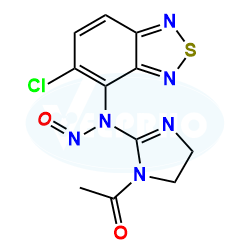
Tizanidine Nitroso Impurity 4
● Under Development
| Catalogue No.: | VE0024487 |
|---|---|
| CAS No.: | N/A |
| Mol. Formula: | C9H6ClN7O2S |
| Mol. Weight: | 311.7 g/mol |
For laboratory use only: analytical, development and regulatory purposes. Supplied in mg quantities. Not for human or veterinary use.
Request a quote for a set
- Request quote for this set
All nitrosamine impurities of Tizanidine
4 productsSee the 4 products
- N-Nitroso Tizanidine VE0011362
- N-Nitroso Tizanidine; Synthesis Attempts and Failure Report (NAP Test) VE0026346
- Tizanidine Nitroso Impurity 1 VE0024486
- Tizanidine Nitroso Impurity 4 VE0024487
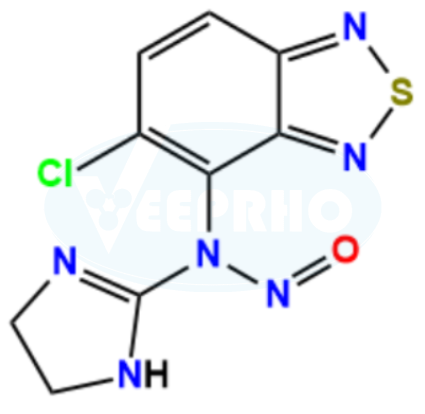
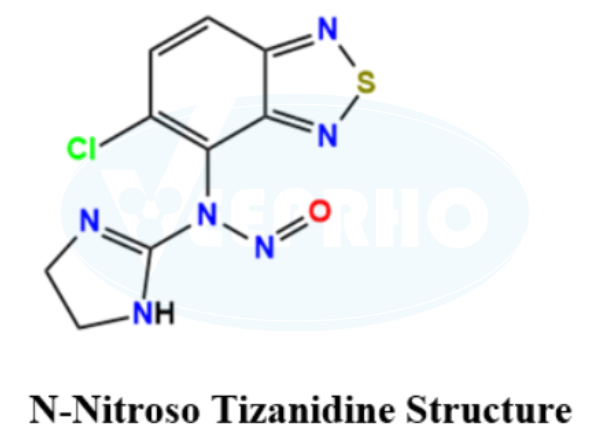
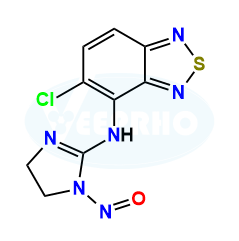
Additional information on Tizanidine Nitroso Impurity 4
| Parent drug | Tizanidine |
|---|---|
| Product type | Impurity standards, Nitroso impurities |
| IUPAC name | N-(1-acetyl-4,5-dihydro-1H-imidazol-2-yl)-N-(5-chlorobenzo[c][1,2,5]thiadiazol-4-yl)nitrous amide |
| SMILES | O=NN(C1=NCCN1C(C)=O)C2=C(Cl)C=CC3=NSN=C32 |
| InChI | InChI=1S/C11H9ClN6O2S/c1-6(19)17-5-4-13-11(17)18(16-20)10-7(12)2-3-8-9(10)15-21-14-8/h2-3H, 4-5H2, 1H3 |
| InChIKey | JMPUCZIROSHPDH-UHFFFAOYSA-N |
| CHNS Ratio (%) (calculated) | C 34.68 · H 1.94 · N 31.46 · S 10.29 |
| Description | Tizanidine Nitroso Impurity 4 is a nitrosamine-related process or degradation impurity associated with the imidazoline-derived skeletal framework of tizanidine. With molecular formula C9H6ClN7O2S and molecular weight 311.7 g/mol, it represents a structurally defined N-nitroso species of regulatory concern because nitrosamines are commonly evaluated under ICH M7 and related mutagenic impurity paradigms. Formation may occur through nitrosating conditions acting on secondary or tertiary nitrogen centers during synthesis, purification, or storage. Quantification typically requires high-sensitivity LC-MS/MS, often complemented by high-resolution LC-MS or GC-MS after suitable derivatization or chromatographic optimization. |
Request a Quote
"*" indicates required fields