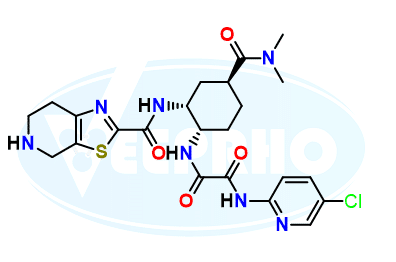
Edoxaban, sold under the brand names Lixiana and Savaysa among others, is an anticoagulant medication and a direct factor Xa inhibitor. It is taken by mouth and is commonly used to reduce the risk of stroke and blood clots in individuals with non-valvular atrial fibrillation. Edoxaban is also prescribed for the treatment and prevention of deep vein thrombosis (DVT) and pulmonary embolism (PE). Compared with warfarin, edoxaban has fewer drug interactions, making it a more convenient option for many patients who require anticoagulation therapy. By inhibiting factor Xa, edoxaban prevents the formation of blood clots, thereby reducing the risk of clot-related complications.

Parent: Edoxaban

Parent: Edoxaban

Parent: Edoxaban

Parent: Edoxaban

Parent: Edoxaban

Parent: Edoxaban

Parent: Edoxaban

Parent: Edoxaban

Parent: Edoxaban

Parent: Edoxaban/ Edoxaban Tosylate Hydrate

Parent: Edoxaban Tosylate

Parent: Edoxaban
![Ethyl 2-(((1S,2R,4S)-4-(dimethylcarbamoyl)-2-(5-methyl-4,5,6,7-tetrahydrothiazolo[5,4-c]pyridine-2-carboxamido)cyclohexyl)amino)-2-oxoacetate](https://veeprho.com/wp-content/uploads/2025/07/VE0024670-Ethyl-2-1S-2R-4S-4-dimethylcarbamoyl-2-5-methyl-4-5-6-7-tetrahydrothiazolo.png "Ethyl 2-(((1S,2R,4S)-4-(dimethylcarbamoyl)-2-(5-methyl-4,5,6,7-tetrahydrothiazolo[5,4-c]pyridine-2-carboxamido)cyclohexyl)amino)-2-oxoacetate")
Parent: Edoxaban

Parent: Edoxaban

Parent: Edoxaban

Parent: Edoxaban

Parent: Edoxaban
![N1-(5-Chloropyridin-2-yl)-N2-((1S,2R,4S)-4- (dimethylcarbamoyl)-2-(5-nitroso-4,5,6,7-tetrahydrothiazolo[5,4- c]pyridine-2-carboxamido)cyclohexyl)oxalamide](https://veeprho.com/wp-content/uploads/2023/02/N1-5-Chloropyridin-2-yl-N2-1S-2R-4S-4-20dimethylcarbamoyl-2-5-nitroso-4-5-6-7-tetrahydrothiazolo-5-4-c-pyridine-2-carboxamido-cyclohexyl-oxalamide.png "N1-(5-Chloropyridin-2-yl)-N2-((1S,2R,4S)-4- (dimethylcarbamoyl)-2-(5-nitroso-4,5,6,7-tetrahydrothiazolo[5,4- c]pyridine-2-carboxamido)cyclohexyl)oxalamide")
Parent: Edoxaban
During the production and storage of edoxaban, impurities can develop that need to be carefully monitored to ensure the medication’s safety and efficacy. Regulatory agencies such as the U.S. Food and Drug Administration (FDA) and the European Medicines Agency (EMA) provide strict guidelines for permissible impurity levels in pharmaceutical products to ensure patient safety.
When taking edoxaban, avoid activities that increase the risk of bleeding or injury, as edoxaban can increase bleeding complications. Additionally, avoid taking NSAIDs (such as ibuprofen) or aspirin, as these medications can increase bleeding risk. Consult your healthcare provider before starting any new medications or supplements.
The most common risk associated with edoxaban is bleeding. Because edoxaban is an anticoagulant, it can increase the risk of bleeding, which may be severe or even life-threatening. Patients should be aware of unusual bleeding symptoms, such as nosebleeds, bruising, or blood in the urine or stool, and seek medical attention if these symptoms occur.
Edoxaban is usually taken once daily at the same time each day for consistency and optimal effectiveness. There is no specific time of day required, so patients can choose a time that best fits their schedule, whether it’s morning or evening.
Yes, you can generally take vitamin D with edoxaban, as there are no known interactions between vitamin D and edoxaban. However, always inform your healthcare provider about all supplements and medications you are taking to ensure there are no potential interactions.